Top Dems: Political environment doomed Harris


Add Axios as your preferred source to
see more of our stories on Google.
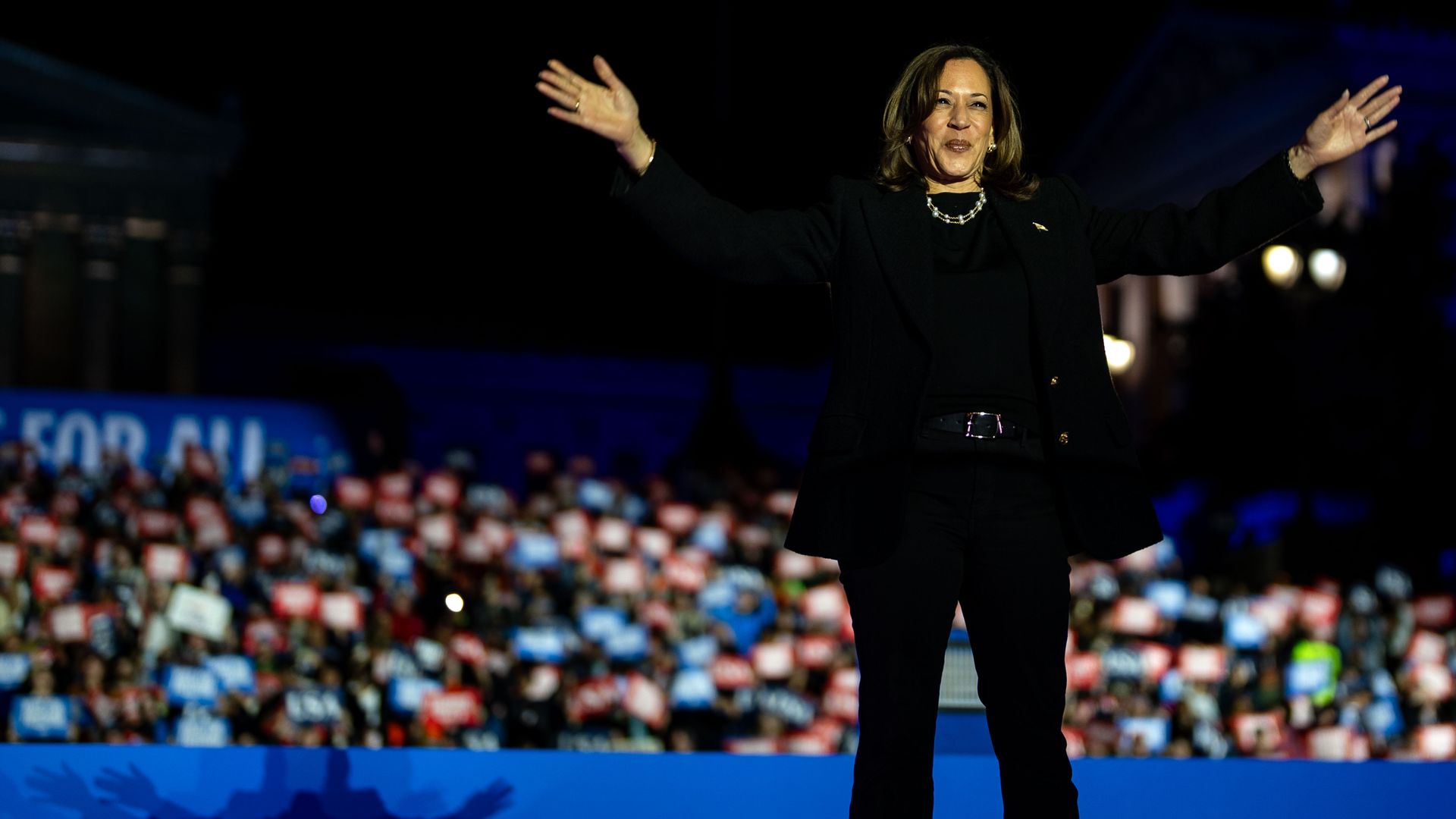
Vice President Harris arrives Monday to speak to the closing rally of her campaign, at the base of the "Rocky Steps" at the Philadelphia Museum of Art. Photo: Kent Nishimura/Getty Images
Vice President Harris faced voters who were hungry for change and thought the country was headed in the wrong direction — fierce headwinds that proved insurmountable.
- She also faced a major political realignment, with Democratic losses up and down the ballot and across the map.
Why it matters: Top Democrats tell us the brutal environment — combined with President-elect Trump's harnessing of voter concerns about immigration and inflation — doomed her candidacy in an election that polled 50-50 to the very end.
Harris inherited long odds from a deeply unpopular President Biden, and powered a 100-day campaign blitz that — by every traditional metric — was teeming with enthusiasm.
- The campaign's internal data projects the seven battlegrounds shifted between 3 and 8 points in her direction from July 21 to Election Day — an impressive feat, but one that will be buried by the front pages of history.
The big picture: Democrats across the country lost ground across virtually every demographic, with deep-blue states — including New York and New Jersey — swinging sharply right.
- "Voters in 2024 were looking for a change, and the broader electoral environment greatly favored Republicans," a top Harris adviser told Axios.
Between the lines: Public and private polling was broadly accurate, with no big polling miss like in 2016 and 2020.
- The Harris campaign always saw Michigan, Pennsylvania and Wisconsin as margin-of-error races that could break their way.
- But in the end — despite massive investment, a superior ground game and a deeply flawed opponent in Trump — the Blue Wall crumbled.
By the numbers: In poll after poll, roughly two-thirds of voters thought the country was headed in the wrong direction — a measure that historically has been predictive in presidential races.
- In the last pre-election Gallup poll before the election, 72% of registered voters said they were dissatisfied with the way things are going in the country.
- Anti-immigration sentiment is at a two-decade high, according to Gallup, and Harris had no good answers for the Biden administration's much-maligned handling of the border crisis.
- Her early assignment to address the "root causes" of a surge in migrants entering the country made Republican attack lines especially potent.
Zoom in: Arab American anger over Biden's support for Israel's wars in Gaza and Lebanon manifested in Michigan, while broader fears of global instability added to the anti-incumbent backlash.
- Dearborn and Hamtramck, the two Michigan cities with the highest percentage of Arab Americans in the country, swung approximately 40 points away from Democrats between 2020 and 2024.
Zoom out: Deep voter pessimism helped fuel presidential losses for the incumbent party in 1992, 2008 and 2016.
- It's also historically rare for two candidates from the same party to be elected in successive presidential elections, Democrats note.
The bottom line: The story of anti-incumbency is an easy one for Democrats to tell themselves.
- Far more troubling is the dramatic gains Trump made with demographics that once wrote him off — the clearest sign that Democratic messaging is fundamentally broken.
Axios' Alex Thompson contributed reporting.
