Why Trump's spending Halloween in deep-blue New Mexico


Add Axios as your preferred source to
see more of our stories on Google.
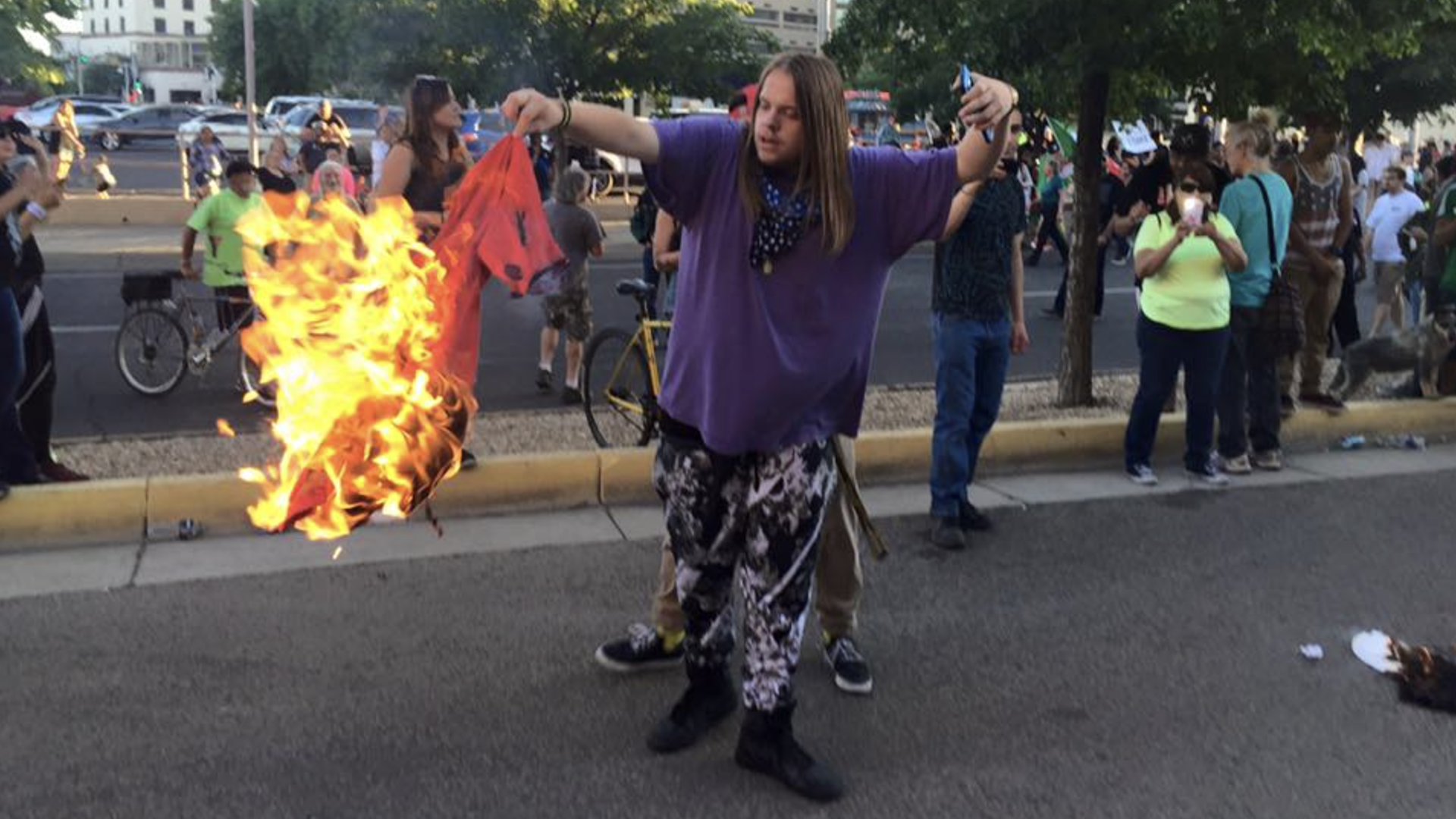
A protester burns a MAGA shirt at a 2016 Trump rally in Albuquerque that turned violent. Photo: Russell Contreras/Axios
ALBUQUERQUE — Former President Trump heads to Albuquerque on Thursday to court Latino voters, push his plans to stop illegal immigration — and once again pitch his ideas with a state he's unlikely to win as the backdrop.
Why it matters: Trump's Halloween visit to the nation's most Hispanic state — where violence marked two of his rallies in previous campaigns — reflects his push to capitalize on Republicans' slight gains recently among Latinos, especially men.
- His trip comes as his proposal to round up and deport millions of undocumented immigrants has alarmed many Latinos, and as he repeatedly has made racist remarks about immigrants during his campaign.
- The visit also will be less than a week after several speakers' racist and sexist rhetoric at a Trump rally in New York — particularly comments by a comedian who called Puerto Rico "garbage" — inflamed many Latino groups.
- That episode has ratcheted up the stakes for Trump's visit.
The big picture: New Mexico is a mostly Democratic border state where most residents are Hispanic or Native American. Six of the seven officeholders elected statewide are Hispanic, and all are Democrats.
- But its proximity to the border and its status as a major producer of oil and gas — big issues for Trump — give him an opportunity to make inroads with relatively conservative Latinos and those with jobs linked to the oil and gas industry.
- Oil and gas companies offer many of the high-paying jobs in the state, and employ thousands of Latino and Native American workers.
- "A Harris-Walz administration would no doubt put its foot on the neck of New Mexico's energy: cumbersome regulations (and) drilling restrictions," Trump's campaign says.
The other side: Democrats note that although "drill baby, drill" is among Trump's slogans, oil and gas production in the U.S. is higher under President Biden than it ever was under Trump.
- "Trump is wasting his time coming to our state," New Mexico Democratic spokesperson Daniel Garcia said, citing polls indicating that "New Mexicans are set to reject his MAGA extremism and divisive rhetoric yet again."
- Garcia pointed out that Trump still owes the City of Albuquerque more than $200,000 from his 2019 campaign visit to nearby Rio Rancho, an amount that Albuquerque Mayor Tim Keller says has actually grown to nearly $500,000 with interest.
- The city and the state turned down requests for two other venues Trump sought — the Albuquerque Convention Center and a spot at the state fair — over claims they were under repair. On Thursday, he'll speak at a private airport depot.
Zoom in: Trump hasn't shied away from making campaign stops in predominantly Latino areas that have been Democratic strongholds.
- Earlier this month he held a rally in Coachella, Calif., where 97% of the residents are Latino.
- He had another rally this week in Allentown, Pa., where 54% of residents are Latino. His visit, just after the New York rally, generated protests.
- In May, Trump held a rally in the Bronx —home to historic Nuyorican enclaves and the birth of hip hop — while attracting a diverse crowd of supporters.
Flashback: Trump campaigned in New Mexico twice in 2016, when anger over his previous anti-immigrant remarks led to protests in downtown Albuquerque and at an airport depot.
- During the first rally, demonstrators repeatedly interrupted his speech, stomped on police patrol cars outside and shattered windows with rocks, causing tens of thousands of dollars in damage.
- Six officers were hurt after being hit with fist-sized rocks, and one demonstrator punched a police horse.
- During the second 2016 Albuquerque rally, demonstrators set up a mock altar to the Mexican folk saint La Santa Muerte — Saint Death — to curse Trump's campaign. After the rally, Trump supporters and protesters exchanged punches.
- A visit to Rio Rancho in 2019 was largely peaceful.
Russell Contreras reported from Albuquerque; Sophia Cai from Washington.
