White House contenders target fewer cities in '24

Add Axios as your preferred source to
see more of our stories on Google.
Kamala Harris and Donald Trump have cast next week's election as one of the most crucial in U.S. history — but their campaign schedules have been historically light, reminiscent of the COVID campaign of 2020.
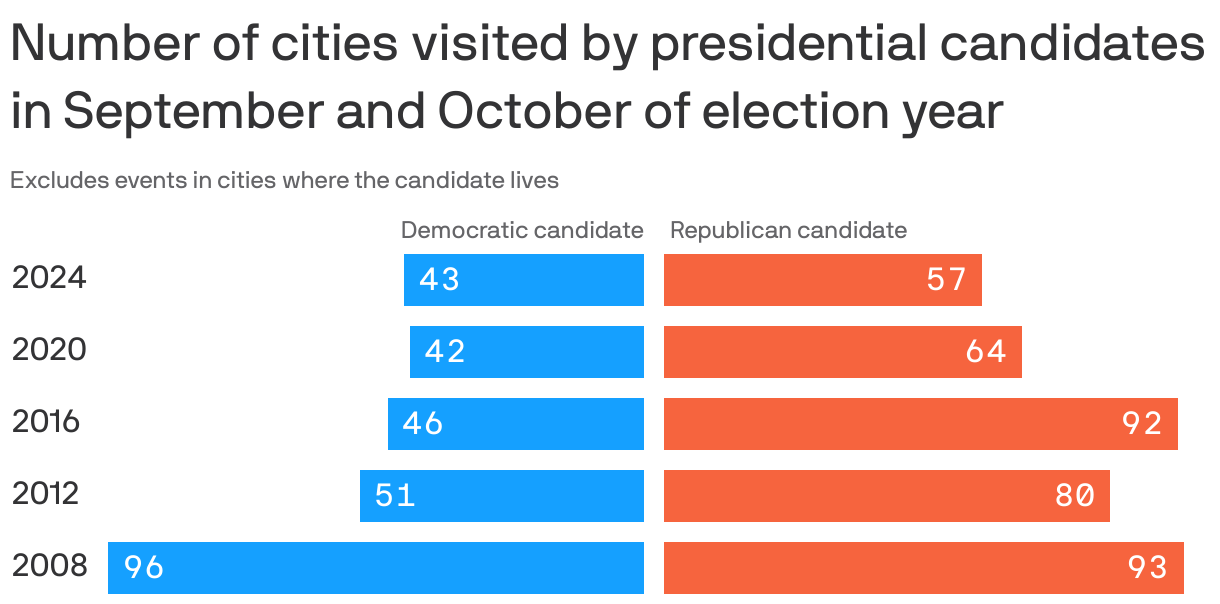
Why it matters: In September and October, Harris, 60, has visited — or plans to visit — fewer cities than the 78-year-old Trump and nearly every other Democratic and Republican presidential candidate in the previous four elections.
- The one exception: Joe Biden, whose "basement" campaign four years ago reflected both his age and pandemic restrictions.
- Both Harris and Trump are hitting the road this week, but they've spent most of September and October treating their race to the Nov. 5 election more like a marathon than a sprint.
- Even as his travel schedule has outpaced Harris', Trump has been taking a more leisurely approach to campaigning compared to his two previous presidential runs.
By the numbers: Harris has visited or plans to visit 43 cities in September and October. Trump will hit 57 cities, according to an Axios review of their public schedules.
- In 2008, Barack Obama talked about the urgency of that election — and he campaigned like it, hitting 96 cities, according to data compiled by professors Daron Shaw, Scott Althaus and Costas Panagopoulos for their book, Battleground: Electoral College Strategies, Execution and Impact in the Modern Era.
- Obama's opponent, John McCain, visited 93 cities.
- In 2012, Obama used Air Force One to visit 51 cities, including political rallies and official presidential events. Mitt Romney, his challenger, unburdened by White House duties, stopped in 80.
- The closing months of Trump's 2016 campaign were defined by big hangar rallies, allowing him to rack up a total of 92 cities. His opponent, Hillary Clinton, hit 46 cities on her way to defeat.
- In 2020, when Biden took serious COVID precautions on his plane, he managed to touch down in 42 cities, compared to Trump's 64.
Zoom out: The 2024 campaign's travel tempo could reflect changes over the past 16 years in how candidates reach voters.
- Traditional audiences have scattered to a wide range of platforms for news and information, and it's often more efficient for campaigns to post ads and other campaign pitches on social media. The Harris and Trump campaigns are both on TikTok.
- Podcast interviews give listeners a chance to assess candidates on their own schedules, and big media appears to be fading.
- Local TV news also is diminished — though the campaigns are still spending big money on ads shown on local stations.
- Both candidates are more focused on driving a national message, and are willing to visit states they have no shot of winning as a backdrop to emphasize a certain issue.
- For Harris, that meant a trip to Texas to talk abortion rights this month in a state with new restrictions on abortion. Trump used a visit to Aurora, Colo., to put a spotlight on crime by undocumented immigrants.
Zoom in: This year's contest is confined largely to seven swing states, putting a premium on multiple visits to the same city.
- Harris, for example, has visited Philadelphia five times. Trump has made three trips to Las Vegas.
- Axios' trip counts didn't include private fundraisers or media interviews for either candidate and only counted public events on the road.
- That means Trump's events and visits to New York City weren't included. Nor were Harris' engagements in Washington, D.C.
What they're saying: "On the days Axios is claiming the VP was 'down,' she was in fact doing debate prep in a swing state; conducting interviews that reach swing voters; meetings with key coalition groups ... meeting with heads of state including Volodymyr Zelensky, and responding to hurricanes Helene and Milton," said Lauren Hitt, a Harris spokesperson.
- "While Kamala Harris hides in safe spaces, President Trump and Senator [JD] Vance have barnstormed the country, maintained an aggressive campaign schedule with rallies and town halls in battleground states, and sat down for numerous interviews with traditional and specialty media outlets," Trump campaign spokesperson Karoline Leavitt said.
