Political ads boost local TV

Add Axios as your preferred source to
see more of our stories on Google.
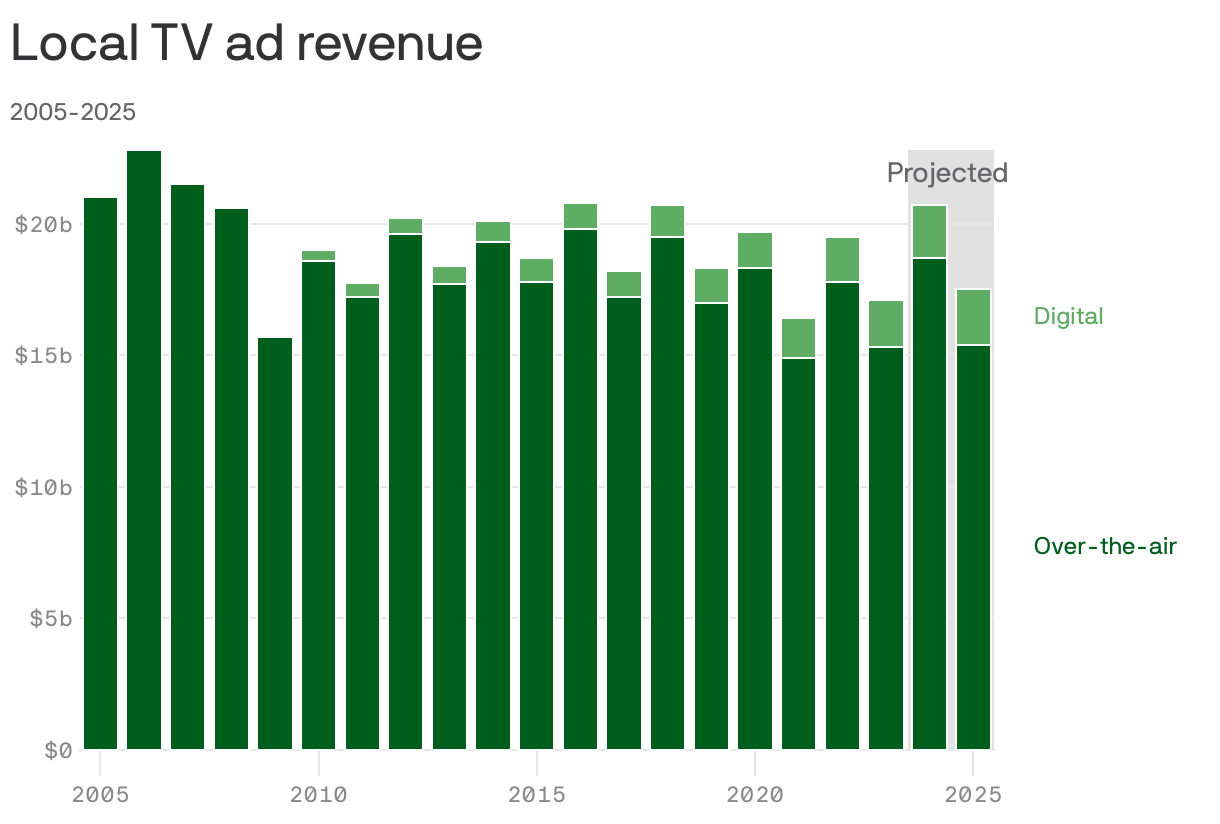
Local TV stations are experiencing an advertising windfall this election cycle, thanks to a record amount of U.S. political ad spend.
Why it matters: Despite an influx of new ways to reach voters online, local broadcast is still the top place campaigns spend their ad dollars, due to its effectiveness for voter persuasion and buying efficiency.
- While streaming ads make it easier for campaigns to target niche voting demographics, they often lack the scale necessary to persuade large amounts of voters in a particular region.
- Regulations around local broadcast ads meant to prevent bias also benefit campaigns, allowing them to unlock cheaper rates and protecting their ads from being blocked because of inaccuracies or misinformation.
State of play: Local TV broadcast stations have historically benefited in even-numbered years from huge upticks in ad spending around congressional elections. Every four years, that number balloons even higher with the presidential election.
- For example, a whopping $2 billion was spent on local political ads in 2020, followed by just $208 million in 2021 and then $1.9 billion in 2022.
By the numbers: This year, around $11.7 billion in political ad dollars are expected to be spent locally, according to BIA Advisory Services, up 21.3% from 2020. Political ads will make up roughly 6.7% of the total local ad market ($173.7 billion).
- Last presidential cycle, around 7% of all local advertising ($138.2 billion) was spent on local political ads, or around $9.6 billion.
- Local broadcast stations are also expected to bring in a record amount ($2.2 billion) in "TV digital" political advertising this year, or advertising sold by local broadcast stations on their digital properties, like their websites or owned and operated streaming apps.
How we got here: The 2010 overturning of campaign finance restrictions led to unprecedented investment in U.S. elections. The pandemic pushed more of those dollars into paid advertising, as campaigns pulled back their ground operations.
- This year, several highly competitive congressional races, combined with new fundraising energy around a close presidential election and a surge in state ballot measures, have driven huge ad opportunities for local broadcasters.
- While campaigns are experimenting more than ever with new mediums, like connected TV (CTV) ads on streaming, more video ad dollars are still flowing to local broadcast than any other medium, for now.
- BIA estimates more than $2.6 billion will be spent on CTV ads this cycle, and because CTV is growing faster than any other medium, more political ad dollars are expected to move into the category in the coming years.
The big picture: One of the reasons local broadcast ads are still so competitive is because there's a finite amount of inventory.
- As such, ad experts don't anticipate the rise of CTV ads to eat at the share of local political broadcast ad dollars anytime soon. Instead, CTV will grow as a complement to local broadcast ads as inventory is squeezed
What they're saying: Local broadcast executives are touting this year's election to investors as record breaking.
- E.W. Scripps, one of the largest owners of local broadcast stations in the country, said it believes its 2024 local political advertising revenue will reach record levels, thanks to Senate races in Montana and Ohio, as well as controversial ballot issues in several states.
- Nexstar saw political advertising double in the second quarter compared to the same three-month period in 2020. In its latest earnings call, Michael Biard, Nexstar president and COO, noted that the shift from Biden to Harris at the top of the Democratic ticket "kept the existing Biden-Harris fundraising in place, seemingly galvanizing both parties and driving meaningful incremental fundraising that ultimately will flow back into political advertising."
- Tegna then-president Dave Lougee said in the firm's August earnings call that fundraising was suppressed when Biden remained in the race, but now with Harris at the top of the ticket, "it's going to keep the enthusiasm in all the Senate races and the fundraising there ... very, very strong."
What to watch: Outside of political advertising, local broadcast faces pressure from digital alternatives, but there are some bright spots.
- Changes to local broadcast ownership rules by the Trump administration gave way to a record level of local broadcast consolidation, which has helped local networks reduce costs through synergies.
- More sports rights are moving out from regional cable networks and into local broadcast stations, boosting viewership.
- New technologies are also expected to make broadcast viewing more sophisticated, which executives believe will help local stations grow to become less reliant on cyclical political advertising.
