Global coral bleaching event is now largest on record

Add Axios as your preferred source to
see more of our stories on Google.
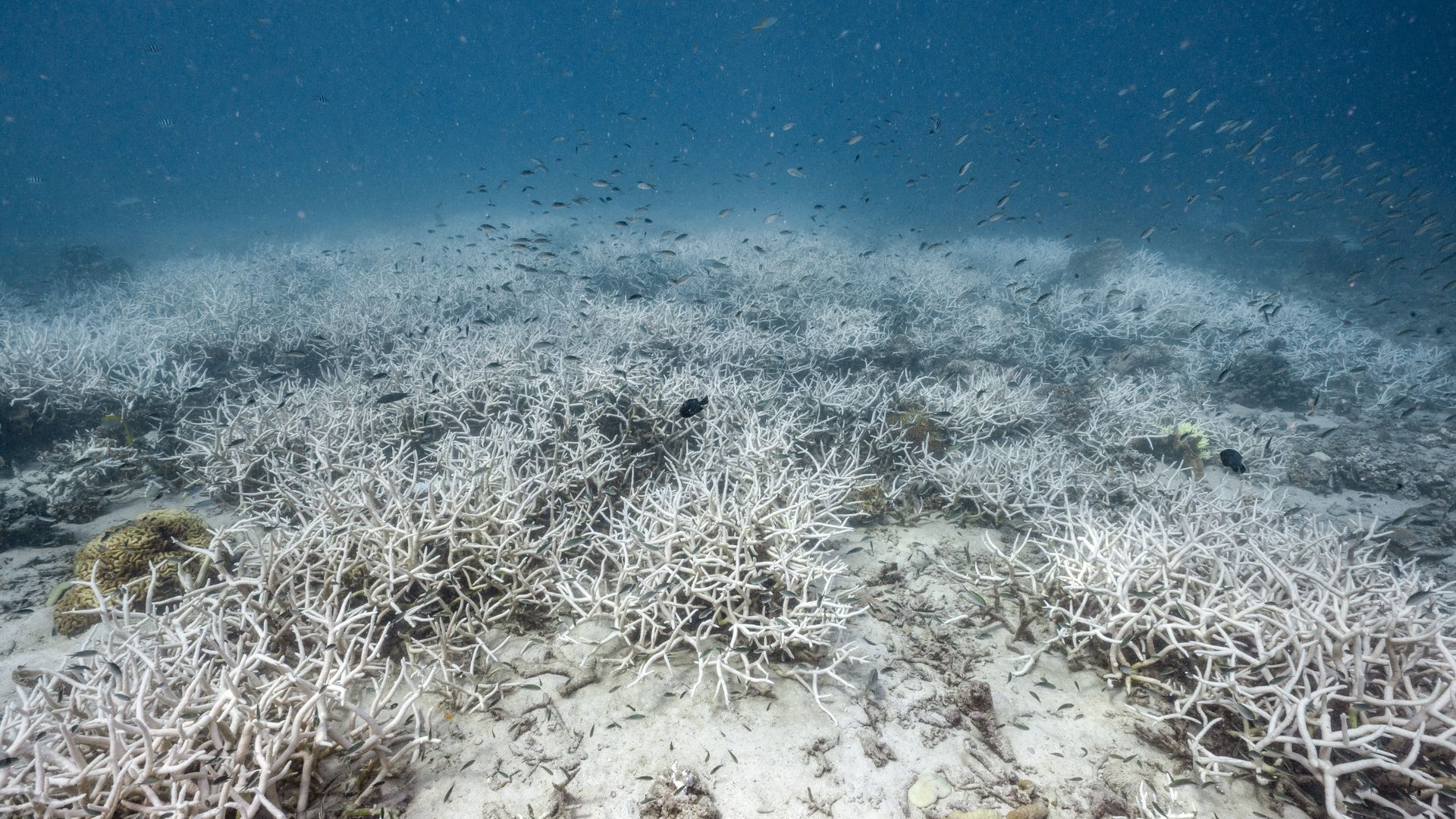
This photo taken June 14 shows bleached corals around Koh Tao Island in Thailand. Photo: Lillian Suwanrumpha/AFP via Getty Images
The ongoing fourth global coral bleaching event is officially the largest on record and still growing, according to NOAA.
Why it matters: Coral reefs act as nurseries for vital global fisheries. Their health is vital for sustaining diverse coastal marine species populations, drawing tourists and even reducing the impacts of powerful storms.
- Widespread coral bleaching results in sick reefs that are more vulnerable to illness, water pollution and other threats.
Zoom in: The ongoing global bleaching event began in January 2023, when global ocean temperatures first spiked to record levels amid a strong El Niño in the tropical Pacific.
- Long-term, human-caused climate change is also playing a significant role in boosting those temperatures, studies show.
- According to Derek Manzello, coordinator of NOAA Coral Reef Watch, corals contribute $3 billion annually to the U.S. economy alone.
- Globally that figure is closer to $2.7 trillion annually, according to the Global Coral Reef Monitoring Network.
- Human-caused warming from burning fossil fuels for energy, among other more minor sources, may already be overwhelming natural climate cycles like El Niño in steering ocean temperatures.
The most recent El Niño ended by June, but the record-shattering global ocean temperatures have continued.
- This has spread coral bleaching to even more areas, including a current, expanding marine heat wave in the eastern Caribbean and western North Atlantic Ocean.
The intrigue: According to Manzello, about 77% of the world's coral reef area has experienced "bleaching-level heat stress" between Jan. 1, 2023, and Oct. 10 of this year.
- The ongoing event is only the fourth global coral bleaching event to be observed. Each has occurred since 1998, in a sign of how much hotter the world's oceans are becoming.
- Since February 2023, he said, "We have confirmed reports of mass coral bleaching from 74 countries/territories. This includes locations in the northern and southern hemisphere of the Atlantic, Pacific, and Indian Oceans."
- The previous record-largest coral bleaching event took place between 2014-2017, when 65.7% of the world's reef area experienced bleaching-level heat stress.
- Reuters was first to report the new statistics.
Stunning stat: "We've eclipsed the previous record by 11.3% and surpassed the previous record in half the amount of time," Manzello told Axios via email. "This percentage is still increasing in size."
How it works: Corals have narrow temperature ranges in which they can live.
- When water gets too warm, corals expel algae that live in their tissues and give them their vibrant colors. This process causes them to turn a ghostly white.
- Bleached corals are then more vulnerable to disease and mortality, though they can eventually recover from a bleaching episode if it is brief and not too extreme.
- But prolonged heat stress can lead to coral die-offs, and these have occurred during the ongoing global event, including along the Great Barrier Reef in Australia.
Between the lines: NOAA has raised the coral bleaching threat level in parts of the Caribbean to a Bleaching Alert Level 5, which is a new and highest level on the scale.
- This level corresponds to a risk of "near complete mortality" of corals in that area.
- The hot waters in the vicinity of this newest marine heat wave helped Hurricane Oscar to stun meteorologists by rapidly intensifying this weekend. This defied computer models and human-generated forecasts, and the storm struck parts of the Bahamas and eastern Cuba.
- "There is severe heat stress in the Caribbean currently, but we have not yet received much info of bleaching this year," Manzello said. "We should know more towards the latter part of the year."
