Behind the Curtain — Election scenario 3: Trump with Dem restraint


Add Axios as your preferred source to
see more of our stories on Google.
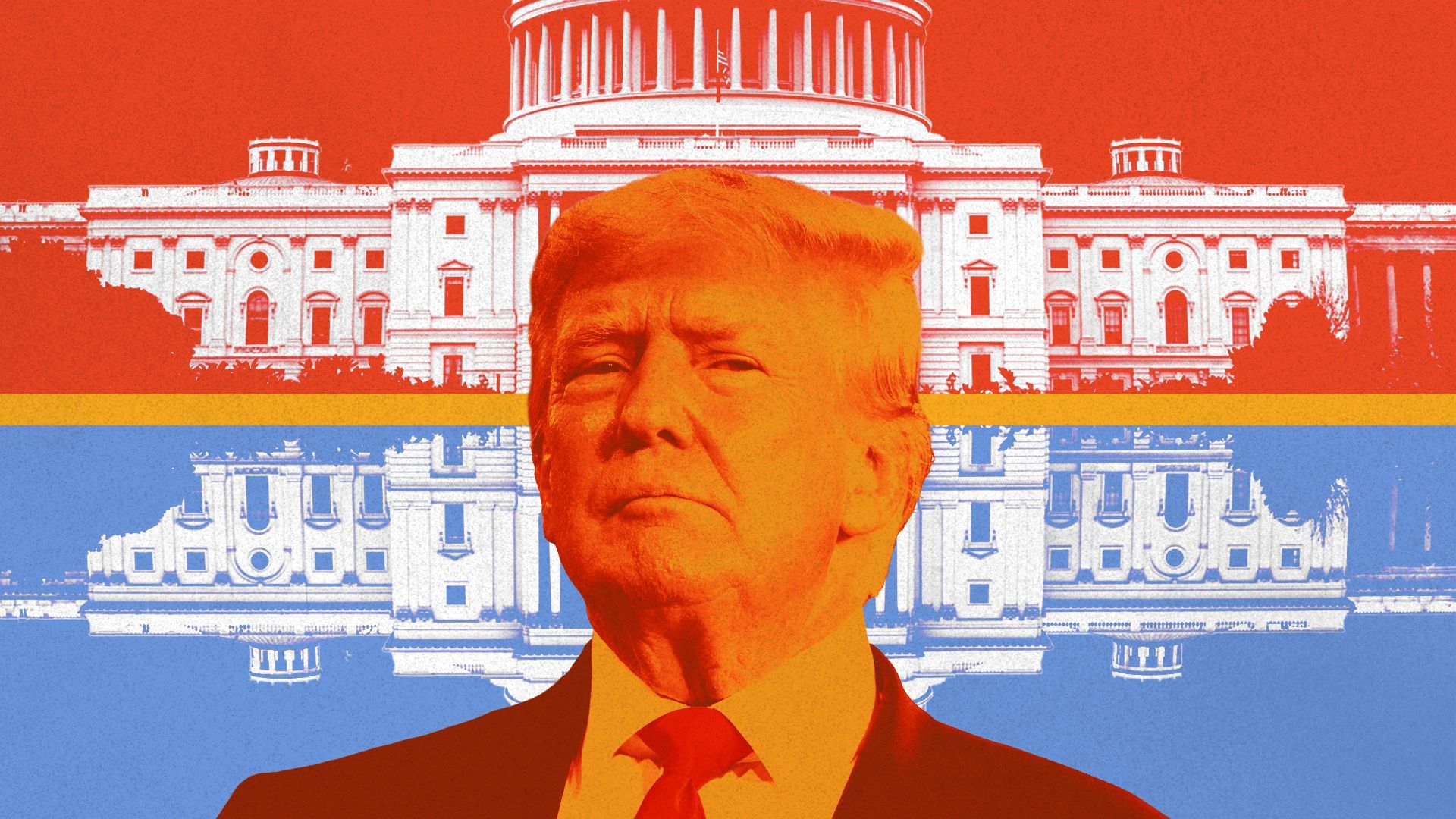
Photo illustration: Sarah Grillo/Axios. Photo: Brandon Bell/Getty Images
Third in a series
If former President Trump wins the election but Democrats control the House, Washington plunges into an epic power struggle and gridlock.
Why it matters: Trump has terrible relations with elected Democrats, and believes powerfully in the expansive authority of the presidency.
That's a recipe for extensive executive action on immigration and other policy arenas. Trump would likely test new limits of unilateral action, and count on conservative courts to back him.
- Expect constant friction between Trump and Democrats, who'd use their own oversight powers to investigate and challenge his administration and force court fights of their own.
- Sleeper scenario to watch: Trump and many Democrats agree on China, trade, targeted tax cuts and domestic energy production. So the possibility of consensus exists.
The big picture: A presentation by FGS Global — a communications and public affairs consultancy advising huge clients on potential election outcomes — spells out the implications of a Trump government if Democrats have a House or (less likely) Senate majority.
- This is the third of four columns, combining our reporting with the FGS "Alternative Futures" analysis.
What to watch in a "power struggle" scenario, under a divided government with Trump in the White House and Dems controlling at least one chamber of Congress:
1. Executive orders, regulatory changes
With a divided Congress, Trump's administration would rely heavily on executive orders to push his top promises. This could include moves to roll back climate rules, restrict immigration and ease corporate regulations.
- Expect a resurgence of executive orders aimed at reversing Biden-era policies — particularly in energy production, environmental regulation and social-policy requirements on infrastructure spending.
- Trump could reintroduce strict immigration policies via executive orders, focusing on border control, deportations and restrictions on legal immigration.
- But without congressional support, many of Trump's more ambitious projects, like a full-scale immigration overhaul and sweeping tax cuts, would be limited.
- The reliance on executive orders could create a volatile legal landscape, with constant court challenges by Dems.
- Corporations, especially in energy and tech, would face uncertainty from a regulatory framework that could change rapidly.
2. Taxes and health care
A divided government would have massive implications for Washington's biggest policy fight in years — the expiration of trillions of dollars of Trump's tax cuts at the end of 2025.
- Democrats would likely block the extension of tax breaks for the wealthiest Americans. But allowing the full 2017 law to expire would mean higher taxes for the vast majority of the country.
- Expect Democrats on Capitol Hill to instead use the looming cliff as leverage to pass their own priorities — like the renewal of enhanced Affordable Care Act subsidies, which also expire next year.
- Common ground in negotiations could include an expanded child tax credit and the elimination of taxes on tips, which both the Harris and Trump campaigns support.
3. Judicial appointments, courts
A Republican-controlled Senate would work closely with Trump to push through conservative judicial appointments, ensuring the federal judiciary continues to shift rightward. Expect a flurry of appointments to appellate courts and possible nominations to the Supreme Court if a vacancy arises. A Democrat-controlled Senate would vastly limit Trump's efforts.
- Trump and Senate Republicans would prioritize confirming conservative judges, solidifying a right-leaning judiciary that could influence decisions on key issues like abortion, voting rights, and regulatory power.
- The size of any Senate majority will matter profoundly, since the 60-vote filibuster still stands. The Senate would serve as a firewall for Trump, blocking Democratic-led investigations or efforts to convict him in an impeachment trial.
- The judiciary would become a battleground for determining the constitutionality of executive orders and legislative actions.
4. Culture wars, Hill gridlock
Trump would use his bully pulpit to push back against what he sees as "woke" policies. Republicans would push legislation inhibiting gender-affirming care, corporate diversity initiatives and the teaching of critical race theory. But legislative progress would be limited by Democrats.
- Trump would continue to push cultural issues like gender and free speech. Executive actions may target LGBTQ+ rights and restrict funding for programs promoting diversity, equity and inclusion (DEI).
- A Democratic House would counter by investigating and challenging Trump's actions. Expect hearings on Trump's handling of federal programs and conflicts of interest — and potentially more impeachment inquiries.
- Expect a lot of noise but little legislative progress — neither side would have the juice to enact sweeping reforms without the other's cooperation.
- Businesses would find themselves routinely stuck in the crosshairs of cultural fights.
5. Immigration, border control
Trump likely would focus on border security and deportation through executive orders. But Democrats could limit his ability to pass new comprehensive immigration reform or expand funding for his border wall.
- Expect Trump to use existing executive authority to tighten asylum rules, increase deportations and pressure sanctuary cities. Federal agencies could see increased enforcement actions targeting undocumented immigrants.
- Efforts to fund further expansion of the border wall or restrict legal immigration pathways would face fierce opposition, resulting in standoffs over budget allocations and funding priorities.
- Trump likely would face legal challenges from Democratic states and civil rights groups, contesting his executive actions on immigration.
- Without congressional backing, his ability to make lasting changes to immigration law would be limited, leading to frustration among his base. Businesses would face uncertain labor markets and internal tension over executive actions.
6. Foreign policy, global relations
Trump's foreign policy would remain focused on "America First." But a divided Congress could curtail his ability to pass significant foreign policy legislation. Instead, Trump could be expected to rely on executive agreements and bilateral deals to reshape America's global relations.
- Expect Trump to continue pushing a tough stance on China, with potential tariffs and sanctions. He might also attempt to renegotiate trade deals with allies like the EU — but without congressional support, comprehensive treaties could be off the table. He'd find some sympathetic Democrats in these fights.
- Trump's relationship with NATO and other international alliances could become further strained, as he prioritizes transactional diplomacy over multilateral cooperation.
- A divided Congress would lead to inconsistencies in foreign policy, as the House and Senate push competing agendas on defense spending, trade and international agreements.
- Global allies and adversaries could exploit these divisions, testing U.S. resolve and creating uncertainty in international relations.
Post-election risks: Trump's reliance on executive orders to bypass congressional gridlock could lead to constant legal battles, undermining confidence in governance broadly.
- Democrats would be likely to launch investigations into Trump's administration, targeting conflicts of interest, alleged abuses of power, and attempts to sidestep congressional oversight.
- Trump could retaliate by refusing to cooperate with subpoenas, leading to constitutional confrontations between the executive and legislative branches.
- The constant legal and political battles could paralyze government — creating uncertainty for businesses, investors, and foreign allies.
Axios' Zachary Basu contributed reporting.
- Go deeper: Read the two previous columns in this series — Trump sweep and Harris sweep.
🗓️ Join Jim VandeHei, Mike Allen, and Eleanor Hawkins this Thursday for an Axios Communicators Pro virtual conversation about this series. You'll hear how potential election outcomes will affect business — and what it means for communications leaders. Become a Comms Pro member to attend.
