What to know about Columbus Day and Indigenous Peoples' Day

Add Axios as your preferred source to
see more of our stories on Google.
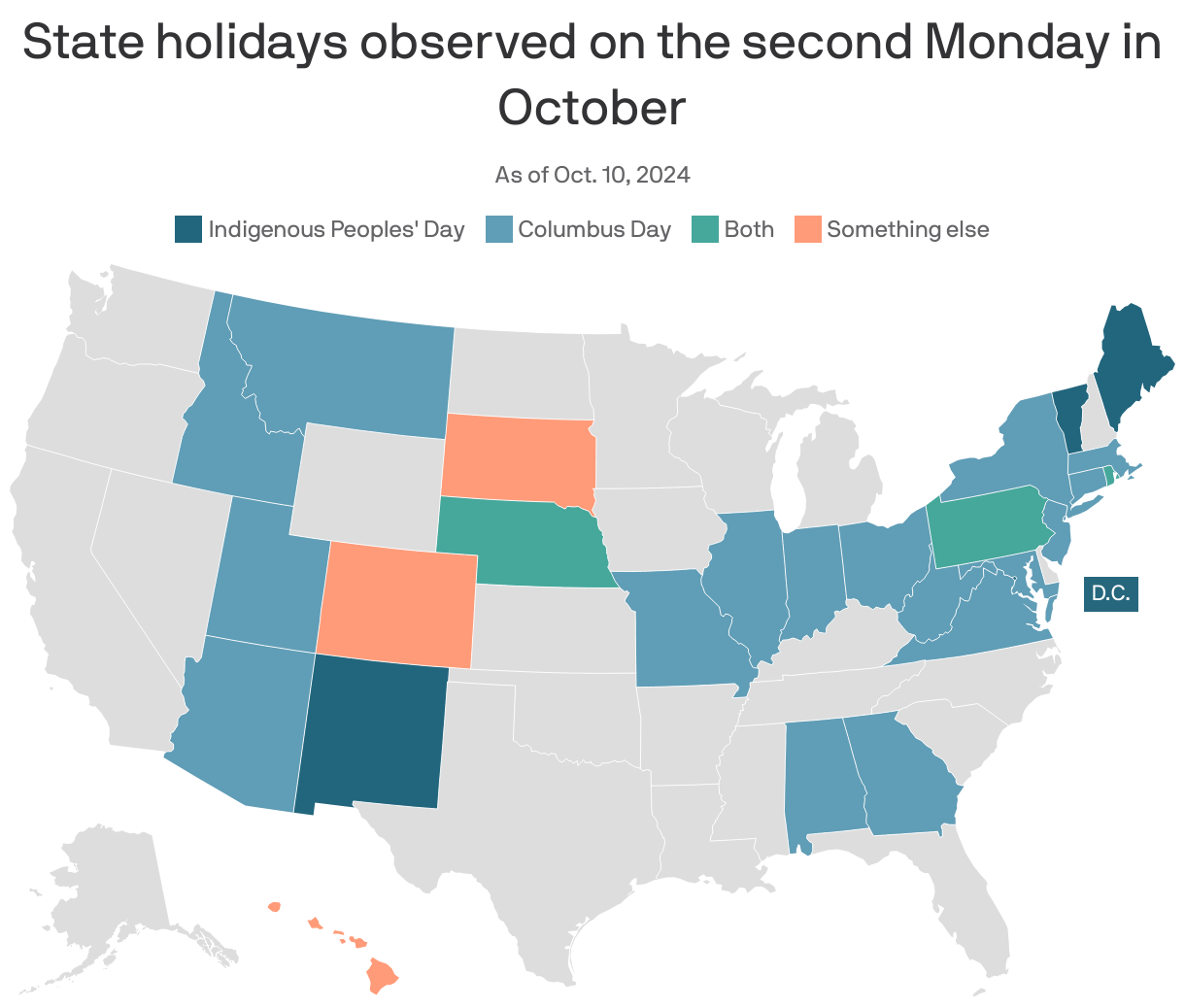
Columbus Day is the federal holiday on the second Monday in October. But what the state holiday is called — Columbus Day, Indigenous Peoples' Day or something else — depends on where you live.
Why it matters: Efforts to change the focus of the holiday from celebrating Christopher Columbus to the contributions of Native Americans are ongoing.
- Lawmakers in Congress reintroduced legislation last fall to have Indigenous Peoples' Day replace Columbus Day.
The big picture: Native American advocates have been pushing to get states to swap Columbus Day for Indigenous Peoples' Day since the early 1990s.
Flashback: In 2021, President Biden became the first president to issue an official proclamation commemorating Indigenous People's Day.
Columbus Day or Indigenous Peoples' Day as state holiday
By the numbers: 17 states observe the second Monday in October as an official public holiday called Columbus Day, according to the Pew Research Center and Axios staff research.
- In Nebraska, Pennsylvania and Rhode Island, the day is known as both Columbus Day and Indigenous Peoples' Day.
- The state holiday is known officially as Indigenous Peoples' Day in New Mexico, Maine, Vermont and D.C.
Yes, but: More than half of states don't recognize Columbus Day or Indigenous Peoples' Day as a state holiday but many have issued proclamations.
Banks, USPS closed Columbus Day; stock market open
State of play: Banks and the U.S. Postal Service are closed Monday for the holiday.
- But unlike Memorial Day, Labor Day and Juneteenth, U.S. stock markets are open.
- FedEx and UPS also are open and delivering, according to their holiday schedules.
More from Axios:
