What we couldn't prepare for with Hurricane Milton

Add Axios as your preferred source to
see more of our stories on Google.
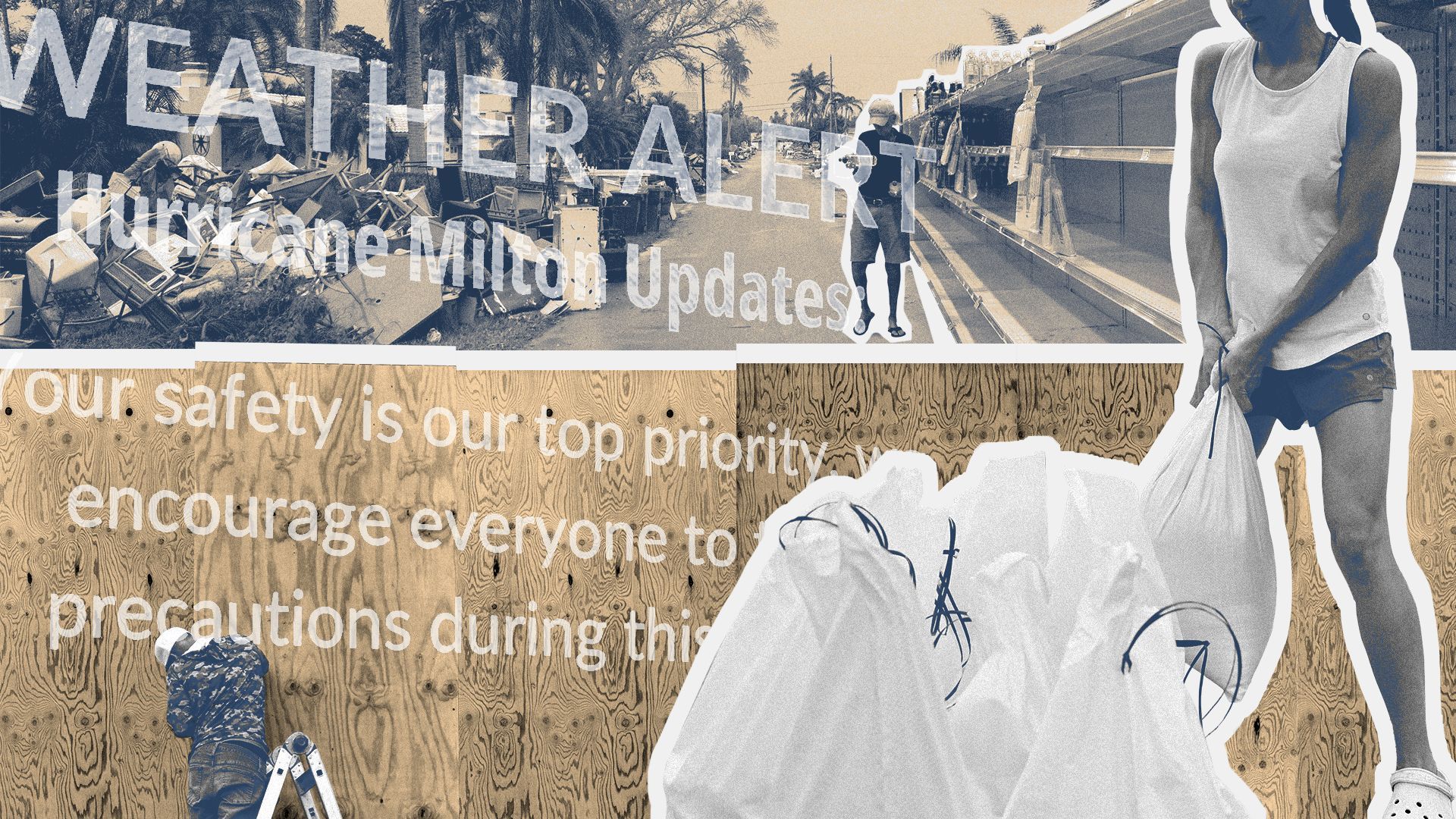
Photo illustration: Lindsey Bailey/Axios. Photos: Bryan R. Smith, Spencer Platt via Getty Images
Forecasters, state and county officials and emergency workers have warned about Hurricane Milton's landfall for days — but we weren't totally ready for it.
The big picture: It’s nearly impossible to fully prepare for the projected scale of devastation of a storm like Milton.
- There are still people and pets in the path of the storm who weren’t able to — or didn’t — evacuate in time.
- FEMA — whose workers will be on the front lines helping people and managing the destruction — is already short-staffed, and is now spread even thinner due to the back-to-back hits from Helene and Milton.
- The scale of the storm itself and the unpredictability of its precise path meant that it was impossible to gauge where the most help would be needed on Florida's coast.
"Unfortunately, there will be fatalities. I don’t think there's any way around that," Florida Gov. Ron DeSantis said at a press conference Wednesday.
Zoom in: Some 7.3 million people live in the 15 Florida counties with mandatory evacuation orders, but not all have left, CNN reports.
- Some can't afford the gas or hotel rates or airfare to get out, some can't find shelters that are open, and some can't find places that take pets.
- Several Florida counties opened up more shelters Wednesday afternoon, according to the Tampa Bay Times.
- Hospitals and nursing homes, which can’t evacuate everyone, set up barricades and stocked up on supplies to ride out the storm, the New York Times reports.
For those who've stayed, resources are thin.
- Power outages have started — and will keep spreading.
- The city of St. Petersburg has shut down two sewage treatment plants, which means most residents can't shower, flush toilets or wash clothes or dishes, possibly for days after the storm.
Plus, FEMA is overextended.
- Milton is the second major hurricane in two weeks. Workers are still helping provide food, water and other assistance to those hit by Hurricane Helene — many of whom are in Florida.
- This comes in the middle of an ongoing staff shortage at the agency. A 2023 report from the nonpartisan Government Accountability Office found that 35% of FEMA's positions were unfilled, partly due to "rising disaster activity during the year, which increased burnout and employee attrition," the New York Times notes.
- And FEMA says a flurry of misinformation has impeded its disaster response efforts.
The bottom line: Hurricane Helene has killed more than 200 people, and the destruction from the storm will take months to clear.
- Milton — and its storm surge — is hitting a far more populated part of Florida.
- "That was a slap," Cathie Perkins, emergency management director for Florida’s Pinellas County said Wednesday. "This is going to be a punch to the face."
