Double disaster: Hurricane Milton terrorizes Helene-battered South


Add Axios as your preferred source to
see more of our stories on Google.
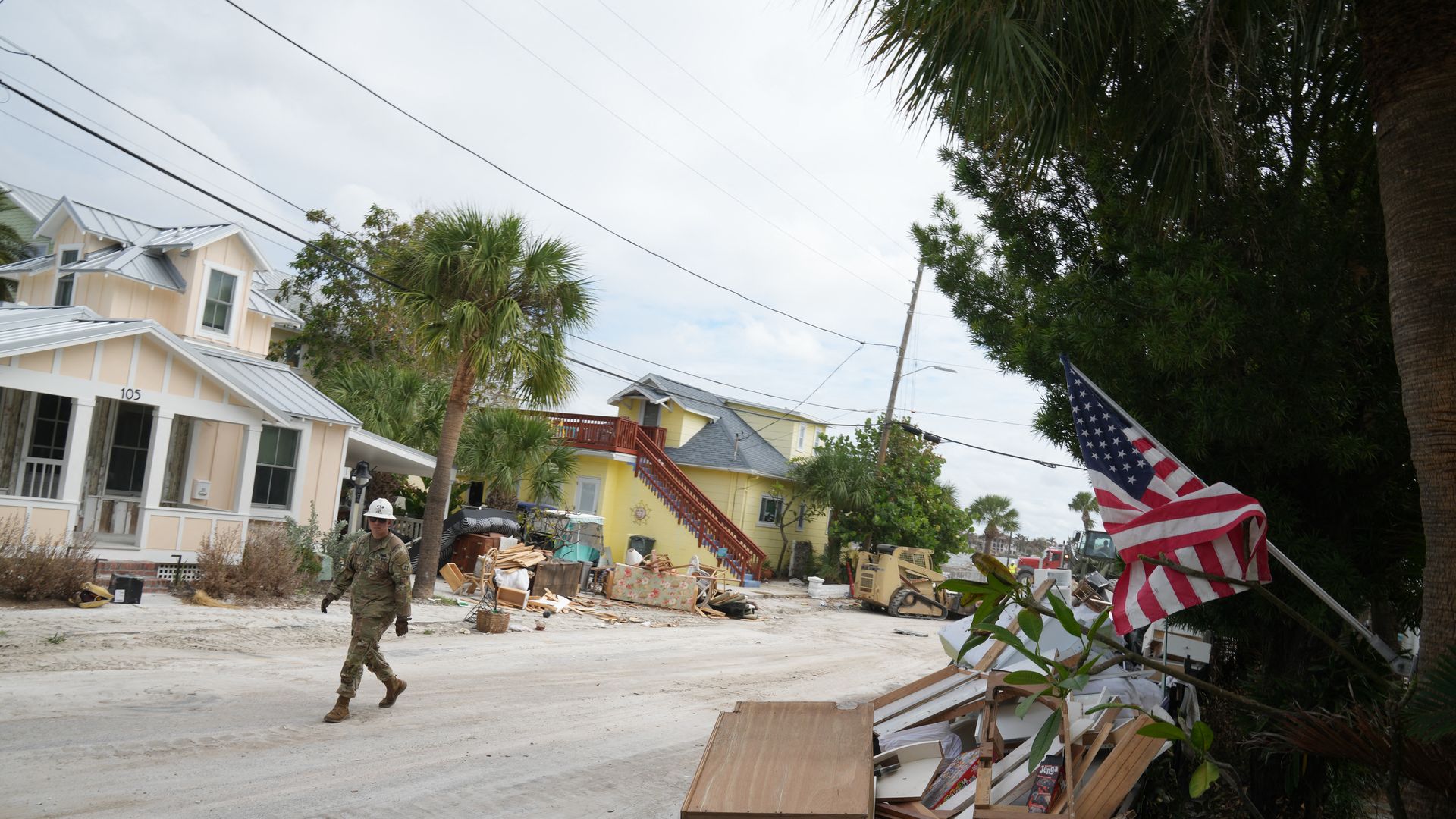
The Florida Army National Guard removes debris in St. Petersburg on Monday ahead of Hurricane Milton's expected landfall in Florida. Photo: Bryan R. Smith/AFP via Getty Images
Emergency responders gameplan for worst-case scenarios, but rarely see one like this roar to life: A Category 4 hurricane is bearing down on Florida, while resources are strained responding to another devastating hurricane in the same region.
Why it matters: Hurricane Milton frightens authorities and experts because it strengthened so rapidly, threatens heavily populated areas and is hitting so close to Hurricane Helene.
Zoom in: Emergency managers in Florida have simulated the "black swan event" in which a Category 4 or 5 hurricane hits Tampa Bay, as Hurricane Milton is threatening to do this week, Rep. Jared Moskowitz (D-Fla.) told Axios.
- "If a Category 5 storm comes into Tampa there are going to be resource challenges that we have probably not experienced before," says Moskowitz, who led the Florida Division of Emergency Management from 2019-2021.
- Assets and equipment along the East Coast have already been deployed for Hurricane Helene. "The resources will be available, but they will take longer to arrive. Everything is going to take longer," Moskowitz says.
However, some resources already in place in Florida to respond to Helene will now be utilized for Milton, says Greg Eaton, a former FEMA Recovery Division Director.
- FEMA has pre-positioned swift-water rescue teams, debris experts and temporary power experts in Milton's path, says Eaton, now a professor of emergency management at Purdue Global.
- But just 9% of FEMA's workforce is available to respond to new disasters, according to the agency's daily operations brief.
- Helene made landfall in the sparsely populated Panhandle. But with Milton, "you potentially are going into major metropolitan areas across the state," former FEMA administrator Craig Fugate tells Axios. That's a very different challenge.
Driving the news: Milton "explosively" intensified to Category 5 on Monday before weakening. Now a high-end Category 4, it is forecast to bring unprecedented storm surge to portions of Florida's Gulf Coast.
- A direct hit on Tampa from the west-southwest — which looks frighteningly possible — would push an 8-to-12-foot storm surge into the bay, the highest forecast on record for that area by the National Hurricane Center.
State of play: FEMA said Monday it'll remain focused on the Helene recovery while pre-positioning resources ahead of Milton's projected midweek landfall. "It'll be challenging, but we'll make it work," FEMA Administrator Deanne Criswell told MSNBC.
- The agency will likely have to redirect some teams and resources from the Helene response to Florida, Fugate says.
- Local, state, and federal agencies prepare for scenarios involving back-to-back disasters, but "that doesn't make it any less challenging," says Tricia Wachtendorf, director of the University of Delaware's Disaster Research Center.
- "When it happens to the same area immediately after the next one, especially for local and state agencies, that puts a huge burden on them. They're tired," she says.
Zoom in: Residents across several counties in Florida affected by Helene in late September have now been ordered to evacuate ahead of Milton. Schools and universities across the state are closing their doors.
- MacDill Air Force Base in Tampa, home of U.S. Central Command, began evacuating non-essential personnel and planes Monday in preparation for Milton's landfall.
Meanwhile, nearly 7,000 federal personnel were deployed as of Monday to areas hard-hit by Helene.
- More than $210 million in federal aid for survivors has been administered, according to FEMA.
- In North Carolina specifically, where more than 100 people have died, 800-plus agency staffers remain on the ground as of Monday, as well as 1,500 active-duty military personnel.
Reality check: Climate change is magnifying the chances for compound disasters by increasing the frequency and amplitude of extreme precipitation events, raising sea levels, and boosting hurricane intensity.
Follow the money: While Criswell has repeatedly emphasized the agency has the resources to respond to Helene, Homeland Security Secretary Alejandro Mayorkas has warned of a looming disaster funding shortfall.
- House Speaker Mike Johnson (R-La.) on Sunday would not commit to reconvening Congress before the election, despite bipartisan pressure to address FEMA's funding woes.
- "Through these two events and ongoing activities, certainly it's straining the disaster relief fund," Eaton says.
What to watch: Criswell noted that "ridiculous" conspiracy theories about the response to Helene — some of them amplified by former President Trump and his allies — were making the response even more difficult. Those are likely to resurface after Milton hits.
- "Listen to your local officials," Fugate said. "Right now, the only messaging that should be really taking place across the Florida west coast that's in the hurricane impact area is evacuation and getting ready."
Go deeper: Storm-battered Tampa Bay braces for Hurricane Milton
