Gaza war defines a generation's perspective on Israeli-Palestinian conflict

Add Axios as your preferred source to
see more of our stories on Google.
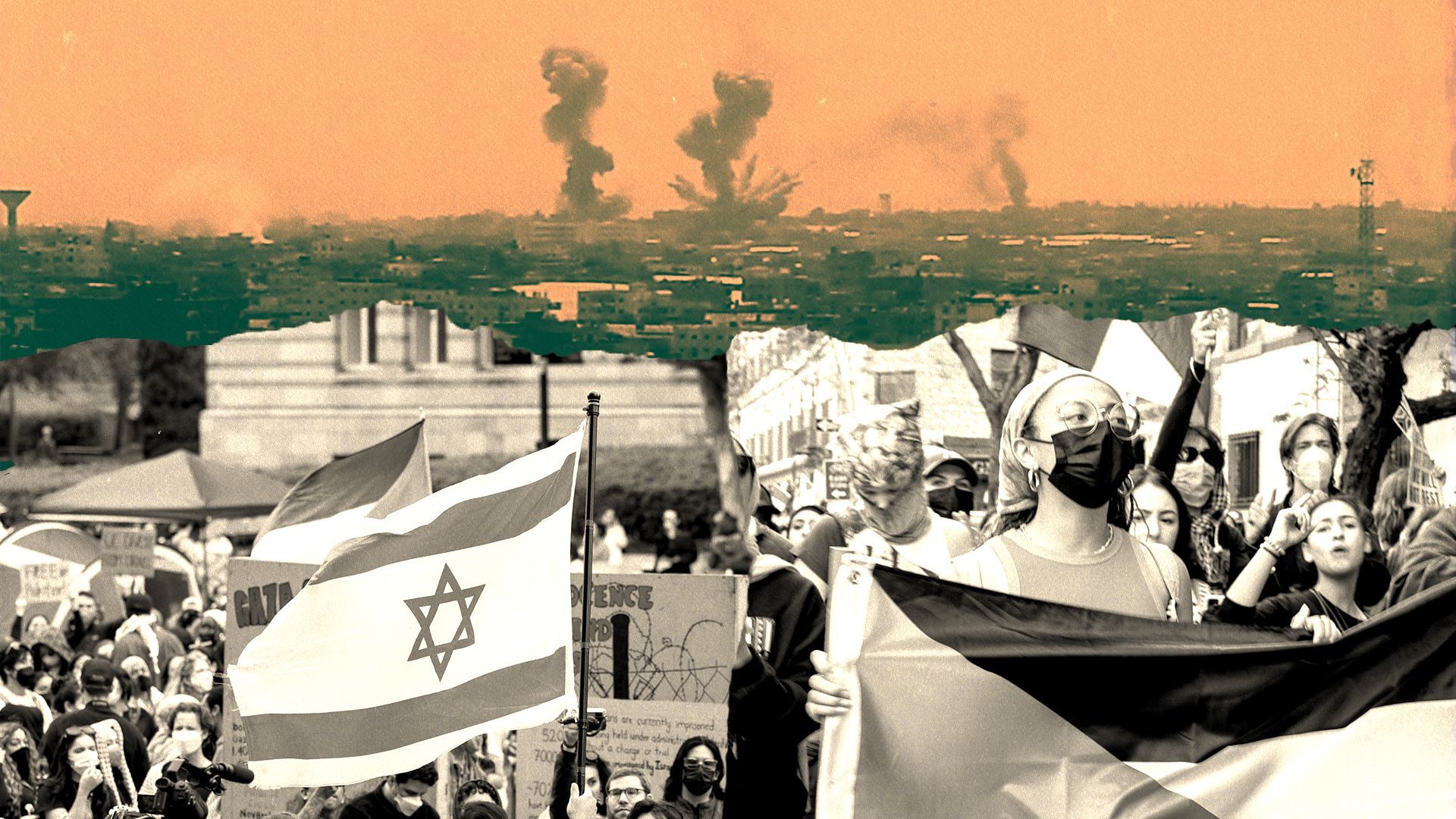
Photo illustration: Brendan Lynch/Axios. Photos: Ahmed Ebu Saud/Anadolu Agency/Getty Images, Qian Weizhong/VCG via Getty Images, and Spencer Platt/Getty Images
The year of war that followed the terrorist attacks of Oct. 7 has shaped the views of a generation of young people, who now see the Israeli-Palestinian conflict and America's role in it in starkly different ways than their elders.
Why it matters: "This new generation is going to go from campuses to the halls of government eventually," says Carmiel Arbit, senior fellow for Middle East Programs at the Atlantic Council. "The events that followed Oct. 7 are going to have a real impact on their view of the world."
Between the lines: “Historically, each generation's attitude toward Israel is shaped by these formative experiences,” says Dov Waxman, a professor of Israel studies at UCLA.
- For the oldest Americans, it was Israel’s creation in the wake of the Holocaust’s horrors.
- “For Boomers, it was Israel’s apparent triumph against the odds and against the Arab states that were threatening its existence," says Waxman, referring to wars in 1967 and 1973.
- "But those under 40 have come of age in a very different time in Israel’s history. Israel has been the dominant military power in the region. And the conflict isn’t against the surrounding Arab world, where Israel was seen as the outnumbered underdog." Now, the youngest generation sees the Palestinian people as underdogs, he says.
Zoom in: Polling in the last year has consistently found Gen Zers and young millennials tend to sympathize with Palestinians and want the U.S. to stop supporting Israel's war effort at higher rates than older Americans.
- Big cities and college campuses across the country saw massive pro-Palestinian protests and encampments in the spring. Those protests have resumed this fall.
- For a year, devastating images from Gaza have spread around the world on social media and news sites. "It's one thing to be told about some conflict in some far away place, and it's something else to see people who just want to live like you being forced to endure horrific violence," says Elia Ayoub, a Palestinian Lebanese writer, researcher and podcaster.
- More than 41,600 Palestinians have been killed, according to Gaza's Hamas-run health ministry, and nearly all of the enclave's population forcibly displaced in Israel's military operation in Gaza. More than 1,200 people were killed by Hamas in the Oct. 7 attack on Israel.
Zoom out: The past year has also been marked by an ugly rise in antisemitism and Islamophobia in the United States.
- "This wave [of Islamophobia] stands out" for the way it's affecting people in schools and workplaces, says Corey Saylor, director of research and advocacy at the Council on American-Islamic Relations.
Most protests have been peaceful. But some demonstrations have featured disturbingly antisemitic or pro-Hamas sentiments, says Oren Segal, vice president of the Anti-Defamation League's Center on Extremism.
- "In the 20 years or so that I've been monitoring antisemitism, I've never seen such brazen support of terrorist organizations from forces online, on college campuses and elsewhere," Segal says.
- Even among well-intentioned young people, there can be a “meme-ification of conflict" that boils everything down to "a single image or catch phrase," Arbit says.
Reality check: Most politicians in Washington still unequivocally support Israel, Waxman notes. And some who’ve been critical of Israel have been voted out in primary races.
- But the Gaza war has "reverberated in all sorts of ways across the United States" and become a domestic issue that politicians can't ignore, says Waxman.
What's next: As young people pressure their politicians, and eventually rise to power themselves, U.S. policy may begin to shift in profound ways.
