The Tesla robotaxi show — what to watch

Add Axios as your preferred source to
see more of our stories on Google.
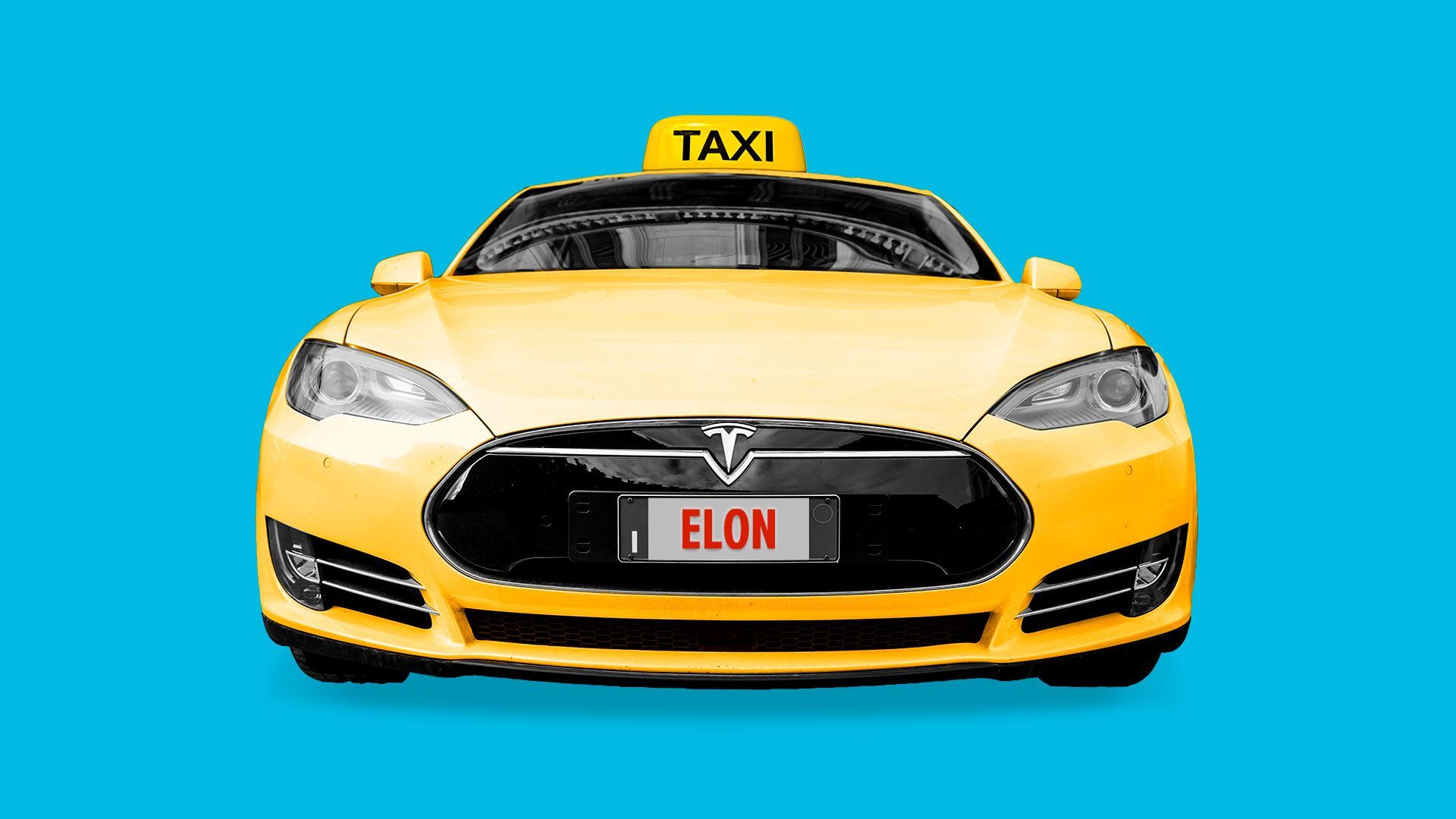
Illustration: Aïda Amer/Axios
Tesla CEO Elon Musk has been promising self-driving taxis for years. Skeptics and true believers will find out soon whether he can deliver.
Why it matters: With new competitors eating into Tesla's electric vehicle market share, Musk is now betting the company on artificial intelligence, including robotaxis.
Driving the news: The billionaire CEO will host an event on Oct. 10 in Los Angeles, where he's expected to reveal a Cybercab prototype and share the latest advancements in Tesla's full self-driving (FSD) technology.
The show at Warner Bros. studios will no doubt be another Musk special, with lots of hype describing it as a product everyone said was impossible.
- Ignore the noise.
What we're watching: There are a multitude of unanswered questions about whether the technology is ready, and how a Tesla robotaxi business would work.
- Here are three big things to pay attention to:
The mystery car
Images of a heavily camouflaged vehicle surfaced online recently, but until the actual Cybercab is revealed, the big question is: Does it have a steering wheel and pedals?
- The answer matters. Without such human controls, Tesla would need an exemption from federal motor vehicle safety standards to deploy them on U.S. roads.
That isn't likely. General Motors tried for years to get such an exemption, finally giving up and scrapping its own purpose-built Origin robotaxi in July, citing "regulatory uncertainty."
- GM decided it'll be easier to scale its Cruise robotaxi service using a standard vehicle.
Musk has been adamant, however, that Tesla build a truly revolutionary robotaxi without a steering wheel or pedals.
- "This is the product that makes Tesla a ten-trillion company," he told biographer Walter Isaacson. "People will be talking about this moment in a hundred years."
The technology claims
Musk has said Tesla will be ready to launch its robotaxi service next year, but he's famous for saying "I'd be shocked if (such-and-such) didn't happen next year" — only to move the goalposts again and again.
What we know is that Tesla has chosen a different development path than many others, including Waymo, the market leader, whose robotaxis are already operating in several cities.
- Instead of using machine learning to train cars to recognize road signs or pedestrians, for example, and then behave in a certain way, Tesla uses a neural network that learns from video data how to drive like a human.
- Such end-to-end AI systems — known as AV 2.0 — are viewed by some as a faster, more capital-efficient way to teach robots to drive. But they require massive amounts of data to train the AI models.
Tesla's advantage: It collects tons of video snippets of everyday driving from its own fleet of 2.2 million cars on the road, giving it a large data sample.
- The downside is that such deep learning systems are a "black box" — if something goes wrong, it's impossible to trace the car's thought process to see why it made the decision, and reprogram it, if necessary.
- That kind of "train and pray" approach to development is problematic in a safety critical industry, Sterling Anderson, co-founder of autonomous trucking company Aurora, said on a recent webcast.
Tesla already faces scrutiny from federal auto safety regulators for hundreds of crashes in which its Autopilot technology failed to protect drivers and passengers.
- Critics say Tesla's camera-based system can't always see in bad weather and darkness. Other AV companies use a combination of camera, radar and laser sensors.
- Musk needs to prove that Tesla's FSD is safer than a human driver.
The robotaxi business
The Cybercab — if cleared by regulators — would be the basis for a future Tesla robotaxi service. And don't be surprised if Musk unveils an Uber-like ride-hailing app as part of the event.
- But his larger vision is to turn Tesla's existing customer-owned fleet into a sort of Airbnb on wheels, with owners sending their driverless cars to pick up riders when they aren't using them.
- For that to work, Tesla needs to share many more details, like who is liable in case of an accident or theft, and who will clean and maintain cars between rides.
The bottom line: Tesla watchers have questions. We'll see if Musk has answers.
