Behind the Curtain: The worst of 2016 and 2020 unite


Add Axios as your preferred source to
see more of our stories on Google.
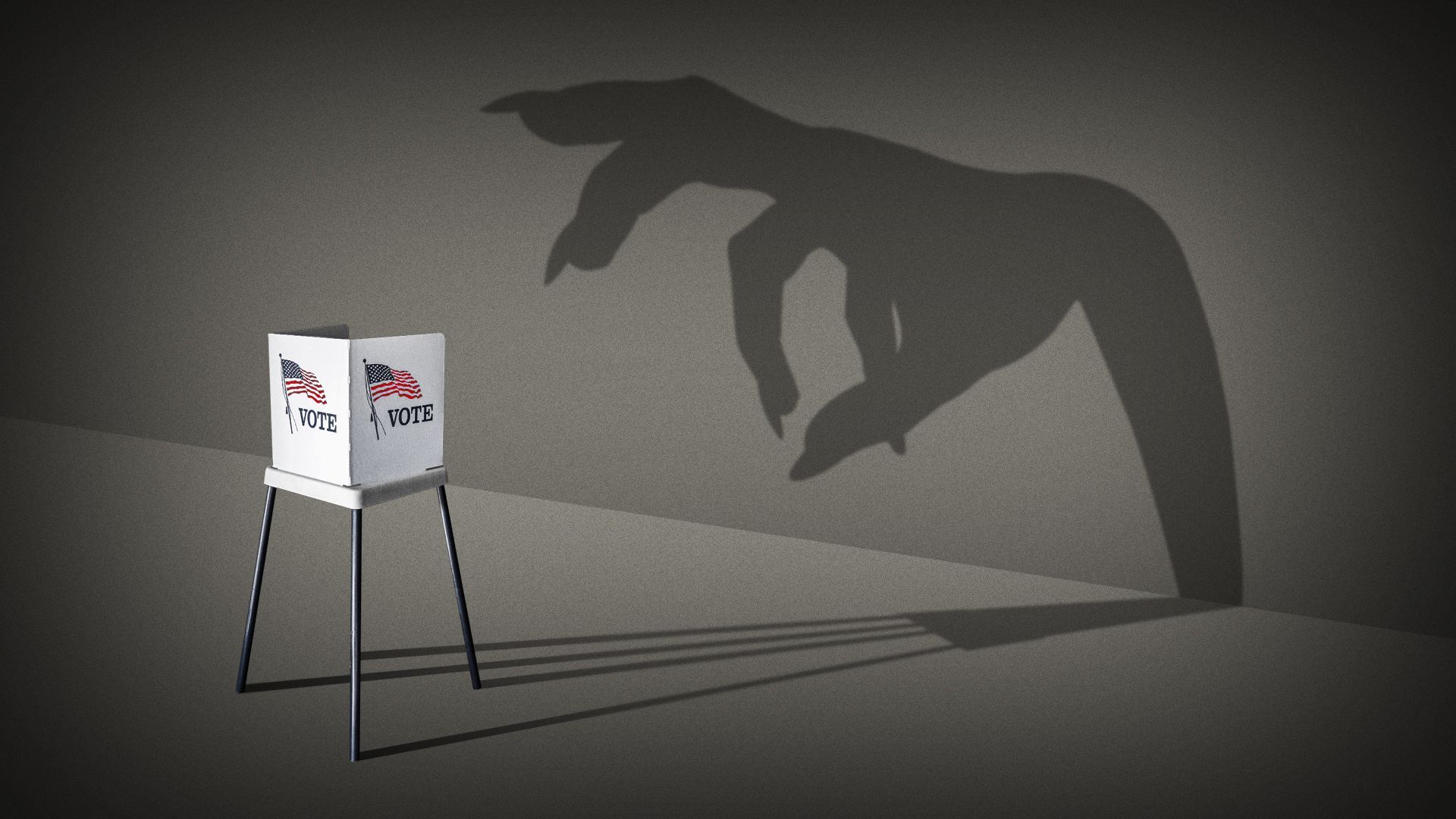
Illustration: Maura Losch/Axios
Thought experiment: Do you feel at least slightly more anxious today than six months ago? Do you feel at least slightly more skeptical that what you're reading is real and true than six months ago?
Why it matters: Join the club. We've been asking people that as we travel the country. Almost everyone nods — regardless of age, region or education. Here's why: This election combines the worst of 2016 with the worst of 2020.
The big picture: Fake news — a concept seared into the American psyche during the 2016 campaign, when Donald Trump tried to discredit real reporting — has exploded in sophistication and scale.
- Political violence, a taboo shattered in the wake of the 2020 election, now threatens U.S. democracy — and candidates — in chilling ways.
- Underpinning it all is growing mistrust of government — and falling trust in institutions of all kinds.
Zoom in: Axios' Zachary Basu has elegantly synthesized the many ways both problems are worsening in the final stretch of the 2024 campaign. Think about the last week alone:
- Former President Trump survived a second assassination attempt. Then, rather than call for unity as he briefly did after being shot in July, he and his allies explicitly blamed Democrats for the threats on his life.
- Elon Musk, who has nearly 200 million followers on X, drew the attention of the Secret Service with a now-deleted post suggesting it was odd that "no one is even trying to assassinate" Vice President Harris or President Biden.
- An Alaska man was charged this week with threatening to torture and kill six Supreme Court justices — the latest in what the Justice Department called an "unprecedented" level of threats against public officials.
Between the lines: Members of Congress are especially open to increasing the Secret Service budget for a scary reason: their own experiences with growing threats and startling security breaches, Axios' Andrew Solender reported this week.
- 60% of U.S. adults find it stressful and frustrating to discuss politics with people who hold different views — up 10 points from the relatively innocent days of 2019, before rampant election denialism, a Pew Research poll found.
- And 60% of Americans limit how much political news they consume to avoid feeling overloaded or fatigued, according to a poll out last week from the AP-NORC Center for Public Affairs Research and USAFacts.
- The American Psychological Association even has a term for it: "political stress." Politics "is increasingly recognized as a significant source of chronic stress, affecting both mental and physical health negatively across a broad swath of the population," the association says.
Now turn to America's mounting swamp of misinformation:
- Trump used the national debate stage to spread fake news: Haitians in Ohio are eating pet dogs and cats. A week later, his allies are still at it — even after a flood of fact checks and bomb threats.
- X is overflowing with conspiracy garbage, often promoted by people who should know better: Musk shared a fake Trump rally bomb threat this week that could have been debunked with one more click.
- Trump's lies are growing more frequent and more bizarre: Over the past month, the former president has told at least 12 "completely fictional" stories, according to a detailed CNN rundown.
- Harris' campaign has been guilty of its own fake-news offenses, using the popular @KamalaHQ social media account to post misleading clips about Trump and Republicans on several occasions — more of a cynical campaign tactic than a sustained misinformation effort.
Reality check: Trump is unique in his refusal to commit to accepting the results of the election unless he wins — as was the case in 2020. That alone is a source of incalculable alarm for many ordinary Americans.
- Like 2020, the 2024 election could take days to call because of razor-thin margins and counting procedures in the most important swing states.
- Like 2016, when prosecuting former Secretary of State Hillary Clinton was a rallying cry for Trump supporters, the convicted former president's personal fate is looming large over the country and the election.
- And like 2020 and 2016, a few hundred thousand votes in just a few states are expected to decide the winner.
Zoom out: The threat of election chaos has been turbocharged by widespread distrust in politicians, the media and institutions. Foreign actors, as in 2016 and 2020, are taking notice.
- Iranian hackers penetrated Trump's campaign and sent stolen emails over the summer to media outlets and people associated with the Biden campaign, the FBI said this week.
- Russia has stepped up efforts to sow discord and undermine the Harris campaign, including by allegedly paying popular pro-Trump influencers through a shell company.
The bottom line: Not to be downers, but end with this thought experiment: How confident are you that the election results will be seen as valid, unpolluted by fake news and free of political violence?
- If you're like most Americans, you're bracing for the worst.
- 67% expressed anxiety about the election in a recent Yahoo News/YouGov poll. 60% cited "political violence" as the election outcome they're most anxious about.
Editor's note: This piece was corrected to note the American Psychological Association wrote about "political stress."
