Why the conservative push to increase the birth rate looks doomed

Add Axios as your preferred source to
see more of our stories on Google.

Illustration: Annelise Capossela/Axios
American women are having fewer babies, and that's become a political issue for many conservative advocates and lawmakers — Elon Musk called the falling birth rate "the biggest danger civilization faces."
Why it matters: Barring an increase in immigration, the record low birth rate threatens future economic growth — but there's little evidence that politics or public policy could meaningfully reverse the trend.
Context: Fewer babies means fewer future workers and that translates into problems like labor shortages, less innovation and productivity.
- More urgently, as the population ages — who is going to take care of all those older folks?
The big picture: This is a global phenomenon. In most wealthy countries now, birth rates are below "replacement" — or 2.1 births per woman — the level needed to maintain population size.
- By 2050, three-quarters of countries will be below that level, per projections published this spring in The Lancet.
The intrigue: Studies have found small gains in birth rates in European countries that put in place child care supports and paid parental leave.
- Funding for IVF, something presidential candidate Donald Trump proposed, can help more older women have children.
- But none of these moves have made a big dent. "They really don't do very much," says Phillip Levine, an economics professor at Wellesley College who studies fertility rates.
State of play: Some Republicans are starting to propose policies to explicitly encourage more kids, as the WSJ reported recently.
- That's new territory in the U.S., says Philip Cohen, a sociologist at the University of Maryland who looks at demographic trends.
- Most European countries and about 40% of Asian countries have explicit policies meant to encourage babies. The U.S. typically has been more focused on individual choice and freedom.
- J.D. Vance has suggested that the cost of childbirth should be paid for by the government; Trump has mentioned "baby bonuses." These kinds of pro-natalist policies, research shows, also haven't made much of an impact in other countries.
"No one's going to have a kid because they get an extra $2,000 a year," says Levine.
Between the lines: Though child care support — subsidies for parents or universal policies, as in France — has been shown to help (a bit) to increase birth rates, both Trump and Vance recently fumbled answers to questions on how they'd make care more affordable.
- Asked what he'd specifically do to address the issue at a conference in New York last week, Trump said raising tariffs would do the trick: "As much as child care is talked about as being expensive. It's, relatively speaking, not very expensive compared to the kind of numbers we'll be taking."
- Asked a similar question at a conference just days before, Vance gave a similar non-answer, as the New York Times noted. He said parents' families could do it, "Maybe like grandma or grandpa wants to help out a little more."
- Vance also seemed to blame regulations for a lack of child care workers. "We've got a lot of people who love kids, who would love to take care of kids but they can't, either because they don't have access to the education that they need, or, maybe more importantly because the state government says you're not allowed to take care of children unless you have some ridiculous certification that has nothing to do, nothing to do with taking care of kids."
- He said child care workers need a "six-year college degree" (which is not true).
The other side: "President Trump's first-term economic policies uplifted families by putting more money in our pockets, while making expanded access to childcare and paid family leave top priorities in his Administration," Karoline Leavitt, the Trump campaign's national press secretary said in an email.
- Trump did approve paid leave for federal workers, and called for a national policy when he was in office. And doubled the child tax credit to $2,000, expanding eligibility for parents to receive it. Vance now is proposing to raise it to $5,000.
Zoom out: In most ways, the decline in the birth rate is a good news story, a result of improvements in health care, science and education, and equality.
- Babies are more likely to survive than in the past, and investments in education pay off into adulthood.
- That means parents have fewer children, and spend more resources on them, says Charles Kenny, a senior fellow at the Center for Global Development. That's not a trend that's expected to reverse nor would we want it to, Kenny says.
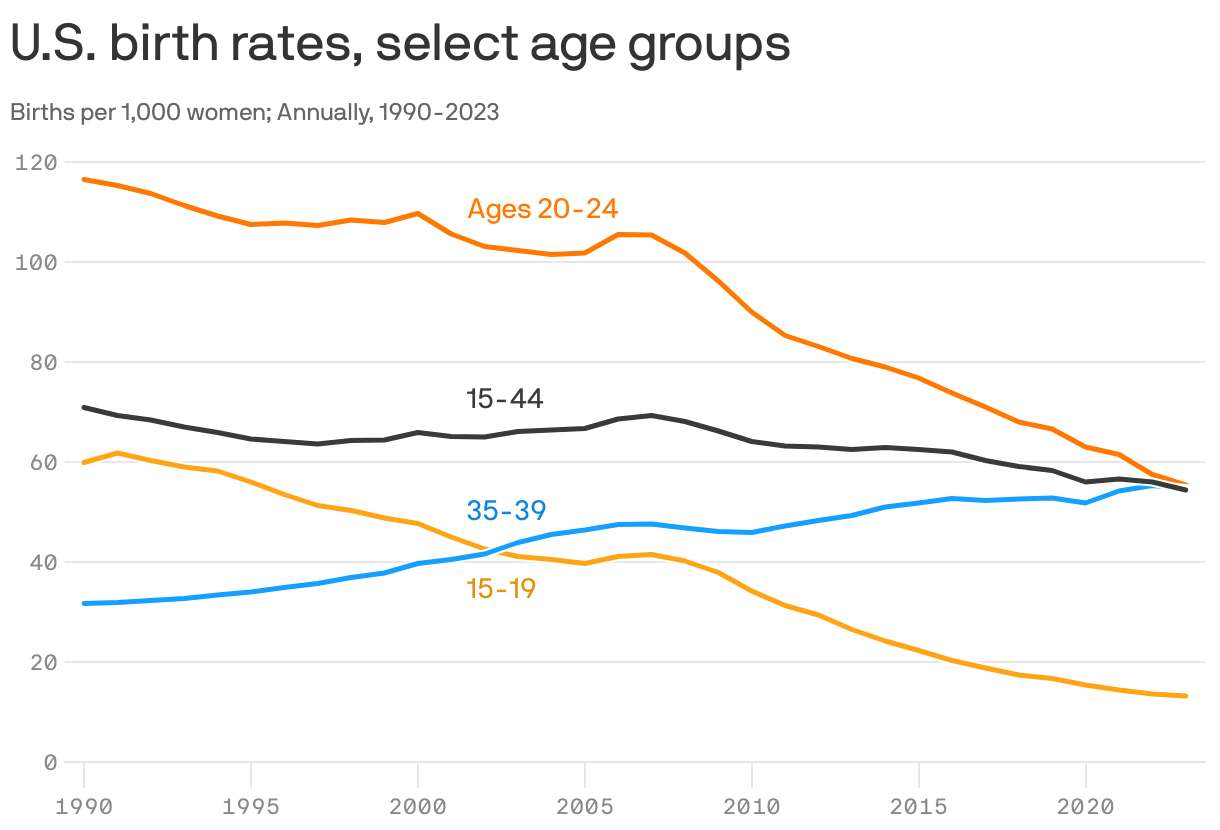
- Perhaps most meaningful, most of the decline in the fertility rate in wealthy countries is because younger, poorer women are delaying childbirth — and wind up having fewer children.
"More than half the drop in America's total fertility rate since 1990 is caused by a collapse in births among women under 19," the Economist noted last year. The advancements in women's equality, "rank among the greatest public-policy triumphs of the postwar era."