Fierce wildfires in California, Nevada force thousands to evacuate


Add Axios as your preferred source to
see more of our stories on Google.
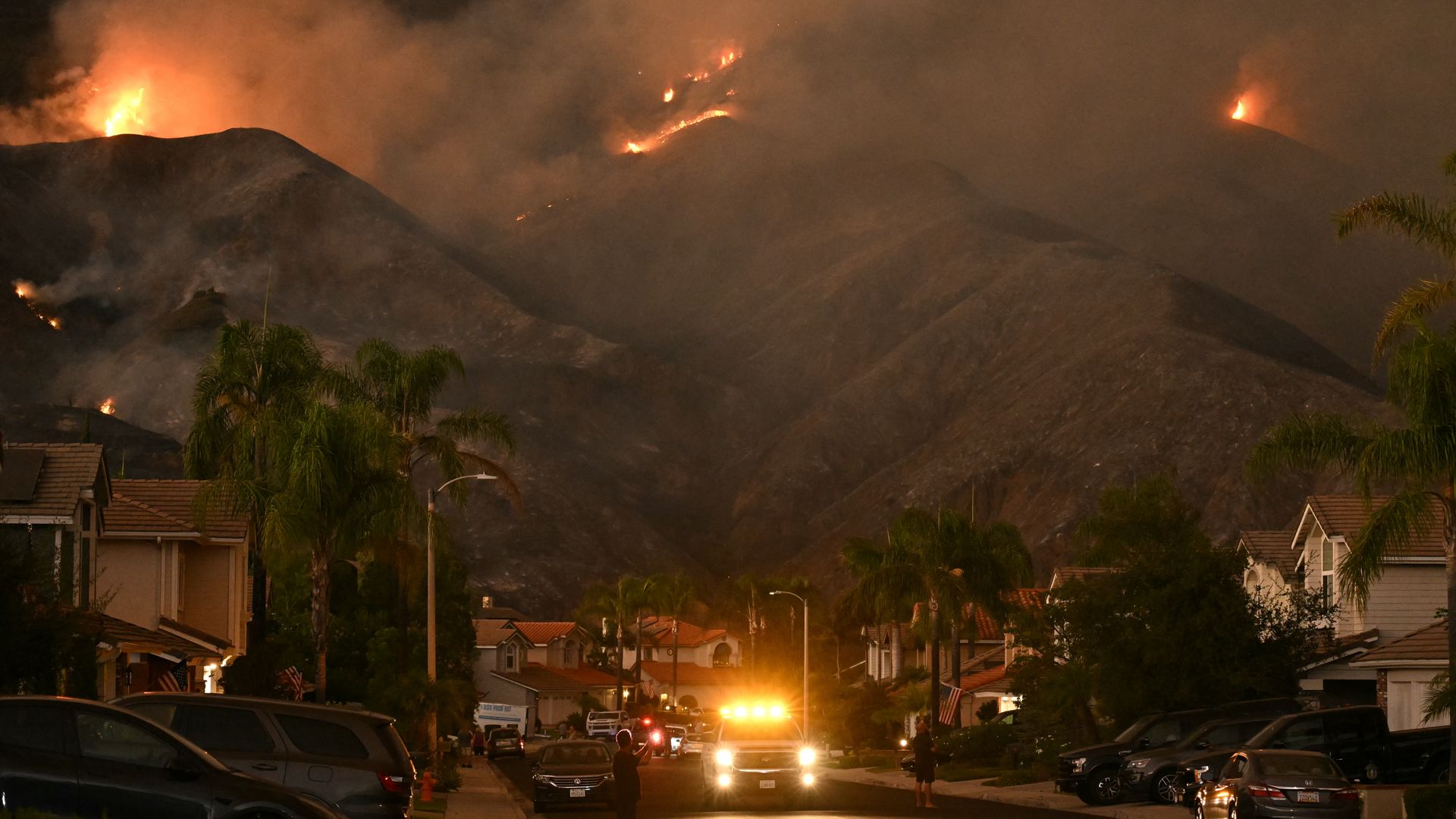
The Airport Fire burns in the hills above homes in Rancho Santa Margarita, Calif. on Sept. 9. Photo: Patrick T. Fallon/AFP via Getty Images.
Fast-moving wildfires in California and Nevada have left tens of thousands of people under mandatory evacuation orders, numerous structures threatened and air quality impacted, as a dangerous heat wave continues to grip Southern California in particular.
The big picture: California Gov. Gavin Newsom activated the National Guard Monday in response to the massive Line Fire in San Bernardino County — one of nine large blazes in California and 71 large fires burning across the western U.S. as of Tuesday, per the National Interagency Fire Center (NIFC).
- Newsom proclaimed an emergency in San Bernardino County on Saturday over the fire that's left over 11,000 people under evacuation orders
- Meanwhile, Nevada Gov. Joe Lombardo declared an emergency Sunday in response to the Davis Fire, south of Reno, where evacuation orders affected some 20,000 people.
Threat level: The Line Fire that's razed 26,426 acres acres since igniting Thursday has injured three firefighters and threatens more than 35,400 structures, per Cal Fire. It was 5% contained as of Tuesday morning.
- Many of the threatened structures include single- and multi-family homes, Cal Fire reports, as the fire erupted within part of what is known as the wildland urban interface, where development borders forests.
- Evacuation orders are in effect for much of San Bernardino County which, along with parts of Riverside County, was under an excessive heat warning through Tuesday evening, as the fire burns in the foothills of the San Bernardino Mountains.
- The extreme heat that has lasted in Southern California for nearly a week has helped dry out vegetation and is leading to wildfires that are able to send up tall plumes of smoke, manufacturing their own weather conditions that make them more difficult to contain.
In Orange County, the Airport Fire ignited in the Trabuco Canyon Monday afternoon and exploded in size to an estimated 5,400-plus acres by 9:30pm local time.
- It's triggered mandatory evacuations and forced the closure of three elementary schools Tuesday.
- The fire was seen burning on top of Santiago Peak on Tuesday at midday local time, with fire whirls visible on the fire-spotting camera located there.
In Los Angeles County, Angeles National Forest visitors were evacuated Sunday evening after a wildfire erupted north of Glendora. It's destroyed nearly 3,000 acres at 0% containment, per Inciweb, an interagency website that tracks wildfires.
Across the border, fire officials in Nevada said the wind-driven Davis Fire had grown to 5,000 acres as it burned out of control, destroying at least 12 structures. It has "left some homes, business and traffic signals without electricity," per a Washoe County online post.
- The National Weather Service forecast office in Reno issued a rare "Particularly Dangerous Situation" red flag warning for the greater Reno area, including the Davis Fire on Wednesday, noting: "Prepare now for rapid fire growth on the Davis Fire."
- This was the first such severe warning issued by meteorologists at that office since 2019, illustrating the uniquely perilous situation.
Zoom out: In addition to California and Nevada, UCLA climate scientist Daniel Swain said on X that extreme fire behavior was "occurring on numerous large wildfires in Idaho" on Monday, including the Lava Fire, and also in Oregon and Wyoming.
- Firefighters were tackling 24 large fires in Oregon, 20 in Idaho, 13 in Montana, five in Washington and three in Wyoming, according to the NIFC.
- Several of the fires in California, Oregon, Washington and Idaho were forming their own thunderstorms, with extreme and shifting winds at the surface, making it more difficult for firefighters to fight the flames.
State of play: Excessive heat warnings remain in effect across Southern California through Tuesday evening as the intense September heat wave continues.
- The National Weather Service San Diego office noted in an online post that several high temperature records were broken on Monday. These included Anaheim (104°F), Vista (98°F) and Escondido (104°F).
- Smoke from the wildfires has settled across highly populated areas in Southern California, mainly away from the immediate shoreline. This has led to school closures due to public health concerns amid the heat and poor air quality.
- Multiple red flag warnings were in place in Los Angeles and across the West.
Between the lines: Human-caused climate change is leading to more frequent, severe and longer-lasting heat waves while also driving an uptick in large wildfires in the West, among other trends.
- California had its hottest summer on record this year, according to a NOAA report released Tuesday.
What's next: Tuesday is likely to be the last day of triple-digit heat during this particular event for portions of Southern California, but hazardous wildfire conditions are likely to continue inland and in surrounding states.
Go deeper: Extreme wildfires doubled in frequency, magnitude since 2003
Editor's note: This article has been updated with new details throughout.
