Harris campaign dodges over EV mandate walkback


Add Axios as your preferred source to
see more of our stories on Google.
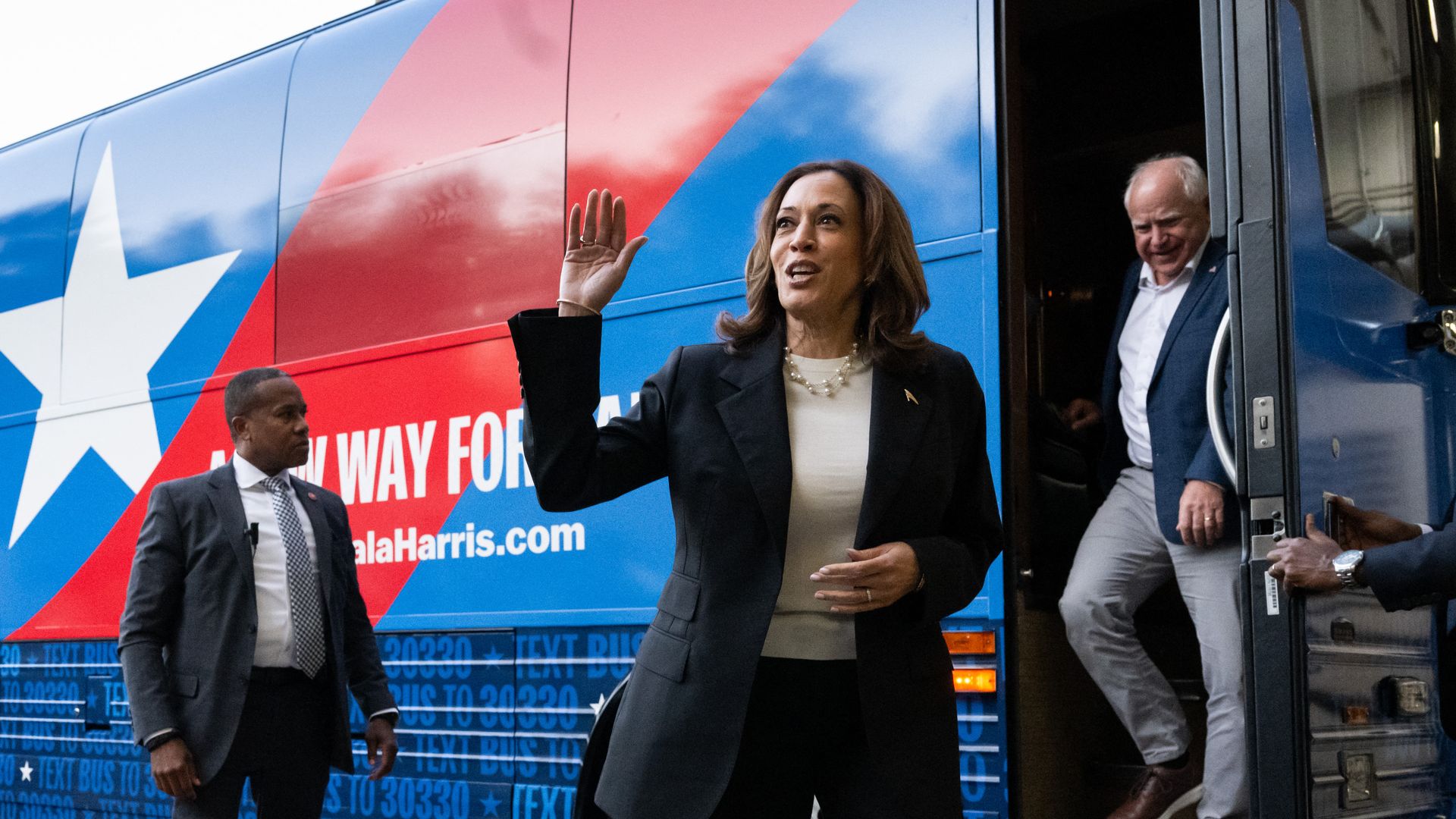
Vice President Harris and her running mate, Minnesota Gov. Tim Walz, right, campaign in Georgia over the holiday weekend. Photo: Saul Loeb/AFP via Getty Images
Vice President Kamala Harris' campaign won't say whether she supports requiring automakers to build only electric or hydrogen vehicles by 2035 — a position she took during her 2020 campaign for president.
Why it matters: Since taking over President Biden's campaign in July, Harris has been light on policy details.
- Harris' campaign has said she no longer supports many of her past progressive positions and has embraced more centrist stances on health care, immigration, gun control and fracking.
- Even so, Donald Trump's campaign has focused on footage from Harris' 2020 campaign to attack her as "dangerously liberal."
Driving the news: Harris' campaign has sent contradictory signals about her position on a mandate for automakers — a key issue in pivotal Midwestern states such as Pennsylvania, Michigan and Wisconsin, where many autoworkers are based.
- In a lengthy "fact-check" email last week that covered several issues, a campaign spokesperson included a line saying that Harris "does not support an electric vehicle mandate" — suggesting she changed her previous position, without elaborating.
- On Aug. 28 Axios asked the Harris campaign to clarify her position, and whether she would sign or veto a bill she co-sponsored in 2019 that included such a mandate for manufacturers.
- On Tuesday afternoon, Harris' campaign ultimately declined to comment.
Trump has falsely claimed that Biden has already instituted such a mandate, but the current administration has pushed the adoption of EVs through a combination of tough regulations and financial incentives.
- It remains unclear how a Harris administration would deal with climate-related rules for automobiles.
Flashback: As a senator from California, Harris co-sponsored the Zero-Emissions Act in 2019, which would require by 2040 that 100% of new passenger vehicle sales in the U.S. release no greenhouse gases.
- Only electric and hydrogen vehicles currently fit that criteria. The bill didn't pass.
During her 2020 campaign, Harris promised to go further and implement an "accelerated model" of the Zero-Emission Vehicles Act, according to her archived website.
- She proposed requiring "50% of all new passenger vehicles sold are zero-emission by 2030, and 100% are zero-emission by 2035."
- Harris also pledged that all new buses, heavy-duty vehicles and auto fleets would be "zero-emission" by 2030, according to her website.
- Her plan to transition the economy to combat climate change would cost $10 trillion over 10 years through public and private money, her 2020 campaign said then.
Zoom in: Harris told CNN last week that her "values have not changed" even if some specific policy ideas have.
- Harris said she no longer thought it was necessary to ban fracking because as vice president she has seen that "we can grow and we can increase a thriving clean energy economy without banning fracking."
Trump and business interest groups are hitting Harris for her past stances on EV and her plans to combat climate change.
- American Fuel & Petrochemical Manufacturers recently launched a $3 million swing state ad buy targeting Harris, arguing that "there may be someone new in the driver's seat, but the destination is the same: a ban on most new gas cars."
- The group cited Harris' 2019 positions.
