Inside Harris' delicate balancing act on the economy

Add Axios as your preferred source to
see more of our stories on Google.
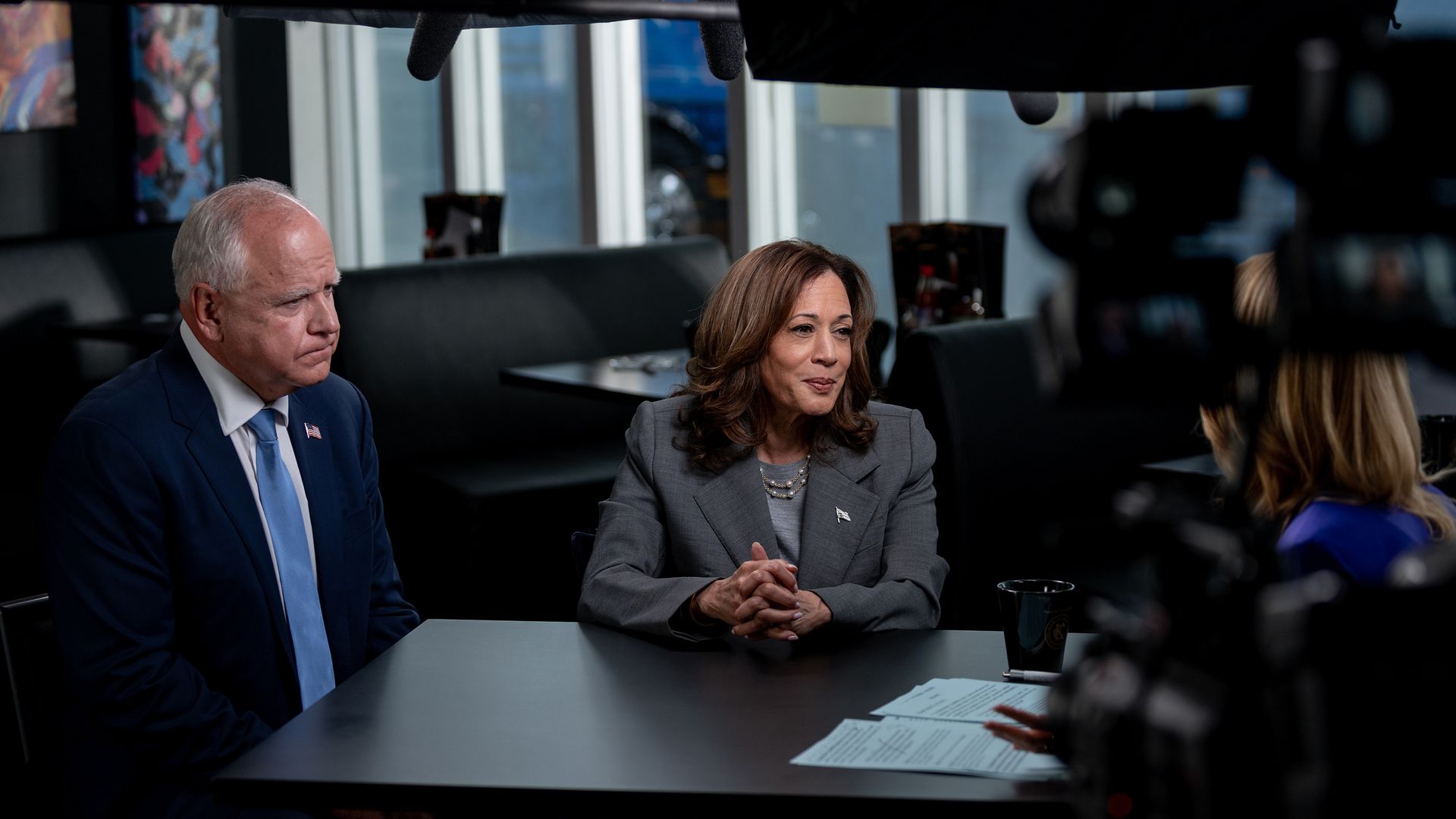
Kamala Harris and Minnesota Gov. Tim Walz, her vice presidential nominee, are interviewed by CNN's Dana Bash. Photo: Will Lanzoni/CNN
In her CNN interview Thursday, Vice President Kamala Harris gave her most forceful defense of President Biden's economic record since becoming the Democratic nominee for president.
Why it matters: But in a reflection of her campaign's "move forward" theme, Harris couldn't bring herself to repeat a word that CNN's Dana Bash used to describe the president's approach to lowering unemployment and tackling high prices: "Bidenomics."
- Instead, Harris carefully took credit for America's post-COVID economic recovery and lowering drug costs while acknowledging there's more work to do.
- "I'm very proud of the work that we have done that has brought inflation down to less than 3%," Harris said.
- "America recovered faster than any wealthy nation around the world, but ... prices, in particular for groceries, are still too high," she said. "The American people know it. I know it."
The intrigue: Harris' prime-time defense of Biden's economy contrasted with her TV ads, in which she looks beyond the current administration and focuses on the pain many voters are still feeling — and how she aims to help working- and middle-class Americans.
- That includes proposals to help first-time homeowners and target price-gouging.
- "When I am elected president, I will make it a top priority to bring down costs," she says in a new ad, using lines and footage from her recent speech in Raleigh, N.C. without mentioning the economic progress she boasted about on CNN.
In contrast, Biden's ads before he dropped out of the race amounted to victory laps on the economy, according to a review of Ad Impact's database.
- "Unemployment is at record lows. Our economy is leading the world," Biden thundered in an ad last fall.
- "I put money in pockets, creating millions of new jobs and capped the cost of insulin at $35 a month," Biden said in an April ad. "There's a lot more to do, but we can do it together."
Zoom out: For most of Biden's presidency, his top advisers have been convinced the economy has been much better than the public was willing to admit.
- The numbers bolstered that view. Inflation is down from its 2022 highs, the economy grew at 3% last quarter and the unemployment rate, while climbing in recent months, is at 4.3%.
Biden's administration has viewed its challenge as essentially a sales job: Persuade voters to trust their wallets and not the elusive "vibes."
- Harris did her part. "Bidenomics is working," she said in Pleasant Prairie, Wis., last August.
- But the public, still smarting over high inflation, remained skeptical. Former President Trump routinely received better marks on the economy.
Zoom in: Now, instead of asking for credit for what Biden's team has done, Harris is telling voters what she'd deliver as president.
- On Thursday, she teased a new tax credit for small businesses — "basically a tax credit ... for small businesses who are starting now," she said in Savannah, Ga.
- What she didn't mention: The rising numbers of small business applications have always been a point of pride for Biden — proof the economy was healthier than the public gave him credit for.
The main thrust of Harris' first economic speech was a new plan to lower grocery prices.
- But just two months earlier, Biden's Council of Economic Advisers released an analysis that touted the Biden administration's progress in lowering the cost of groceries.
- Harris has trotted out new proposals on housing, including a $25,000 tax credit for first-time homeowners — an increase over Biden's $10,000 proposals.
- She also proposed giving families of newborns a $6,000 bonus, on top of the $3,600 child tax credit that Biden championed.
The bottom line: Harris is making a delicate argument. She's pushing new plans to turbocharge an economy that her boss insists is already humming.
