Gaza talks focus on "nitty gritty" in hope of getting hostage-ceasefire deal

Add Axios as your preferred source to
see more of our stories on Google.
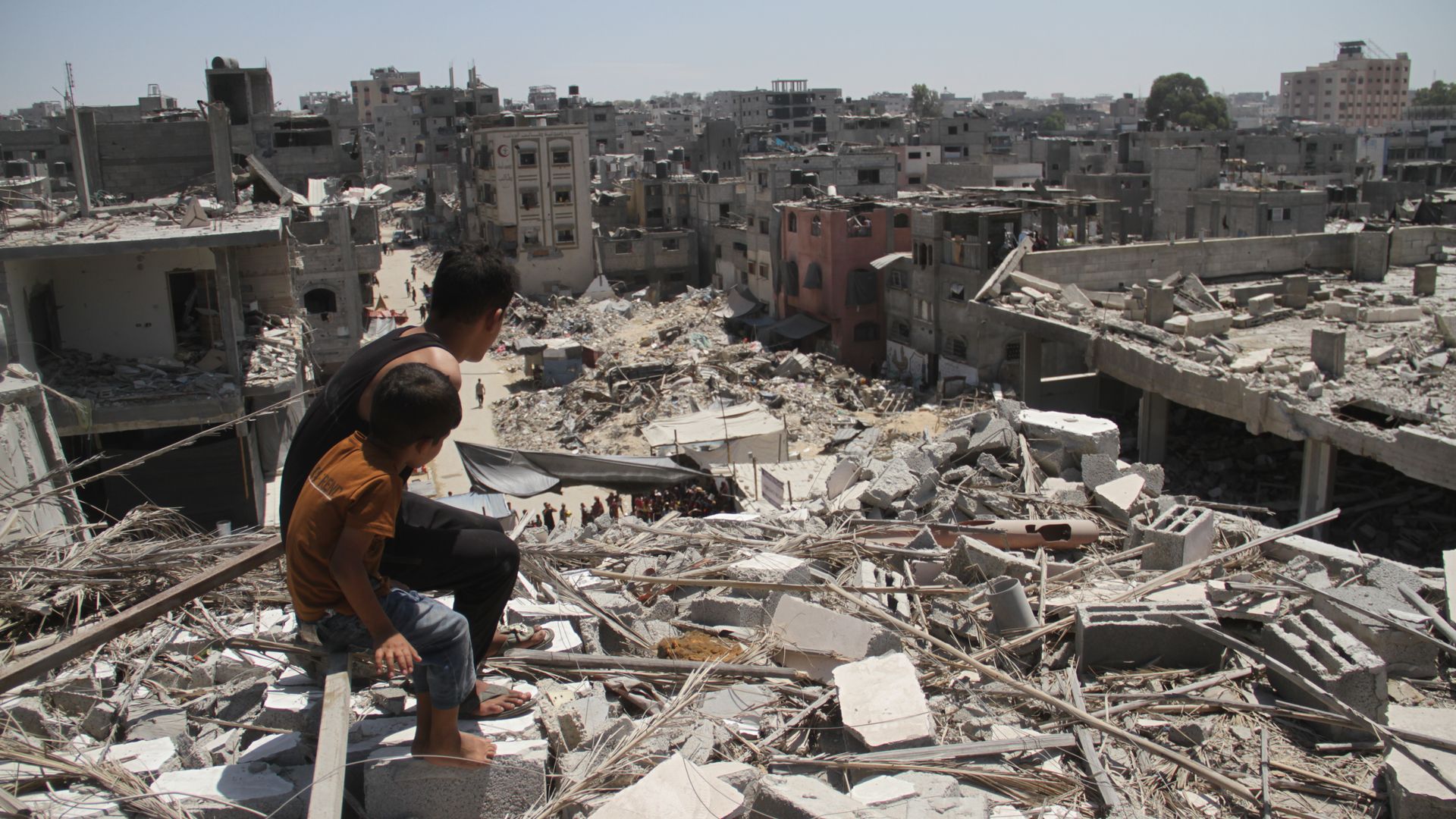
Two Palestinian children look at displaced Palestinians who escaped an Israeli army attack and took shelter in the Jabalia Refugee Camp in northern Gaza on Aug. 26, 2024. Photo: Mahmoud Issa/Anadolu via Getty Images
Talks continued this week in Cairo and Doha in an effort to get Israel and Hamas to agree on the details for implementing a hostage-release and ceasefire in Gaza deal, U.S. and Israeli officials said.
Why it matters: The White House is hoping that having these details in place and presented as part of a comprehensive package will persuade Hamas leader Yahya Sinwar and Israeli Prime Minister Benjamin Netanyahu to compromise on some of the big issues so the deal can go through.
- Israeli officials say the U.S., together with Qatari and Egyptian mediators, wants to try to get an agreement on as many practical details as possible, fill in the blanks with their own ideas on the broader deal and present it to Israel and Hamas again as one package.
- U.S. and Israeli officials say they hope that when the package is ready, Hamas will see it is getting most of what it wanted: At least six weeks of ceasefire, hundreds of prisoners released, the return of displaced Palestinians to their homes, an influx of humanitarian aid to Gaza, initial reconstruction, and medical treatment for hundreds of wounded Hamas militants in Egypt.
- Thorny issues, including Israeli Prime Minister Benjamin Netanyahu's demand to retain full control along the Egypt-Gaza border and to monitor movement of Palestinians from southern Gaza to the north, and Hamas leader Yahya Sinwar's demand that the deal will lead to the end of the war, would be postponed to the last stage of the talks.
- "The political hot potatoes will be left for the end and then the U.S. will likely put forward an updated and final bridging proposal to the parties and face them with a decision," an Israeli official said.
The big picture: While there hasn't been a breakthrough in the talks, U.S. officials said they are encouraged that the talks continue and that a regional escalation with Hezbollah or Iran has so far been prevented.
Driving the news: On Sunday and Monday, working-level officials from Israel, Hamas, Qatar, Egypt and the U.S. continued discussions in Cairo on the text of the agreement.
- "There continues to be progress, and our team on the ground continues to describe the talks as constructive," White House spokesperson John Kirby told reporters on Monday.
- The talks ended on Monday night with Israeli officials returning to Israel and Hamas officials going back to Doha to consult with leaders.
- On Wednesday, an Israeli delegation of working-level officials from the Mossad, Israel Defense Forces and the Shin Bet traveled to Doha to continue the indirect talks with Hamas through mediators from the U.S., Qatar and Egypt, Israeli officials said.
- The talks in Doha ended on Thursday night and the Israeli delegation returned to Israel.
Between the lines: President Biden's top Middle East adviser Brett McGurk participated in the talks in Cairo and in Doha, U.S. officials said.
- A U.S. official said McGurk wouldn't have stayed in the region if he didn't think there was progress being made.
- "We have advanced the discussion to the point where it is in the nitty gritty and that's a positive sign of progress but nothing is done until it's done," White House national security adviser Jake Sullivan said in a press conference in China on Thursday.
Behind the scenes: Israeli and U.S. officials said the main issue negotiators focused on this week was the process of exchanging hostages held by Hamas for Palestinians who are in Israeli prisons.
- The details include "what that exchange looks like, how many, exactly who will be released on either side and at what pace," White House spokesman John Kirby said.
Zoom in: According to the draft deal, Hamas would release 33 living hostages, who are either women, men over the age of 50 or in serious medical condition. If there aren't 33 living hostages, Hamas would meet that number by returning the bodies of dead hostages.
- As part of the negotiations, mediators recently gave Hamas a list from Israel of more than three dozen hostages it sees as falling under this category, Israeli officials said.
Israel is expected to release several hundred Palestinian prisoners as part of the draft deal, among them 150 who are serving life sentences in jail for murdering Israelis. Israel wants to be able to veto the release of 65 prisoners and demands all the prisoners who served life sentences won't return to the West Bank or Gaza.
- In recent days, Hamas through mediators gave Israel a list of some of the prisoners it wants released, Israeli officials said.
- The Israeli officials said negotiators in Cairo and Doha this week began discussing each of them.
- Israeli officials said that while there has been no agreement yet on who will be released from each side, there has been significant progress on the issue.
What they're saying: Sen. Joni Ernst (R-Iowa), who is leading a congressional delegation to the Middle East, met with Netanyahu earlier this week in Israel.
- Ernst told Axios she found him to be more upbeat about the possibility of getting a deal.
- The Israeli prime minister expressed confidence that the current military pressure on Hamas will force a deal and allow at least its first phase to be implemented, she said. That phase includes 42 days of ceasefire in return for the release of hostages.
- Ernst said Netanyahu sees Israeli control of the Philadelphi corridor along the Egypt-Gaza border as key to pressing Hamas to agree to a deal and she doesn't think Israel will agree to fully withdraw its forces from there in the near term.
- "I am cautiously optimistic. I heard from the Israelis that there is growing pressure on Hamas, including from the people of Gaza who want the war to end," she said.
Editor's note: This story has been updated to reflect that the talks in Doha ended on Thursday night.
