The sense of global gloom is abating

Add Axios as your preferred source to
see more of our stories on Google.
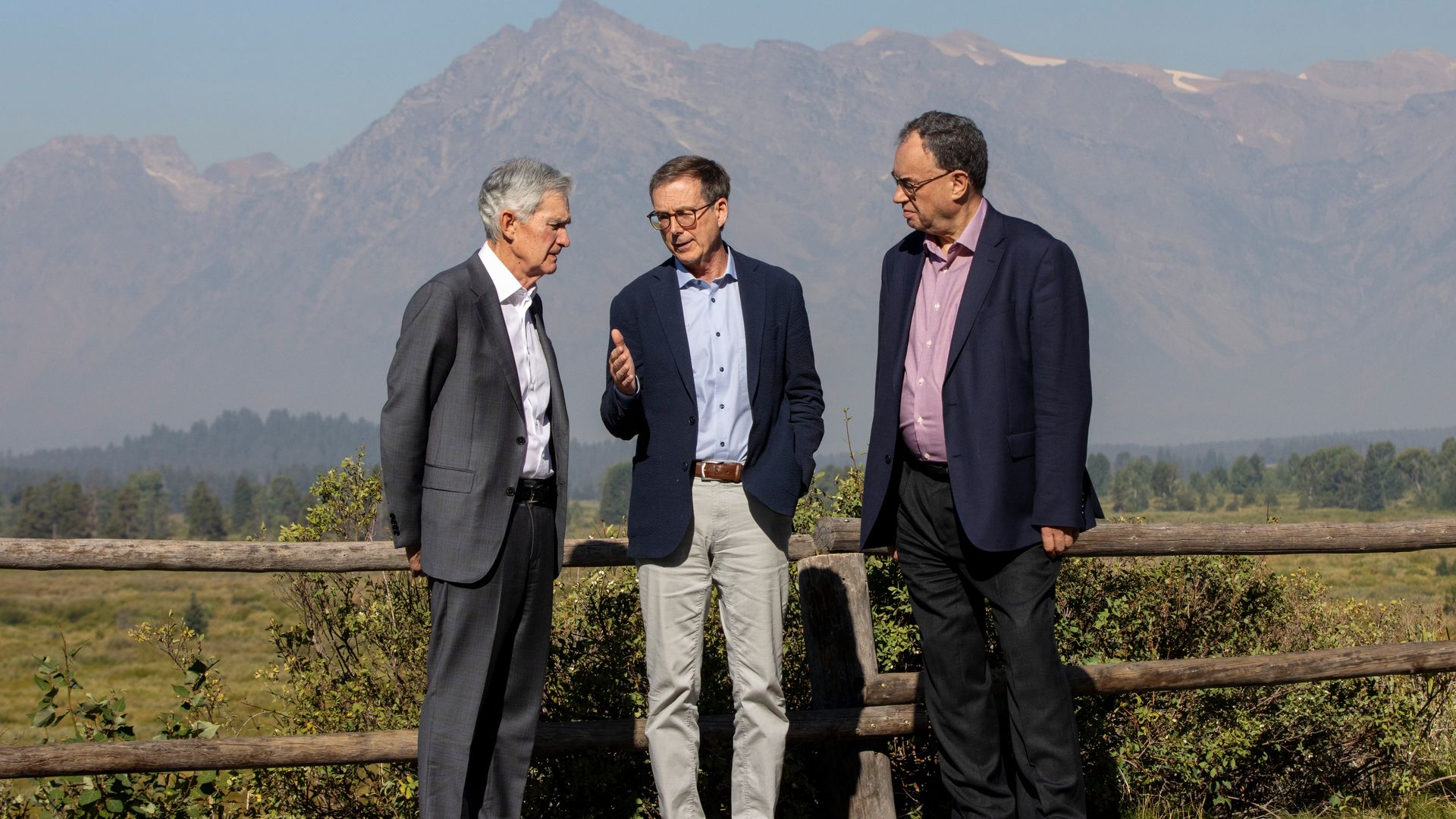
Fed chair Jerome Powell, Bank of Canada governor Tiff Macklem and Bank of England governor Andrew Bailey in Jackson Hole on Friday. Photo: Natalie Behring/Bloomberg via Getty Images.
The world is no longer on fire. That's the central takeaway from the annual assemblage of the grandees of global economics in Jackson Hole, Wyoming, that concluded Saturday.
The big picture: Global central bankers largely feel that a long period in which the world economy has been whipsawed has come to an end, and that the outlook is for a return to steady growth and low inflation.
- It's not that the world's economic problems are defeated, of course, but the feeling of careening from one crisis to the next, which has hung over the symposium the last few years, is gone.
Flashback: In 2020 (when the symposium was remote), the pandemic threatened global depression. In 2021 (still remote), inflation was taking off and the pandemic scars were still deep.
- In 2022, with officials finally gathering again in person in the Grand Tetons, inflation had risen to crisis levels around the world, and the Russian invasion of Ukraine created a sense that that extreme volatility was a new normal.
- In 2023, central banks had pushed interest rates to multidecade highs and had limited confidence that the war on inflation could be won without major economic pain.
State of play: Now, the Fed is set to join its counterparts around the world in cutting interest rates next month. Inflation is within sight of the 2% central banks aim for in much of the world.
- The economists gathered in Wyoming put low odds on a recession anytime soon.
What they're saying: "There have been times I've been here when our economy and other economies around the world are doing poorly and it's downbeat," Alan Blinder, a former Fed vice chair who has attended the Jackson Hole gathering for four decades, told Axios.
- "But right now, by and large, the world's economies are doing pretty well and the U.S. economy is doing very well," he said.
Reality check: There have been a few worrying data points in the last couple of months about how the U.S. job market is holding up (more on that below).
The bottom line: "If you look at the basic underpinnings of the U.S. economy, they look pretty solid," Harvard's Karen Dynan told Axios on the sidelines of the conference, hosted each year by the Kansas City Fed.
- Still, there are always risks outside the control of economic policymakers, like wars, pandemics, or disruptive economic policies by elected officials. Those seem like the kinds of risks that appear more likely to cause the next recession than a failure of central banks to manage aggregate demand and financial imbalances.
- "I think the people gathered here are optimistic," said Dynan. "But I don't think they're taking anything for granted."
As a tribe, central bankers are prone to worry, knowing there are always risks ahead. One such risk is that they are now behind the curve in adjusting policy to align with economic reality.
Between the lines: Numerous signs over the last few months have pointed to meaningful softening in the U.S. labor market. But because the Fed's interest rate policies affect the economy with lags, the high rates of the last 13 months may continue to exert a downward tug on economic activity even after rate cuts arrive next month.
- "A central question facing us is whether the economy is settling down into a full employment steady state or is going to keep cooling into something worse," Austan Goolsbee, president of the Federal Reserve Bank of Chicago, said in an interview.
- "That also raises in my mind the question of how long are the lags in monetary policy, and the longer you think the lag is, the more concerned we should be about whether the Fed could make a rapid pivot."
There are, however, risks in the other direction as well. While inflation has come down dramatically from its 2022 highs, some officials have been concerned about inflationary embers that could reignite price pressures.
- "The return to target is not yet secure," European Central Bank chief economist Philip Lane said in a panel Saturday, adding that "the monetary stance will have to remain in restrictive territory for as long as is needed to shepherd the disinflation process towards a timely return to the target."
The bottom line: The feeling of crisis that hung over the world's central bankers for four straight years starting in 2020 has ebbed — but few are inclined to declare lasting victory.
