Campaigns ride the meme wave as 2024 election cycle heats up

Add Axios as your preferred source to
see more of our stories on Google.
Illustration: Aïda Amer/Axios
Memes — viral snippets of a cultural moment — are defining the 2024 presidential election cycle.
Why it matters: In a fragmented media landscape, memes still find a way to transcend constituencies, shape narratives and forge connection.
State of play: Since launching her presidential bid last month, Vice President Kamala Harris has been the benefactor of "brat summer," "femininomenon," celebrity content and coconut memes.
- Donald Trump supporters, meanwhile, have circulated the fist-pump image following July's assassination attempt and embraced Hulk Hogan's viral "Trumpmania" moment from the RNC.
💭 Eleanor's thought bubble: I've been covering the rise of the "go direct" communications strategy for two years now, and it's a thing.
- By adopting this strategy, Harris and Trump are validating the power of hyper-targeted digital comms campaigns.
However, communicating through memes comes with some risk.
- They have a very short shelf life and can backfire if they are deemed too forced or inauthentic.
Zoom in: Memes have also been used to flip the script by taking ownership of an unflattering or cringey moment.
- "The concept of 'flipping the meme' has been around for a long time in American politics," says Doug Busk, principal at Arvo Advisory and former adviser to the Obama campaign. "It's when a candidate embraces a meme in a self deprecating way that inoculates them."
- "There's power in that. It makes clear that you don't, as a candidate, view it as a point of weakness. It is instead a point of strength," he adds.
What they're saying: Memes are meant to elicit connection and signal a range of emotions that galvanizes supporters, says Caleb Smith, president of Drive Public Affairs and a former digital director for three Republican House Speakers.
- "This style of communication is most effective when it's based in truth and reflects who the candidate is," says Smith. "Humor is certainly when Trump is at his best — 2016 Trump was funny. ... In 2020, we saw more vindictive and angry memes coming out of the campaign."
The intrigue: Republican operatives have long contended that the Left can't meme — take for example, the "Dark Brandon" memes that often fell flat.
- However, Democrats say that their desire to be more online has always been there — and now that the top name on the ticket has changed, so can the digital strategy.
- "They're finally letting us do fun things again," said one Democratic digital strategist.
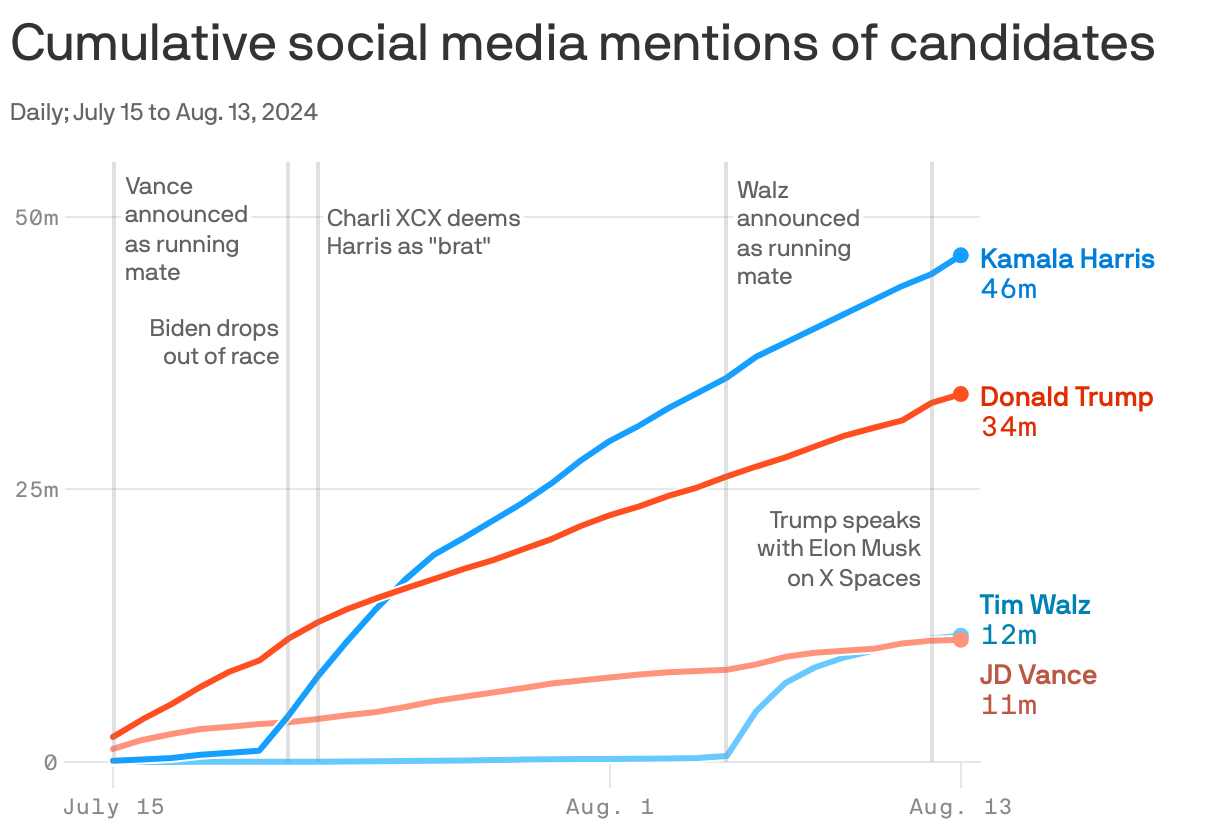
By the numbers: Harris has been mentioned roughly 46 million times across social media platforms in the past 30 days, according to social listening platform Hootsuite.
- That's a 62,800% increase in over a month's span.
- Trump saw about 34 million mentions in the past 30 days, with the biggest bumps taking place around the announcement of JD Vance as his running mate and his X interview with Elon Musk.
- Tim Walz and Vance have seen less online chatter, with 12 million and 11 million mentions, respectively.
Zoom in: Harris and Walz have slightly less negative sentiment across social media than Trump and Vance, according to Hootsuite data.
- Plus, "Laffin' Kamala" memes being pushed by the right have not seen as much engagement as the "Brat" and "coconut tree" memes, which have developed more organically.
Yes, but: This is a digital strategy that extends beyond simply getting clicks or mentions, says Maxwell Nunes, executive vice president and head of paid digital at SKDK.
- "All of these [political] memes are about driving a message, changing the conversation and getting ahead of the other side," he added.
Between the lines: The Harris-Walz campaign's mastery of memes have given them more time to skirt traditional media.
- Instead, they are meeting a key voting block where they are — online, says Ben O'Keefe, CEO of Chaotic Good Media and a former aide to U.S. Sen. Elizabeth Warren.
- "What I'm seeing is just a real opportunity to embrace an authentic language that resonates with this core demographic that Democrats desperately need to win, but we're not previously capturing," O'Keefe adds.
- Trump is also engaging with more voters online, most recently by returning to X and participating in an X Spaces interview with Elon Musk.
🥊 Reality check: This strategy assumes that online chatter and vibes alone can get people to the polls.
What to watch: Democrats will have to bridge the meme momentum from the web to the main stage of next week's DNC.
- Democrats have enlisted hundreds of influencers to create content throughout the convention and are using vertical video to stream the event across TikTok, Instagram and YouTube.
More on Axios: DNC to stream vertically on TikTok, Instagram and YouTube
