How Getty beams those incredible Olympic images around the world within seconds

Add Axios as your preferred source to
see more of our stories on Google.
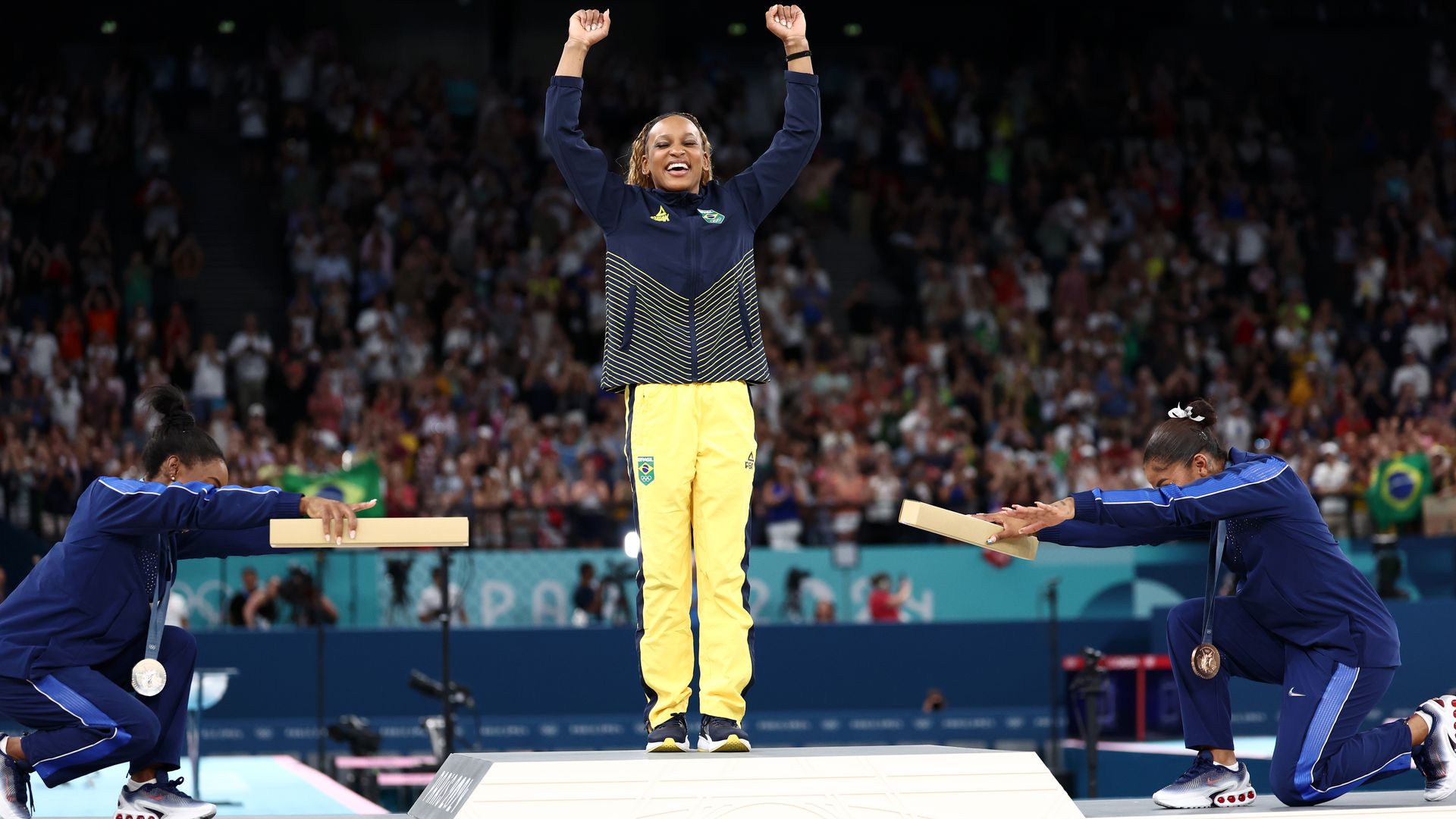
American gymnasts Jordan Chiles and Simone Biles bow in appreciation to gold medalist Rebeca Andrade of Brazil during the medal ceremony for floor exercise. Photo: Naomi Baker/Getty Images
When Naomi Baker captured the iconic image of Simone Biles and Jordan Chiles bowing down to Brazilian gold medalist Rebeca Andrade during the floor exercise medal ceremony, it was sent electronically to an editor in London and broadcast to the world via an array of state-of-the-art technology.
Why it matters: Photography giant Getty is relying on an array of technology, including private 5G networks, to ensure its images from the Paris Games reach media customers almost as soon as they happen.
Zoom in: Getty's goal is that for key moments photos hit their wire in as little as 26 seconds from when they were taken — a feat that requires a tremendous combination of technology and human efficiency. Already during the games it has uploaded more than 350,000 pictures for media outlets to choose from.
- Editors at several clusters around the world are sent the photos. Almost none of the editing is being done in Paris, the first time Getty has gone fully remote with its Olympics editing. Getty has flown editors to three locations — London, Australia and the U.S. so they can work physically proximate, while also ensuring all the time zones are covered.
- For Paris, the company has established an array of private 5G networks, allowing it to augment the wired ethernet connections it has used for years. The wireless network at Bercy Arena, for example, allowed Baker to move from apparatus to apparatus at gymnastics as multiple events took place simultaneously.
- Paris also marks the first Olympics where Getty has used Starlink satellite modems as a backup network option.
- Getty has also upgraded its underwater robots from the ones used in Tokyo and has set up an array of remotely controlled cameras high above the track and pools in Paris to augment what its photographers can do from the ground.
What they're saying: "The robots allow us to really get that eye-in-the-sky view," said Michael Heiman, VP of global sport for Getty.
Between the lines: Paris' ambitious outdoor opening ceremony posed a particular challenge, further complicated by a steady downpour, but Heiman said the photos got up far faster than expected, even with the weather and cellular difficulties.
- "Outside of losing a few cameras to water, it was pretty fantastic," he said.
What's next: AI isn't yet playing a role for Getty at the Games, though Heiman can imagine it helping with the massive task of tagging and sorting through images. The agency has used AI to identify faces from a more narrow range of athletes, say for a professional soccer match or NBA game where all of the athletes are already well known.
- Getty would also love to fully ditch the ethernet cables in favor of wireless transmission, but it's been hoping to do that since before 4G arrived.
- "We'll see if we get there," Heiman said.
