Bibi seeks validation in his visit to a turbulent D.C.

Add Axios as your preferred source to
see more of our stories on Google.
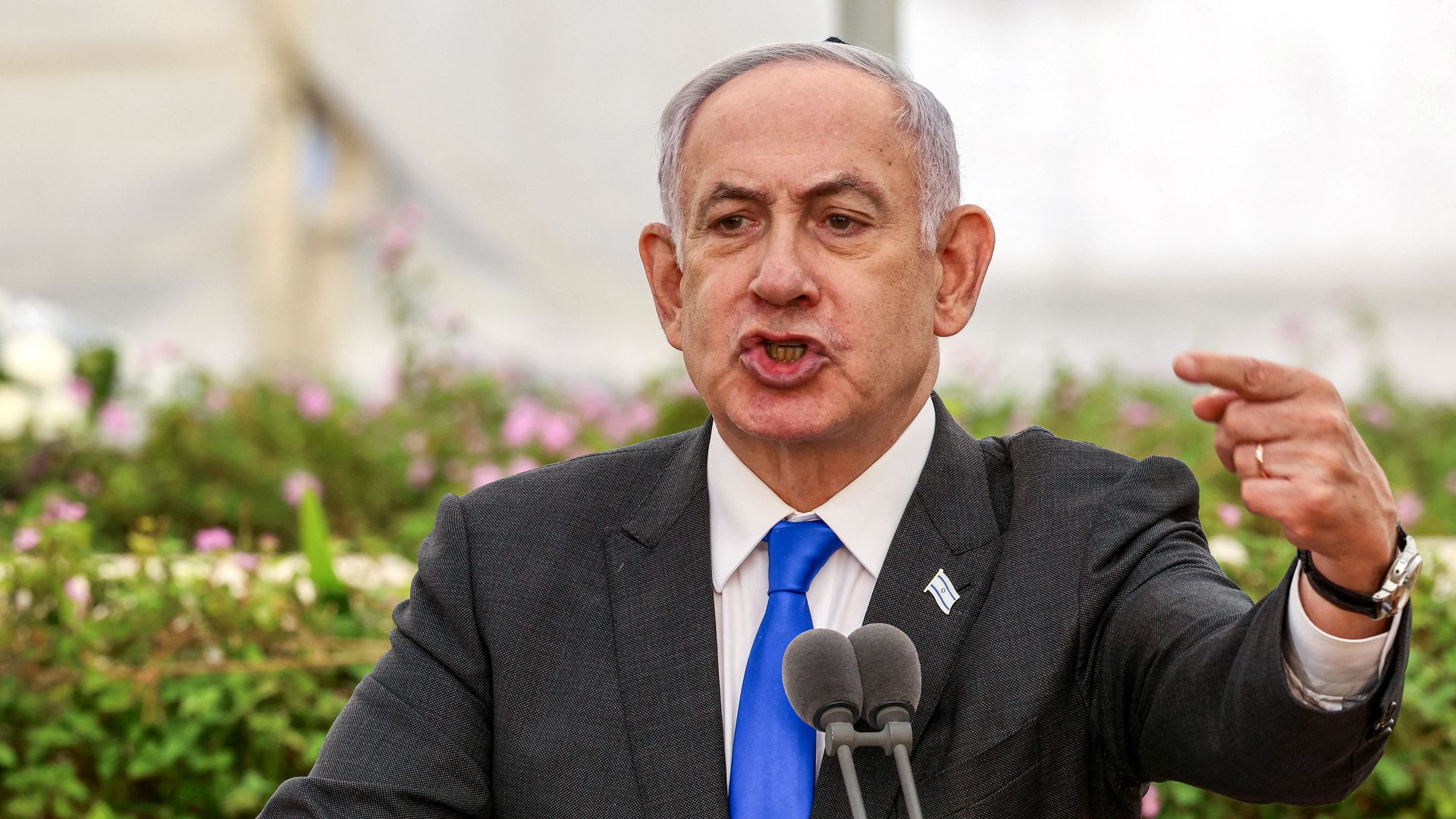
Benjamin Netanyahu. Photo: Shaul Golan/Pool/AFP via Getty Images
Israeli Prime Minister Benjamin "Bibi" Netanyahu arrives in Washington on Monday, right into an unprecedented storm in American politics.
Why it matters: It will be Netanyahu's first visit to Washington in almost four years, and his first trip abroad since Hamas' Oct. 7 attack on Israel that led to the war in Gaza.
- More than 38,000 Palestinians and more than 1,500 Israelis have been killed in the war that has made Netanyahu a particularly controversial figure in the U.S. and created divisions within the Democratic Party.
Netanyahu hopes his visit will reassert his leadership both in the U.S. and back home in Israel. But his arrival comes as most of his counterparts on both sides of the Atlantic are interested in one thing: Who will be the Democratic nominee for president in the Nov. 5 election.
- Netanyahu wants to use his visit to the White House on Tuesday — and his speech to Congress on Wednesday — to rehabilitate both his tarnished image as "the protector of Israel," and as the Israeli politician with the most power and influence in the U.S.
State of play: Netanyahu's last visit to Washington was in September 2020, when he came to the White House as a strong and relatively popular leader of a center-right unity government to sign a peace agreement with the United Arab Emirates.
- That deal was brokered by then-President Trump.
- Now Netanyahu will visit as a weakened and highly unpopular leader of the most conservative government in Israel's history.
- It's a government that has seen the worst massacre of Jews since the Holocaust take place on its watch.
In Israel, a recent Channel 12 poll indicated that 72% of Israelis want him to resign, either now or after the war. Just 30% said they think he's the person most fit to be prime minister.
- Yet, with a 64-member majority of the Knesset, Netanyahu still survives in office. With the Knesset going to recess in less then a week, he's be under no threat of early elections before November.
Driving the news: Just a few months ago, Senate Majority Leader Chuck Schumer (D-N.Y.) said publicly that Israelis should have early elections to replace Netanyahu. Biden didn't want to invite him to the White House.
- Now the tables have turned.
- Netanyahu's Democratic adversaries and critics have been in disarray, and Biden is at the weakest point of his presidency. Republicans and their supporters are mostly united behind Donald Trump.
Zoom in: Netanyahu was supposed to meet Biden in the Oval Office on Monday, but that meeting has been pushed to Tuesday because Biden is recovering from COVID.
- Netanyahu also will also meet with Vice President Kamala Harris, whom Biden endorsed Sunday to be the Democratic nominee for president.
- Now out of the race, Biden likely will focus on his legacy in the next six months — and likely seek to end the war in Gaza while he's in office.
- National Security Adviser Jake Sullivan said Friday that Biden is focused on closing the remaining gaps in the negotiations over hostages still held in Gaza hostage and a ceasefire in the war.
Netanyahu has toughened his position regarding a hostage and ceasefire deal, and it's unclear whether he really wants a deal or is just playing for time to keep his government from collapsing.
- An Israeli delegation will resume talks on Thursday, after Netanyahu ends his trip to Washington.
- A senior Israeli official said Netanyahu wants to use his meeting with Biden to win U.S. support for his new demands, which include monitoring movements of Palestinians from southern Gaza to the north and maintaining control over the Gaza-Egypt border.
The other side: Netanyahu also hopes to meet with Trump. The Israeli prime minister has been courting Trump, who's held a grudge against Netanyahu for years.
- "F**k him," Trump told Axios about Netanyahu in April 2021, during a rant over Netanyahu congratulating Biden for winning the presidency in 2020.
The intrigue: Netanyahu's speech to Congress will be a highly sensitive political event. Many Democrats are still annoyed by his previous speech to Congress in 2015, which he orchestrated with Republicans behind the back of the Obama White House.
- Netanyahu used the 2015 speech to attack the nuclear deal with Iran that was Obama's hallmark foreign policy initiative. The result was a rift with the White House and Democrats that has never fully healed.
- Israeli minister Ron Dermer (the architect of the 2015 speech) and national security adviser Tzachi Hanegbi visited the White House last Monday and gave Biden's top advisers a preview of the speech.
- An Israeli official told Axios the speech won't be defiantly against Biden, and will have a bipartisan message on the need for the U.S. to support Israel during war.
- Sullivan said Friday that Dermer and Hanegbi told him the speech will include arguments that do not contradict the Biden administration's policies.
- "Our expectation is that his speech will be one that doesn't look like 2015," Sullivan said.
What to watch: Dozens of Democratic lawmakers have said they'll boycott Netanyahu's speech, mainly because of Israel's actions in the Gaza war. Some Democrats think that as many as 100 House and Senate Dems won't show up.
- Netanyahu also is expected to face significant protests in Washington — from U.S. activists who oppose the war, and Israeli pro-democracy activists who oppose his conservative regime.
