Unlikely bedfellows line up behind Custodia Bank

Add Axios as your preferred source to
see more of our stories on Google.
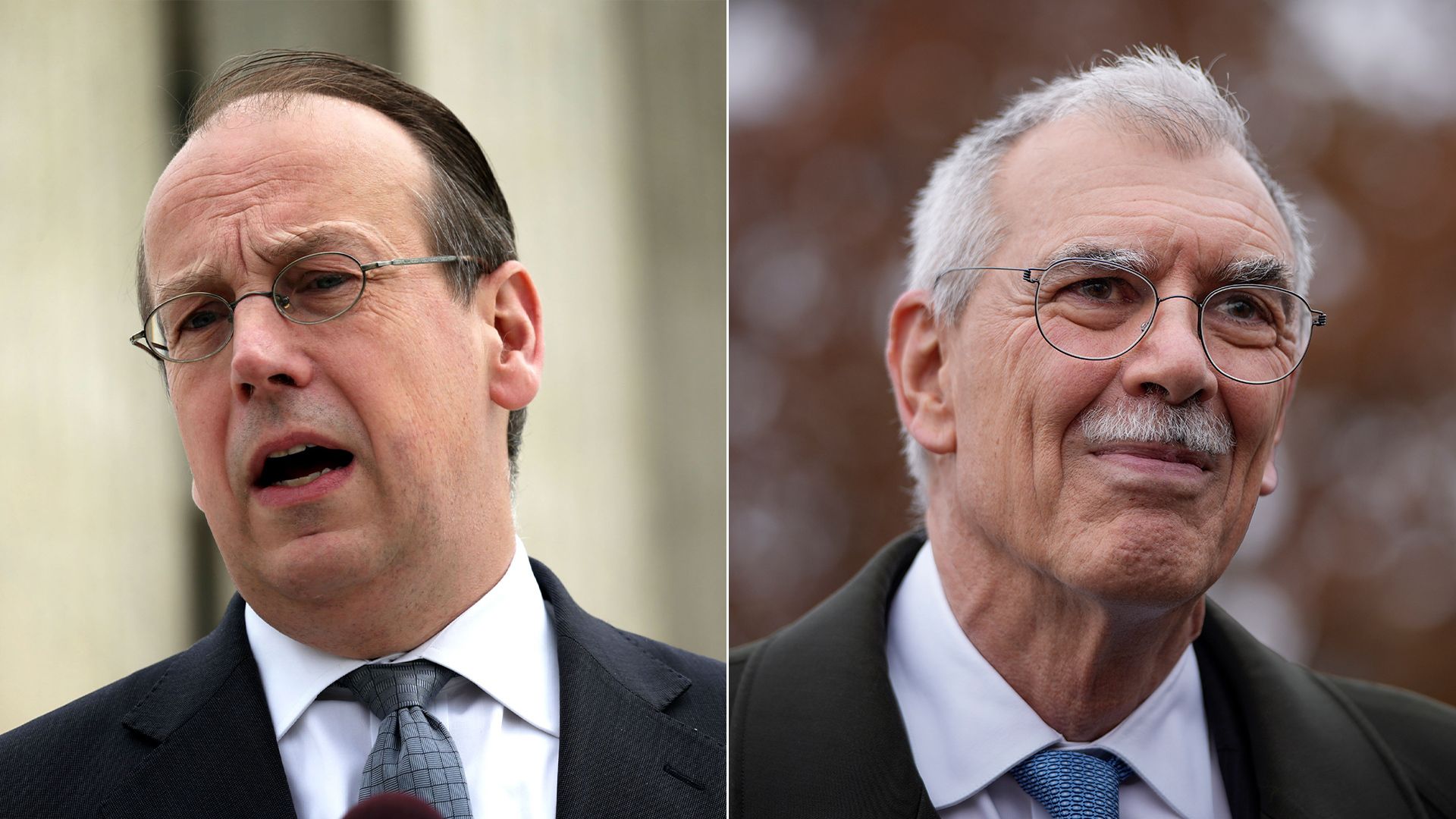
Former solicitor generals Paul Clement, left, and Don Verrilli. Photos: Alex Wong, Drew Angerer/Getty Images
An unexpected duo is aligned behind Custodia Bank's appeal to be allowed into the Federal Reserve Board's fold and get access to its payment and settlement systems.
Why it matters: Custodia is a state-chartered bank that wants to do business in crypto but has been hamstrung after a regional Fed bank denied it access to a master account in 2023.
- Its second go in court revives big issues, the crux of which questions whether the Federal Reserve Board has the authority to decide which banks get access to its services, and which don't.
- Don Verrilli, former solicitor general for the Obama administration, and Paul Clement, former solicitor general for the George W. Bush administration, are supporting the appeal.
Our thought bubble: Recent Supreme Court rulings to narrow agency discretion could help Custodia's case — one overturned the Chevron doctrine and another extends the time frame to challenge regulations.
Catch up quick: The bank sued the Federal Reserve Bank of Kansas City in 2022 for taking too long to process its account. After Custodia was rejected, it amended its complaint in February 2023.
- That complaint alleged a politically motivated Federal Reserve Board was "pulling the strings" — a power Congress didn't authorize.
Between the lines: Custodia contends it was wrongfully denied a master account. (And advocates filed arguments last week in support.)
Behind the scenes: Verrilli, writing on behalf of the Blockchain Association, said Custodia's application is an example of coordinated efforts to debank the digital asset industry starting in 2021, in a nod to what crypto has dubbed Operation Choke Point 2.0.
Clement pushed further, arguing that the district court's interpretation "undermines fundamental principles of federalism" and that the method for choosing regional Federal Reserve Bank presidents is "unconstitutional."
- The U.S.'s dual banking system ensures that states can "exercise their sovereign authority" and that their authority to innovate is a "constitutionally protected role," he wrote.
- "The district court's decision threatens that dual system by granting Federal Reserve Bank officials unreviewable discretion to 'effectively crippl[e]' state-chartered banks operating legally."
- Clement represents industry groups the Digital Chamber and the Global Blockchain Business Council.
The big picture: Without a master account, Custodia can't clear checks, transfer securities or cash savings bonds; instead it has to pay a bank that was granted access to perform those banking services on its behalf.
- Custodia alleges that those go-between banking relationships are suffering regulatory pressure too.
What they're saying: "The point is the debanking problem," Custodia chief Caitlin Long told Axios.
- Long said in congressional testimony in May that it recently lost a second banking relationship — because of what the bank called "regulatory chokeholds."
