Gaza hostage-ceasefire deal talks hinge on Hamas demand for written commitments

Add Axios as your preferred source to
see more of our stories on Google.
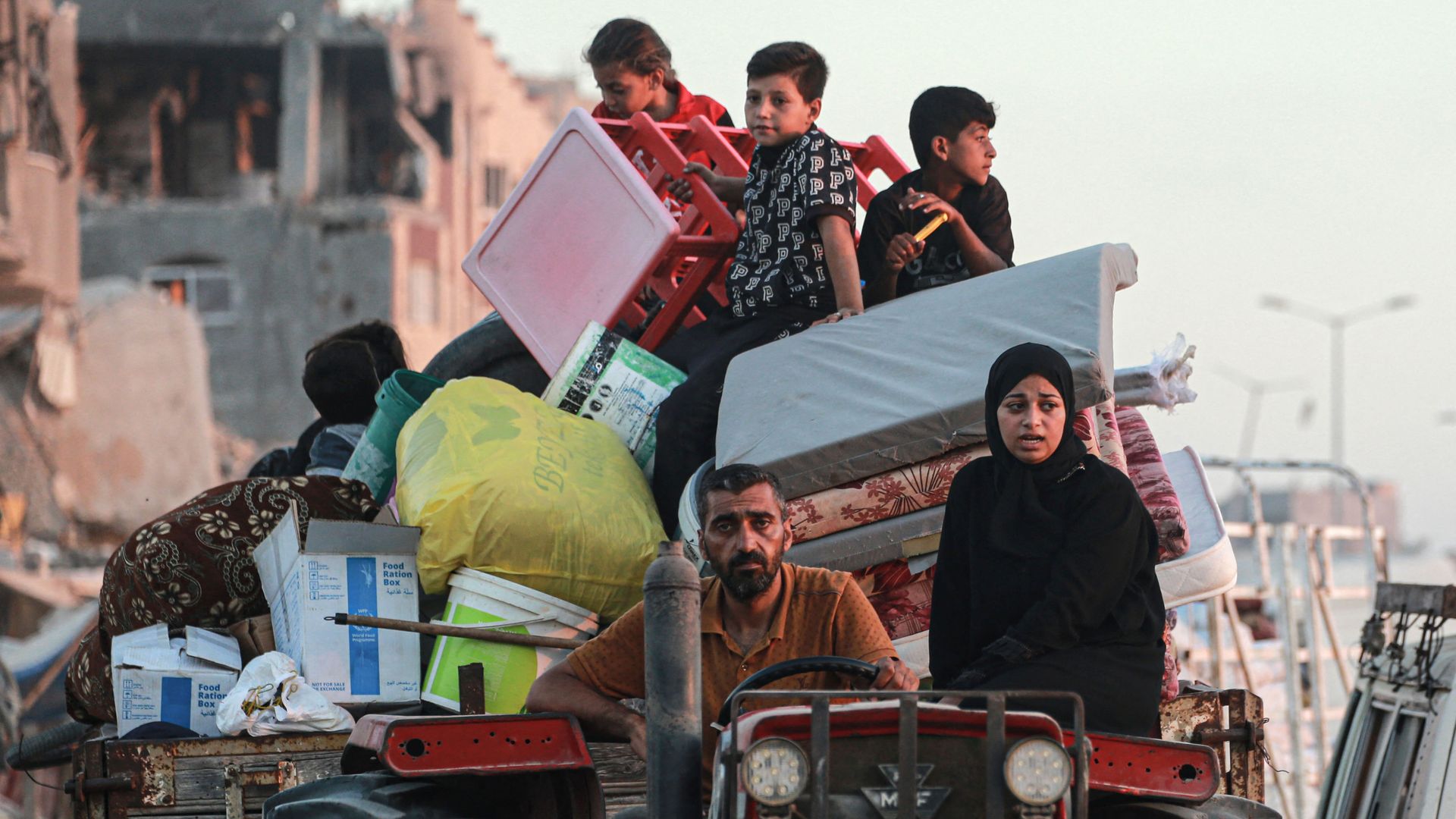
Displaced Palestinians leave an area in east Khan Yunis after the Israeli army issued a new evacuation order on July 1. Photo : Bashar Taleb/AFP via Getty Images
Hamas' demand for written commitments from the U.S., Egypt and Qatar is a key gap that remains before mediators can come to the table and start to hash out the details of a hostage and ceasefire deal in Gaza, two Israeli officials told Axios.
Why it matters: Israeli and U.S. officials are more optimistic than before that the latest back and forth with Hamas leaders can lead to a deal to release hostages being held in Gaza and establish "sustainable calm" in the enclave.
Friction point: In its latest response to the Israeli proposal for a hostage and ceasefire deal, Hamas demanded the U.S., Egypt and Qatar commit to continuing negotiations over the second phase of the deal with no time limit while the first phase of the deal is underway.
- The White House and the CIA are trying to come up with a compromise to bridge the gap between Israel and Hamas on the issue.
- A U.S. team was in Doha on Friday to participate in the talks, but CIA director Bill Burns is not expected to travel to the region at the moment, U.S. officials said.
The latest: Mossad director David Barnea traveled to Qatar on Friday and met with the prime minister of Qatar, two senior Israeli officials told Axios.
- The officials said Barnea was to convey a message to the deal's mediators that Israel does not accept Hamas' demand for a written commitment regarding negotiations for the second phase of the agreement.
- A statement from the Israeli Prime Minister's Office after the meeting said Israeli negotiators will travel to Doha next week to continue the talks.
- "There are still gaps between the parties," the Prime Minister's Office said.
Driving the news: Senior Israeli officials said the remaining gap between the parties is focused on Article 14 in the Israeli proposal.
- It concerns the duration of negotiations that Hamas and Israel are supposed to start during the first stage of the agreement in order to agree on the terms of the second phase of the agreement.
- According to the original language of Article 14, the U.S., Qatar and Egypt will "make every effort" to ensure this negotiation ends in an agreement and the ceasefire continues as long as the negotiations continue.
- In the response from Hamas delivered to Israel on Wednesday, the group demanded the words "make every effort" be deleted and replaced by the word "ensure."
- U.S. officials told Axios the Biden administration presented a compromise and offered to use the word "undertake," which the administration sees as less binding than the word "ensure" but more binding than "make every effort."
Between the lines: Israeli officials said that if the agreement were to include the written commitment Hamas demands, the group would be able to draw out negotiations about the second phase of the deal indefinitely.
- The 42-day ceasefire that is part of the first phase of the deal could be extended without Hamas releasing the soldiers and men under the age of 50 years being held by the group as outlined in the second phase of the proposed deal.
- Senior Israeli officials claim that in such a scenario, it would be very difficult for Israel to resume fighting without it being considered a violation of the agreement.
- If Israel is perceived to have violated the agreement, the United Nations Security Council could decide to impose a ceasefire without the release of all the hostages, the officials said.
The other side: Hamas official Osama Hamdan told AFP on Friday that the group is waiting to hear the Israeli position about its response "today or tomorrow."
- Hamas' response to the Israeli proposal included "some ideas ... to overcome" the gaps, Hamdan said.
- He said if Israel's response is positive, "it will not take long" to reach a "detailed agreement."
Behind the scenes: The remaining gap regarding Article 14 was at the center of a meeting convened by Israeli Prime Minister Benjamin Netanyahu on Thursday night ahead of the Mossad director's trip to Doha, senior Israeli officials said.
- A senior Israeli official said that at the meeting it was decided Barnea would mainly discuss this issue and would convey a message to Qatari Prime Minister Mohammed bin Abdel-Rahman Al-Thani that Israel does not accept the changes that Hamas seeks to make in Article 14.
- However, Barnea was also to make clear to the Qatari prime minister that Israel believes this is an issue that can and should be resolved in order to proceed to detailed negotiations on the implementation of the agreement.
What they're saying: White House press secretary Karine Jean-Pierre told reporters on Friday that President Biden is hopeful a deal can be reached but stressed there is still a lot of work to do.
- "It is time for the war to end," she added.
