Biden tells Netanyahu: It's "time to close" Gaza hostage-ceasefire deal

Add Axios as your preferred source to
see more of our stories on Google.
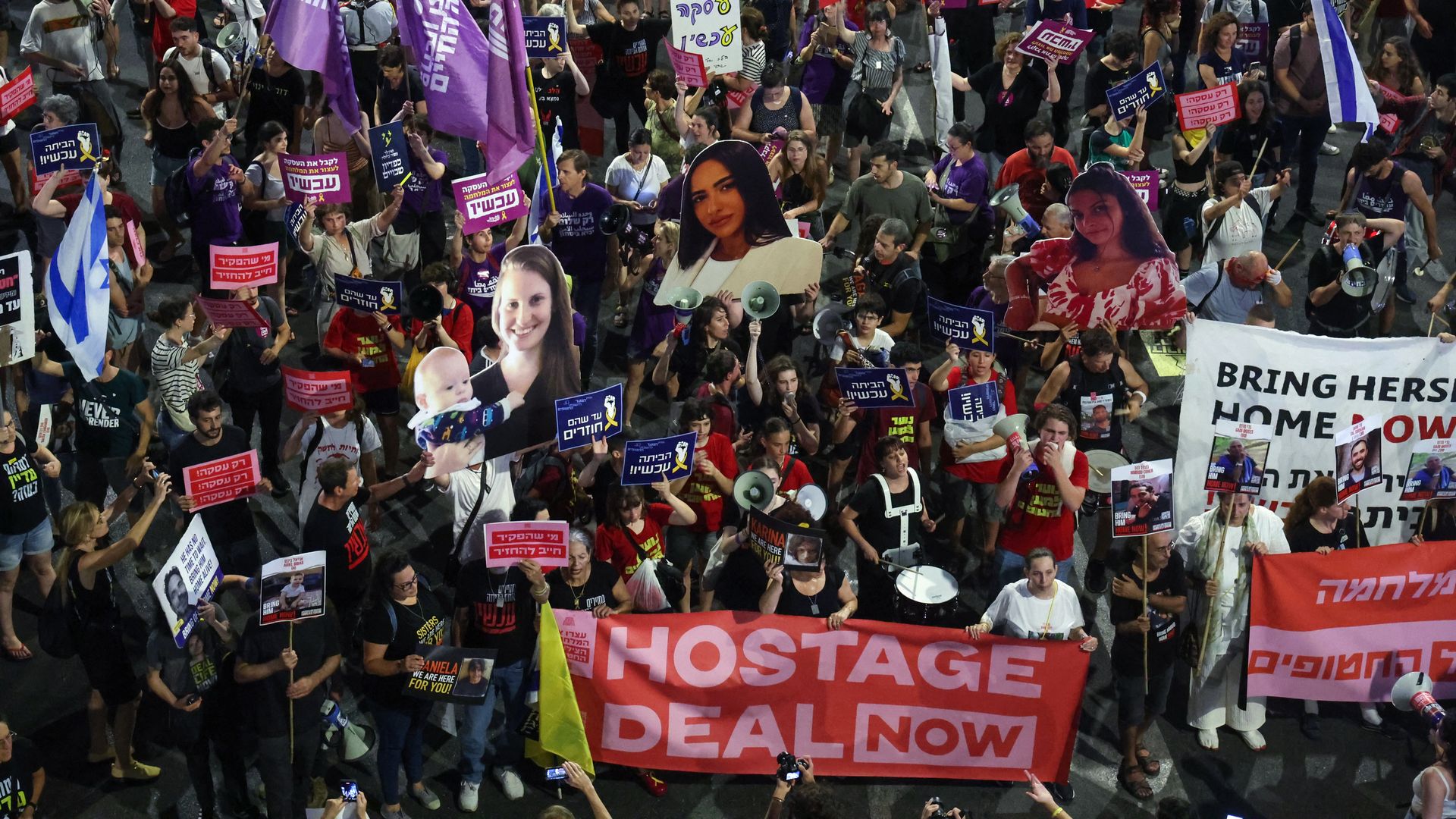
Relatives and supporters of hostages being held in Gaza demonstrate calling for their release in Tel Aviv on Jun. 26, 2024. Photo: Jack GuezJ/AFP via Getty Images
President Biden in a call on Thursday told Israeli Prime Minister Benjamin Netanyahu "it is time to close" a hostage and ceasefire deal in Gaza.
Why it matters: Biden has pushed for a deal for months. White House officials said they want to take advantage of Hamas' positive response to the latest proposal in order to close the remaining gaps and reach an agreement.
- An agreement to release hostages being held in Gaza, including U.S. citizens, and lead to a ceasefire in the enclave would be a huge foreign policy accomplishment for Biden who is facing intense criticism after the presidential debate in June.
Driving the news: Hamas on Wednesday gave its updated response to the latest Israeli proposal.
- Israeli officials said Hamas' response represents major progress and that it opens the door to more detailed negotiations that could result in a deal.
- On Thursday, after Hamas' response, Netanyahu approved sending Israeli negotiators for detailed negotiations, the prime minister's office said.
- Netanyahu told Biden in their call about his decision to send a delegation to continue negotiations and reiterated "Israel's commitment to ending the war only after all of its goals have been achieved," Netanyahu's office said.
What they're saying: Biden "welcomed the Prime Minister's decision to authorize his negotiators to engage with U.S., Qatari, and Egyptian mediators in an effort to close out the deal," according to a readout of the call from the White House.
- A senior White House official said the president was encouraged by his conversation with Netanyahu and by the fact that the prime minister authorized his team to go to the talks in Doha.
- "We believe there is an opportunity now. It is not only in the hands of the Israelis but also in the hands of the mediators and in the hands of Hamas," the official said.
Zoom in: The senior White House official said that in the past day Biden and his team studied Hamas' response and made the determination that it "moves the process forward" and provides a basis for reaching an agreement.
- The official described Hamas' response as "a breakthrough" and said the group agreed for the first time to the framework Biden laid out in a speech in late May.
- A "key point of contention in the negotiations" was the transition between the first and second stages of the deal and "now both sides agree to the framework," the official said.
- "There is more work to be done regarding the details of the implementation of the agreement."
- The official said the Israeli delegation will arrive in Doha tomorrow to begin detailed negotiations. A U.S. team will also be on the ground to assist in the talks.
During the call, Biden and Netanyahu discussed efforts to de-escalate the fighting between Israel and Hezbollah.
- Netanyahu told Biden that Israel wants to find a diplomatic solution that will allow Israeli citizens to return to their homes in the north, the White House official said.
Catch up quick: The latest proposal was approved by Israel's war cabinet and includes a three-phase deal that would lead to the release of the 120 remaining hostages held by Hamas and to "sustainable calm" in Gaza.
- The first phase focuses on humanitarian cases and includes a 42 day ceasefire in return for the release of women, female soldiers, men over the age of 50 years old and men in critical medical condition who are being held hostage by Hamas.
- In return, Israel would release about 900 Palestinian prisoners, among them more than 150 who are serving life sentences for killing Israelis.
Behind the scenes: Israeli officials said Hamas' response makes it possible to reach an agreement on Articles 8 and 14 — the main gaps between the parties.
- In Article 8, which outlines Israel-Hamas negotiations that would begin during implementation of the first stage of the deal, Hamas agreed to replace the word "including" with another word proposed by the U.S. and acceptable to Israel, Israeli officials said.
- They stressed the new wording would still allow ambiguity for both parties in negotiations about the focus of the first stage of the deal.
- Hamas wants to change the language in Article 14 of the proposal so it wouldn't say the U.S., Qatar and Egypt are going "to make every effort" to continue the negotiations until an agreement is reached about the second stage of the deal, but that they will "commit" to that.
- Israeli officials said that demand could be solved in further negotiations between the parties.
What's next: Mossad director David Barnea is expected to travel to Doha with an Israeli delegation to continue the negotiations over the deal.
- He is expected to meet Qatari Prime Minister Sheikh Mohammed Bin Abdul Rahman al-Thani, per two sources with knowledge of the negotiations.
The bottom line: Israeli officials said the main point is Hamas' response includes flexibility that would allow the parties to enter into the first stage of the deal, while taking the risk that the next stages won't materialize.
- A senior Israeli official expressed optimism and suggested once negotiations on the details of the agreement begin a deal can reached within two to three weeks.
Editor's note: This story has been updated with new details throughout.
