"Enrollment cliff" looms

Add Axios as your preferred source to
see more of our stories on Google.
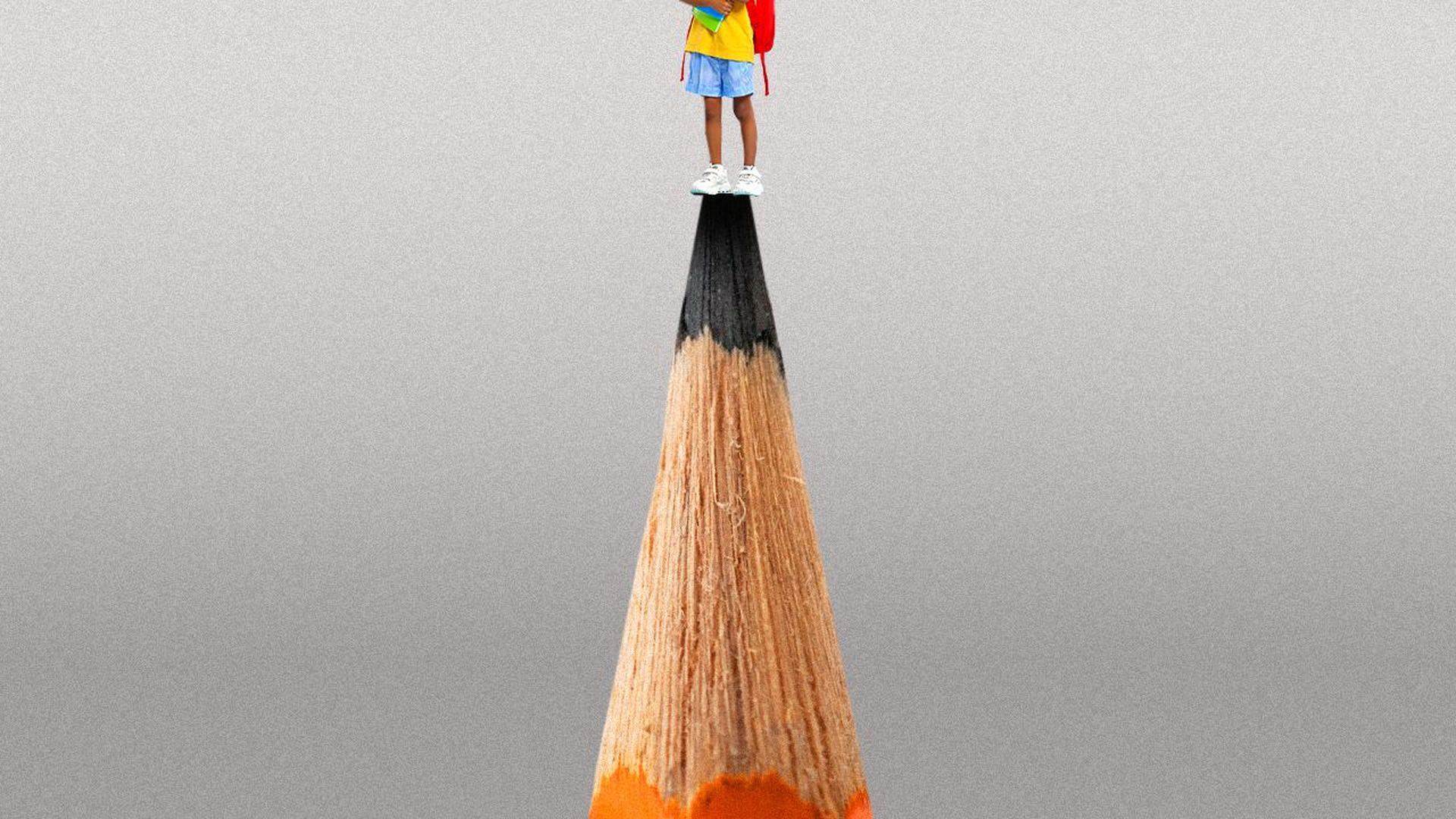
The number of U.S. high school graduates is expected to peak in 2025 or 2026 and then decline for years to come — posing severe challenges to schools at all levels.
Why it matters: Schools and colleges are closing, faculty members are being laid off, and districts are facing financial dilemmas — all as education is under political fire from every side.
Driving the news: Due to a birthrate drop after the 2008 recession, schools are planning for a decadelong dry spell that's being referred to as the "enrollment cliff" or "demographic cliff."
- Colleges — primarily small liberal arts schools in the Midwest, Northeast and California — are closing, and others are giving notice to faculty.
- K-12 schools — mostly in cities that lost population during the COVID-19 pandemic — are doing the same.
- Districts are cutting budgets and making tough choices as they plan for lower per-pupil financial allocations: Does tutoring get the axe? Sports? After-school activities?
What they're saying: "I think folks are getting a sense of the ramifications at this point," says Patrick Lane, VP of policy analysis and research at the Western Interstate Commission for Higher Education (WICHE).
- "The elementary schools are already living it — they're seeing smaller K-12 classes."
By the numbers: The U.S. is expected to reach "peak high school graduate" in 2025, when around 3.9 million young people will graduate, per WICHE.
Zoom out: There's a simultaneous "financial cliff" as K-12 schools brace for pandemic-era relief money to expire this September.
- Colleges are suffering from the Department of Education's FAFSA snafu — which delayed financial aid offers — as well as declining public trust in higher education.
- Campus protests — and the fall of the presidents of Harvard and the University of Pennsylvania — have contributed to skepticism about the value of pricey degrees.
Between the lines: This isn't the first time the number of school-age children has dropped — but prior dips dovetailed with an increase in high school graduation and college attendance.
- That's because more people saw the value of educational attainment, as Jon Boeckenstedt, vice provost for enrollment management at Oregon State University, wrote in the Chronicle of Higher Education.
- By contrast, Americans' confidence in higher education fell to 36% in 2023 — much lower than in 2015 (57%) and 2018 (48%), per Gallup polling.
Where it stands: Since the pandemic, "there has not been a rebound in public school enrollment," Thomas Dee, an economist and professor at Stanford's Graduate School of Education, tells Axios.
- He documented an enrollment decline of 1.1 million students — or 2% — nationally in K-12 public schools in the first full school year after the onset of the pandemic.
- A third of that was in kindergarten alone.
"Parents were confronted with putting a kindergartener or first-grade student in front of the laptop all day," Dee says.
- At the K-12 level, the continued rise of homeschooling and chronic absenteeism are playing a role too.
Risk factor: Colleges, meanwhile, are announcing closings at a rate of one a week, per the Hechinger Report — and others are in big financial trouble.
- Some are trying to combat the "enrollment cliff" by recruiting nontraditional students — adults with jobs and families, for instance.
- They're also beefing up their "distance learning" options — i.e. Zoom classes.
Reality check: A shrinking candidate pool may make it easier for your kid to get into less competitive schools, but it's not going to be their ticket to the Ivies.
