New AI hype alert: Cost-free knowledge

Add Axios as your preferred source to
see more of our stories on Google.
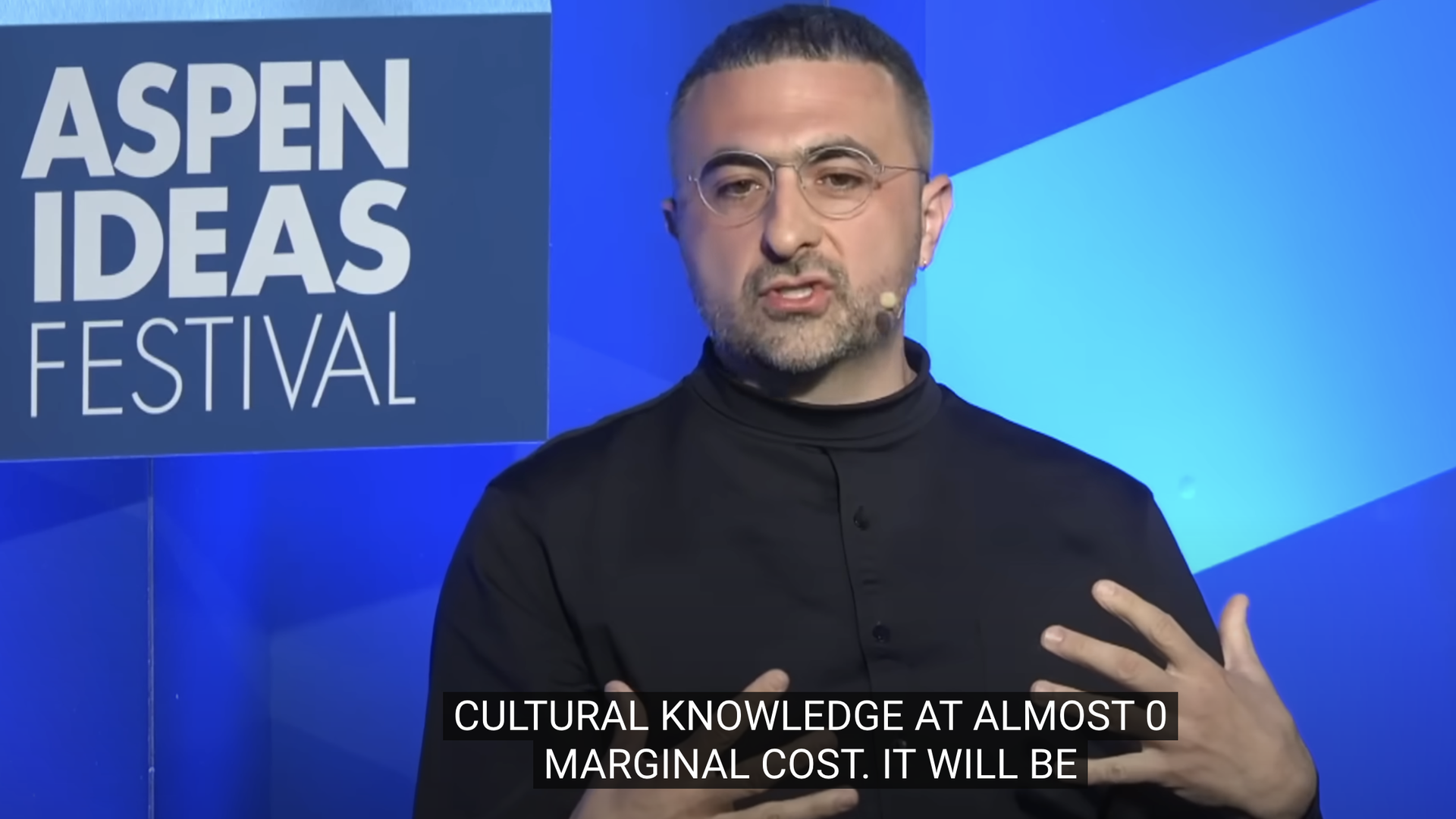
Mustafa Suleyman at the Aspen Ideas Festival. Screenshot: NBC News/YouTube
The latest pitch for AI's revolutionary power predicts that the technology will make knowledge production cost-free.
Driving the news: Mustafa Suleyman — DeepMind cofounder and now Microsoft AI's CEO — made this case at the Aspen Ideas Festival last week.
- "The economics of information are about to radically change because we're going to reduce the cost of production of knowledge to zero marginal cost," Suleyman said at the festival.
- "In 15 or 20 years' time, we will be producing new scientific, cultural knowledge at almost zero marginal cost. It will be widely open sourced and available to everybody."
- "I think that is going to be a true inflection point in the history of our species."
- Suleyman's quote was clipped and dissected on "Morning Joe," NBC and CNBC.
Why it matters: If Suleyman is correct, we're facing a world of information abundance and economic dislocation that few institutions are prepared for.
Yes, but: Suleyman is no late-to-the-AI-party huckster — he's an industry veteran with a serious record. But his zero-cost knowledge claim is a telltale sign of tech-bubble thinking.
- As market valuations for AI firms and projects soar, the rhetoric surrounding them inflates to justify the continuing influx of vast sums.
Suleyman's vision of zero "marginal cost" knowledge production works from these assumptions:
- Knowledge is a quantifiable good, a sort of intellectual widget, and AI will produce such widgets at a trivial cost.
- AI models have consumed so much existing human knowledge that they can regurgitate and recombine it to suit any human need.
- Before too many more years, the "marginal cost" of doing so will fall to zero.
Let's look at how many ways this vision fails to match reality:
The upfront costs are astronomical.
- The tech industry is collectively pouring hundreds of billions of dollars into a massive AI buildout.
- Suleyman's equation ignores the high initial costs of building these systems (even when AI makers don't pay data producers for their information) and the still significant costs of running them — in both hardware and energy resources.
Knowledge is more than information.
- Computers store data and AI can find patterns in data. But "knowledge" is something people acquire through learning and experience.
- Many AI experts argue that large language models don't "know" anything at all — and they can't even tell when they lack the information to provide a useful answer.
Originality comes from people.
- AI can distribute existing knowledge, but it's not at all clear that today's (or tomorrow's) AI is capable of "producing" it in any original way.
- Discovery remains a uniquely human endeavor, and "producing" new knowledge demands all sorts of expertise and context that today's AI can't approach.
- AIs can't do field research, design new experiments or create great artworks that respond to the feeling of being alive in a particular moment.
The other side: AI has a wealth of potential applications in areas like helping scientists invent new proteins or model complex climate systems.
- Many AI optimists foresee researchers and artists working with AI at their elbow, boosting their powers of exploration and creativity.
- "What are we collectively," Suleyman said at Aspen, other than "an intellectual production engine?"
- "We produce knowledge. Our science makes us better. So what we really want in the world, in my opinion, is new engines that can turbocharge discovery and invention."
Flashback: The rise of the web in the 1990s saw similar predictions that all knowledge would eventually become universally available for free.
- The web did democratize information in many ways, and some of its crown jewels, like Wikipedia, have proven essential foundation-stones for today's chatbots.
- But each new tech boom forgets all over again that Stewart Brand's famous dictum — "information wants to be free" — always came with the corollary that "information wants to be expensive."
The bottom line: Even Wikipedia, though freely accessible, isn't zero-margin-cost knowledge production, and the nonprofit organization that runs it has to beg for donations to pay the virtual rent. You should assume that we will have to pay for AI's knowledge bounty, too.
