"The president is now a king": Key lines from Trump immunity ruling

Add Axios as your preferred source to
see more of our stories on Google.
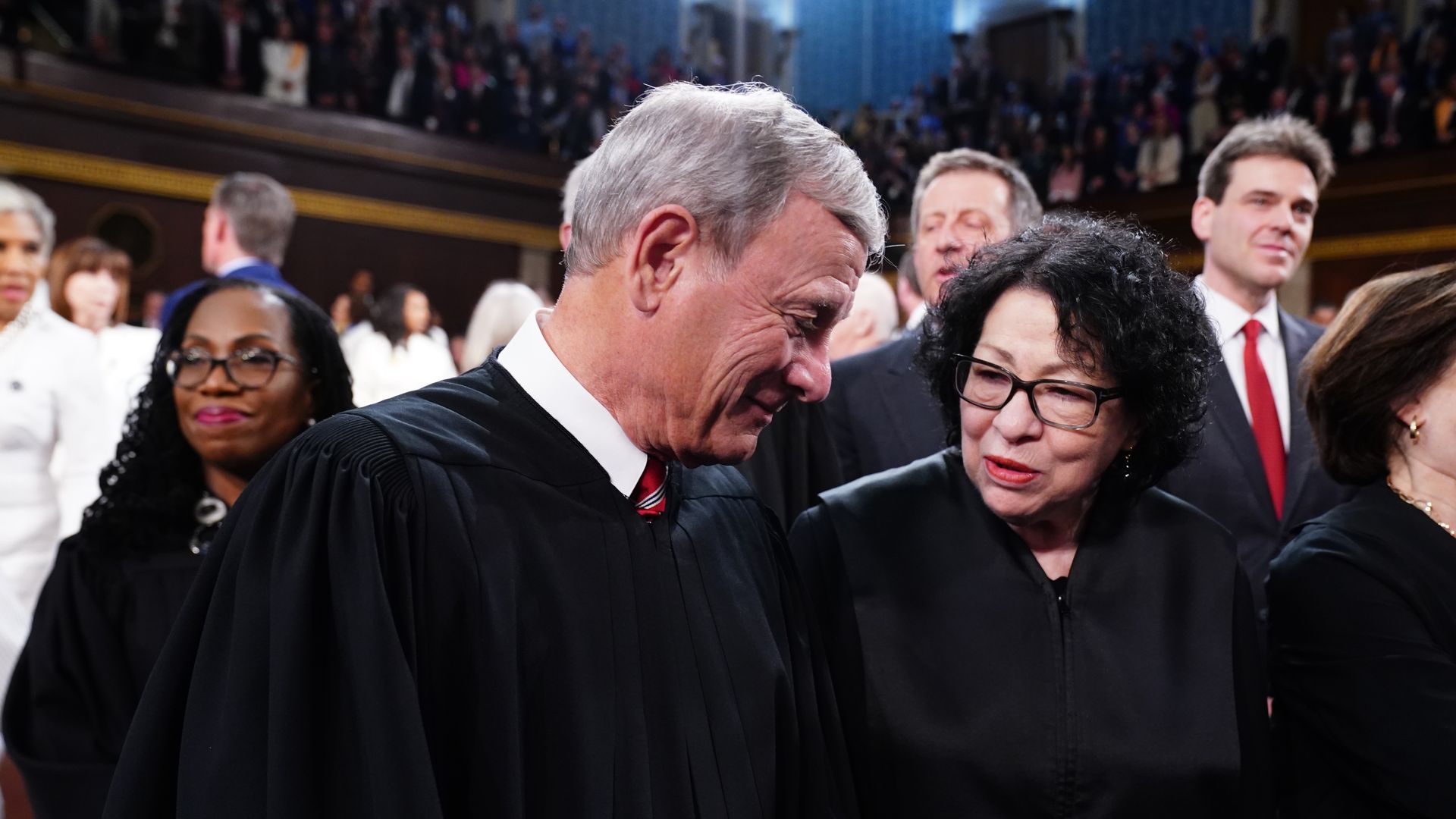
Chief Justice John Roberts and Associate Justice Sonia Sotomayor talk on the House floor ahead of the annual State of the Union address on Mar. 7, 2024 . Photo: Shawn Thew-Pool/Getty Images
The Supreme Court's long-awaited ruling Monday granting presidents immunity from prosecution while carrying out "official acts" included consequential conclusions from the majority as well as forceful dissents from liberal justices.
Why it matters: Dissents by Justices Sonia Sotomayor and Ketanji Brown Jackson warned of the dangers of an unrestrained executive power blanketed with immunity for vague, undefined official duties.
Catch up quick: The 6-3 ruling punted to lower courts the question of whether some of former President Trump's alleged crimes in his Jan. 6 case should be considered official acts.
What they're saying: Chief Justice John Roberts delivered the court's majority opinion, with the three left-leaning justices dissenting.
"We conclude that under our constitutional structure of separated powers, the nature of Presidential power requires that a former President have some immunity from criminal prosecution for official acts during his tenure in office. At least with respect to the President's exercise of his core constitutional powers, this immunity must be absolute. As for his remaining official actions, he is also entitled to immunity."— Chief Justice John Roberts
- Roberts provided some examples delineating official and unofficial duties, writing that Trump's discussions with acting Attorney General Jeffrey Rosen are "readily categorized in light of the nature of the President's official relationship to the office."
- But Roberts wrote that allegations related to Trump's interactions with former Vice President Mike Pence, state officials, certain private parties and his comments to the public "present more difficult questions."
The other side: "With fear for our democracy, I dissent," Sotomayor wrote, stressing that that broad immunity could grant a surge in executive power.
- "The relationship between the President and the people he serves has shifted irrevocably," she wrote. "In every use of official power, the President is now a king above the law."
- "It is a far greater danger if the President feels empowered to violate federal criminal law, buoyed by the knowledge of future immunity," she continued.
- "I am deeply troubled by the idea, inherent in the majority's opinion, that our Nation loses something valuable when the President is forced to operate within the confines of federal criminal law."
Jackson's dissent echoed Sotomayor's warning of the commander-in-chief assuming a monarch-like power.
- "For my part, I simply cannot abide the majority's senseless discarding of a model of accountability for criminal acts that treats every citizen of this country as being equally subject to the law—as the Rule of Law requires," she wrote.
- "That core principle has long prevented our Nation from devolving into despotism. Yet the Court now opts to let down the guardrails of the law for one extremely powerful category of citizen: any future President who has the will to flout Congress's established boundaries," she continued.
Go deeper: Supreme Court rules Trump has immunity for "official acts"
