Ford CEO: U.S. policy keeping Chinese EVs at bay

Add Axios as your preferred source to
see more of our stories on Google.
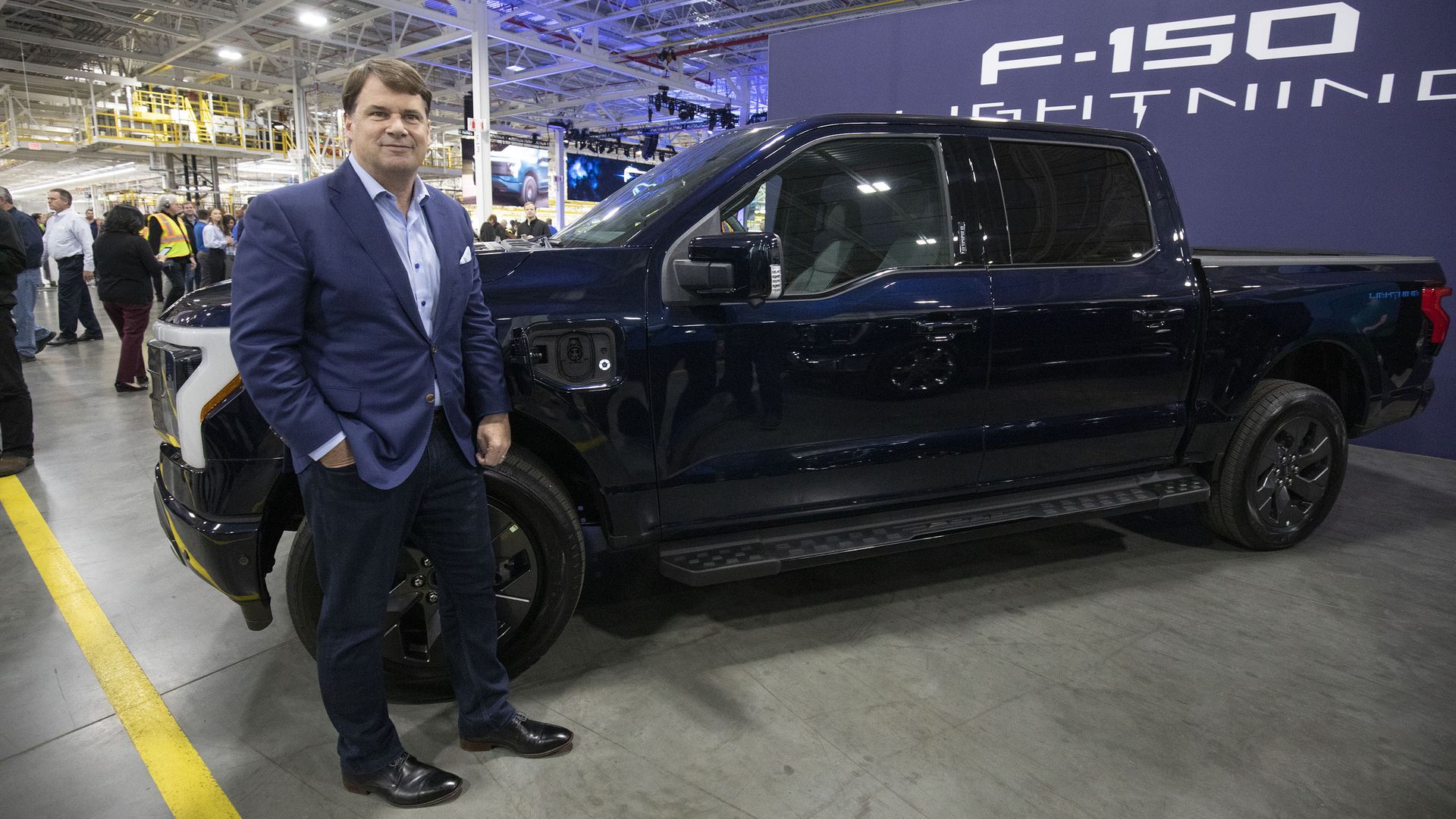
Ford Motor CEO Jim Farley says he's growing more confident the automaker can produce EVs profitably in the U.S. because government policies have helped level the playing field with low-cost Chinese competitors.
Why it matters: Ford is the second-largest EV brand in the U.S. — although well behind Tesla — thanks to the popularity of its Mustang Mach-E, F-150 Lightning pickup and E-Transit commercial van.
- But EVs are still a money-losing proposition for Ford, which expects to lose a whopping $5.5 billion on them this year.
Driving the news: The next generation of EVs will be cheaper to build, Farley told Axios last Friday after speaking at the Aspen Ideas Festival in Colorado.
- That's in part because of EV incentives in the Inflation Reduction Act (IRA), plus other government policies.
- For example, the Biden administration has imposed 100% tariffs on Chinese EVs and moved to crack down on technology that could track U.S. drivers — all part of a broader effort to block low-cost Chinese EVs from coming to the U.S.
What they're saying: "It seems like the government is very serious about passing policy around data privacy and autonomous technology coming from those OEMs," Farley told Axios, referring to Chinese manufacturers.
- "With the recent changes, I am more confident than I was before that we would have a level playing field with the Chinese in the U.S."
State of play: An existing 27.5% tariff has all but barred low-cost Chinese EVs from the U.S. so far.
- But some models from BYD, which recently surpassed Tesla as the world's largest EV manufacturer, sell for less than $11,000 — far below comparable American models.
- And China is already on America's doorstep, with Chinese imports now accounting for 20% of new car sales in Mexico.
Threat level: It's only a matter of time, Farley says, before Chinese manufacturers set up factories in Mexico and begin shipping EVs to the U.S.
- Ford's answer is to attack the EV market with its next generation of vehicles from two angles, Farley said.
- "We're now betting on an affordable platform with multiple vehicles. And we're betting on commercial vehicles."
