Ford CEO: U.S. policy is helping fight off Chinese electric cars

Add Axios as your preferred source to
see more of our stories on Google.
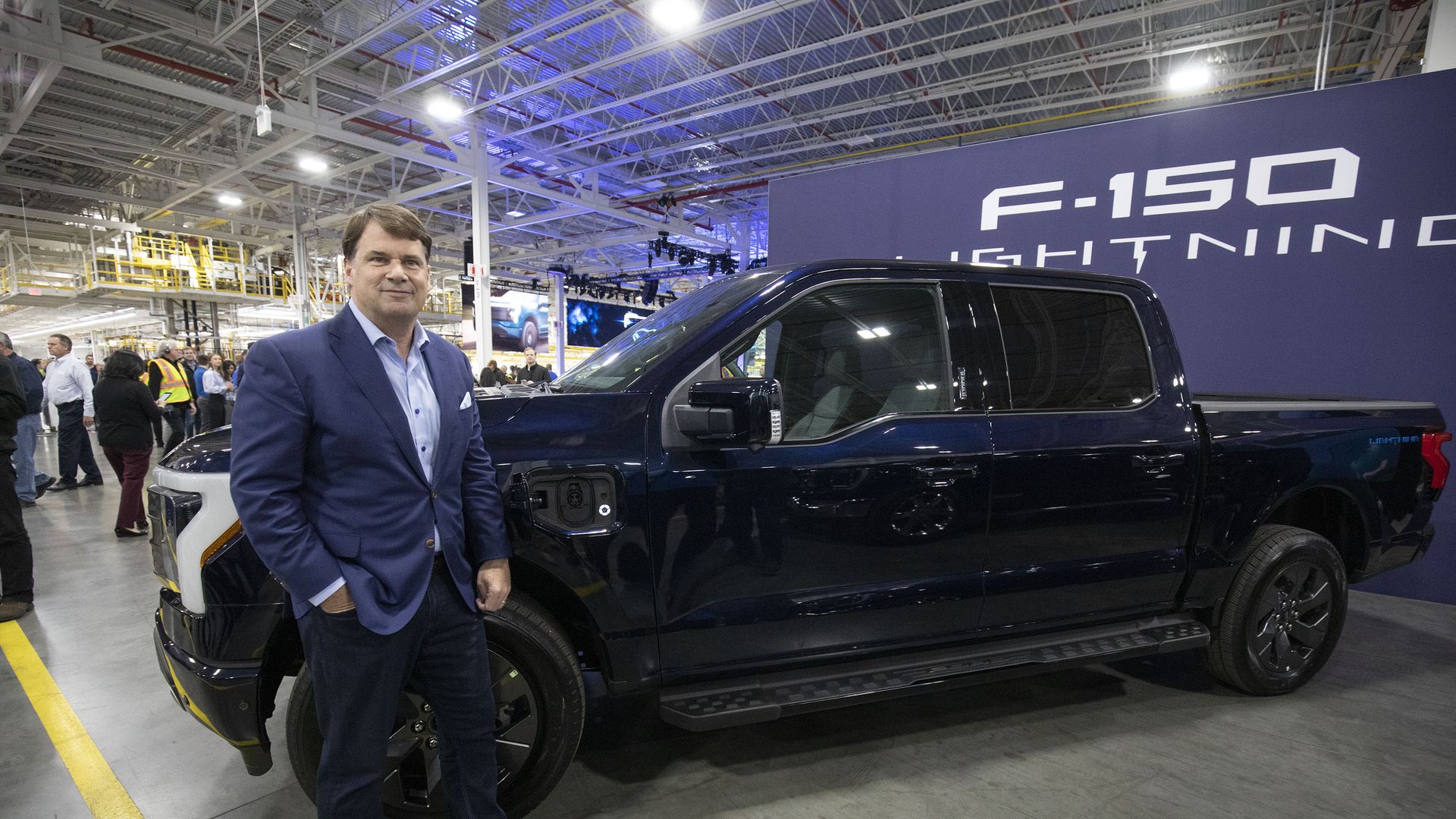
Ford CEO Jim Farley with the electric Ford F-150 Lightning pickup truck at the Ford Rouge Electric Vehicle Center in Dearborn, Mich. (Photo by Bill Pugliano/Getty Images)
Ford Motor CEO Jim Farley says he's growing more confident the automaker can produce EVs profitably in the U.S. because government policies have helped level the playing field with low-cost Chinese competitors.
Why it matters: Ford is the second-largest EV brand in the U.S. — although well behind Tesla — thanks to the popularity of its Mustang Mach-E, F-150 Lightning pickup and E-Transit commercial van.
- But EVs are still a money-losing proposition for Ford, which expects to lose a whopping $5.5 billion on them this year.
Driving the news: The next generation of EVs will be cheaper to build, Farley told Axios in an interview Friday after speaking at the Aspen Ideas Festival in Colorado.
- That's in part because of EV incentives in the Inflation Reduction Act (IRA), plus other government policies.
- The IRA not only provides consumer tax credits of up to $7,500 on EV purchases, it also included billions of dollars in incentives for automakers that produce EVs and batteries domestically.
- Plus, the Biden administration has imposed 100% tariffs on Chinese EVs and moved to crack down on technology that could track U.S. drivers — all part of a broader effort to block low-cost Chinese EVs from coming to the U.S.
What they're saying: "It seems like the government is very serious about passing policy around data privacy and autonomous technology coming from those OEMs," he told Axios, referring to Chinese manufacturers.
- "With the recent changes, I am more confident than I was before that we would have a level playing field with the Chinese in the U.S."
State of play: An existing 27.5% tariff has all but barred low-cost Chinese EVs from the U.S. so far.
- But some models from BYD, which recently surpassed Tesla as the world's largest EV manufacturer, sell for less than $11,000 — far below comparable American models.
- And China is already on America's doorstep, with Chinese imports now accounting for 20% of new car sales in Mexico.
Threat level: It's only a matter of time, Farley says, before Chinese manufacturers set up factories in Mexico and begin shipping EVs to the U.S.
- They'll need to include some U.S. components as required under North American free trade agreements, which "isn't free," he noted.
Ford's answer is to attack the EV market with its next generation of vehicles from two angles, Farley said.
- "We're now betting on an affordable platform with multiple vehicles. And we're betting on commercial vehicles."
Ford learned a lot from customers who bought its early EVs like the Mach-E and the Lightning, he added.
- "We have all the data off the cars, so we can see the Mach-E. We can see how people are using it, what their state of charge is, where they drive, how often they charge."
- "And we were shocked to find out that more people than we thought don't take long trips."
By the numbers: Ford's research showed that roughly half of Americans take four or fewer trips over 150 miles a year.
- That's what convinced the company that there's a market opening for cheaper EVs with shorter-range batteries.
- A $7,500 tax credit is a "game changer" for many entry-level EV buyers, Farley said.
- "That's where the customer is telling us EVs should go."
The bottom line: Ford is juggling battery supply chains and adjusting its production plans to capitalize on U.S. policies in a bid to make EVs more cheaply.
- "We are in a global race to compete in a future where electric propulsion will undoubtedly be a giant force in transportation," Farley wrote in a blog post ahead of the Aspen Ideas Festival.
- "America cannot cede innovation leadership to China, Europe or any other region."
