Americans are living in a “fragile society," poll finds

Add Axios as your preferred source to
see more of our stories on Google.
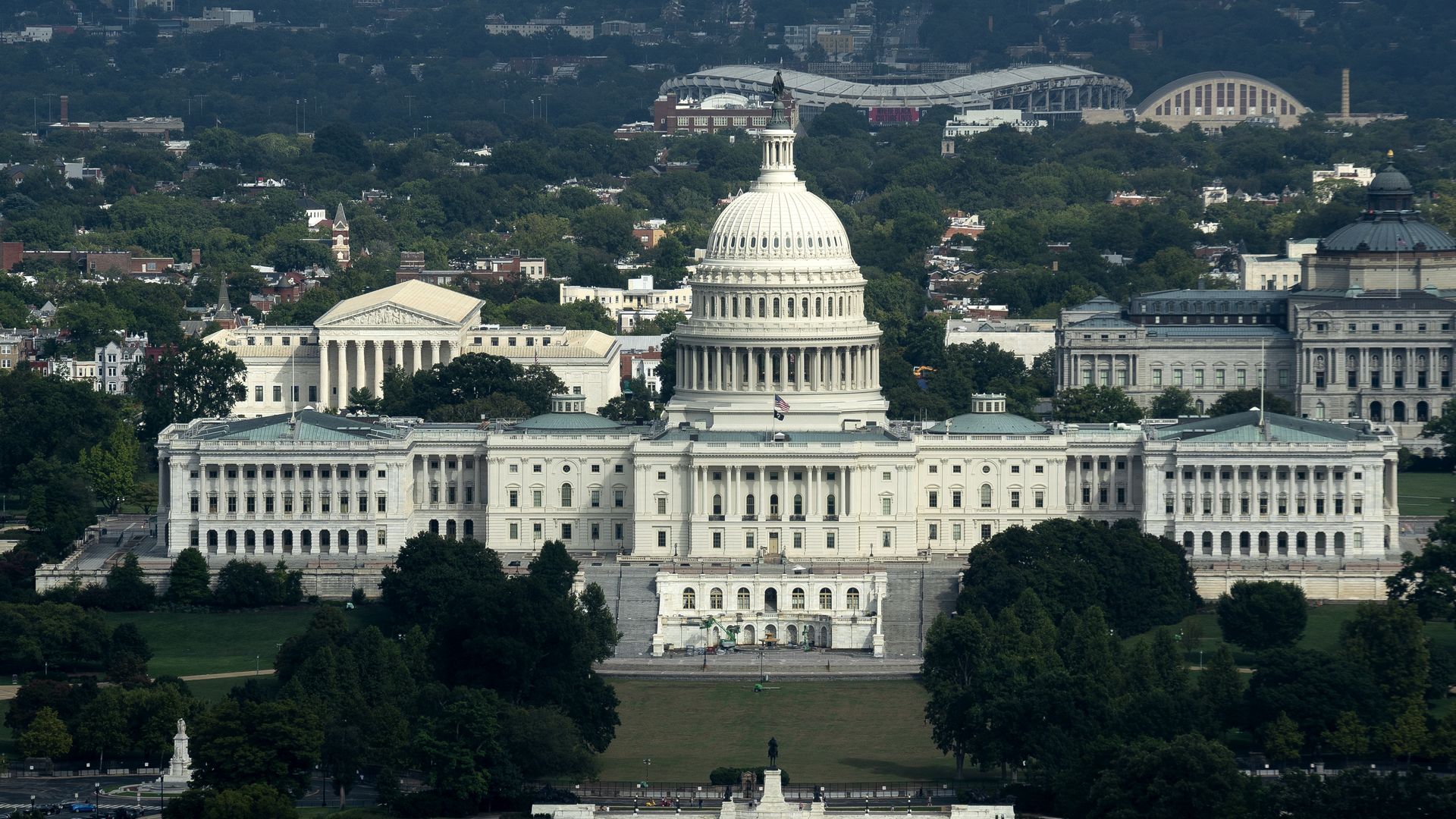
The U.S. Supreme Court and U.S. Capitol in Washington, D.C. U.S. Photo: Stefani Reynolds/Bloomberg via Getty Images
Americans are some of the most resilient people in the world when it comes to disaster preparedness and rebounding from shocks, a new poll found. But as a society, they are strikingly fragile.
Why it matters: The U.S. is in the middle of a major election year as fears of political violence rise and polarization deepens.
- The U.S. scored above the global average for individual and household resilience on the World Risk Poll Resilience Index — a sign respondents feel well-equipped to protect themselves and their families if faced with setbacks, like a natural disaster or job loss.
- This includes households that have a plan in place for if a disaster occurs or have enough savings to survive for an extended period of time without income.
- But the U.S. scored well below the global average measuring how well its institutions and people can respond to a crisis quickly and collectively.
- "No other country in the world has such resilient individuals living in such a fragile society," the report on the U.S. findings said.
State of play: The World Risk Poll Resilience Index was first issued in 2022, and this year's edition comprises data from 142 countries.
- It measures individuals, households, communities, and nations' capacities for resilience, a metric that indicates how well they can respond to and bounce back from crisis.
- Individual and household resilience is measured by gauging a respondent's sense of agency, education level and financial assets, Nancy Hey, director of evidence and insight at Lloyd's Register Foundation, said.
- Lloyd's Register Foundation produced the report with data gathered by Gallup.
The big picture: Most countries see higher levels of societal resilience than individual resilience.
- Only the U.S. and eight other countries — including Peru, Bolivia, Canada and Taiwan — exhibited the opposite trend.
- Trust in key U.S. institutions — including the government, judiciary, military and the honesty of elections — fell to a record low since 2006.
Between the lines: Low societal resilience and political volatility are often connected, Hey told Axios.
- "For democracy to work well, you need to be able to have disagreement and binary views," she said.
- "But in order to be able to then function as a society, you need enough" social resilience to withstand "necessary disagreement," she added.
Zoom in: Societal resilience takes into account how much confidence Americans have in their national institutions, if they feel they've experienced discrimination, and how much they feel their government cares about them.
- The U.S. had the highest self-reported rates of discrimination in the world in 2023, with 55% of Americans saying they'd experienced some form of discrimination.
- More than half (52%) said they felt think their government doesn't care about them "at all."
Go deeper: America's political polarization could cost the U.S. economy
