Poll: Majority of Americans support preserving Confederate history

Add Axios as your preferred source to
see more of our stories on Google.
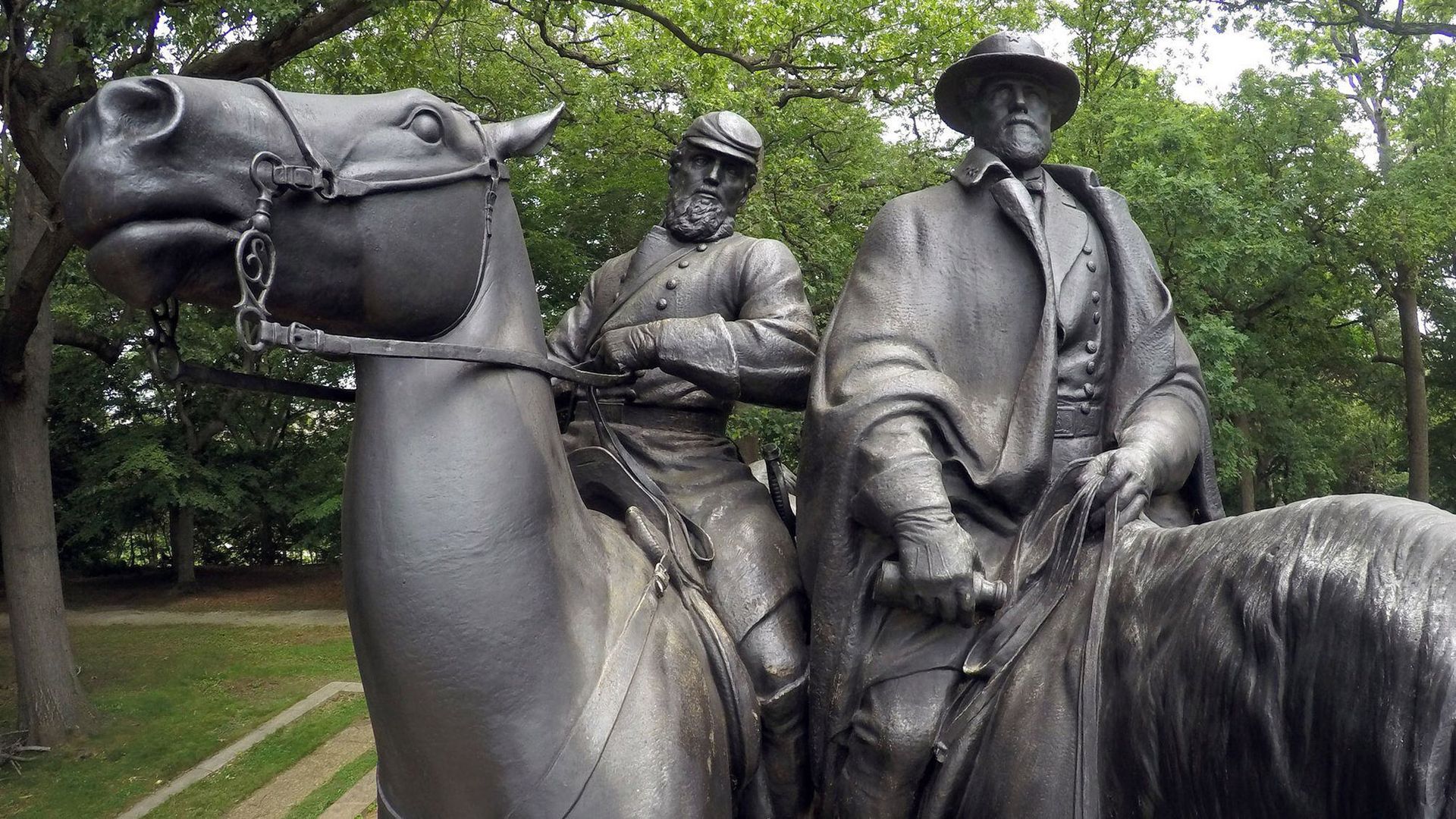
The Robert E. Lee and Thomas. J. "Stonewall" Jackson Monument in the Wyman Park Dell was erected in 1948. A Baltimore city commission recommended in 2023 it be removed. Photo: Baltimore Sun/Tribune News Service via Getty Images
A slim majority of Americans (52%) support efforts to preserve the legacy and history of the Confederacy, while 44% oppose such efforts, a new poll finds.
Why it matters: As Juneteenth gains popularity as a national holiday, most Americans still support keeping alive the "Lost Cause" myth, which arose after the Civil War and romanticizes the Confederate uprising, ignoring slavery as its root cause.
- The "Lost Cause" popularity persists even after the 2020 murder of George Floyd prompted cities and states to remove Confederate monuments and names of former Confederates from schools amid a racial reckoning.
Zoom in: The 52% in support for preserving the history of the Confederacy is almost identical to results of 2022 survey, the nonpartisan Public Religion Research Institute poll found.
- The new survey found that Americans from Southern states (58%) are more likely than Americans elsewhere (50%) to support efforts to preserve the legacy of the Confederacy.
- "Black Americans (25%) are the only racial group without majority support for efforts to preserve the legacy and history of the Confederacy, compared with 58% of white Americans" and 54% of Latinos, PRRI said.
- "Gen Z (41%) is the only generation without majority support for preserving the legacy of the Confederacy, compared with two-thirds of the Silent Generation (62%), 58% of Gen X, 56% of baby boomers, and 51% of millennials," PRRI wrote.
Background: The Lost Cause myth was developed by white Southerners to portray the Civil War as a noble effort to protect "states' rights" and the Southern way of life while downplaying the horrors of enslavement.
- White mobs after Reconstruction terrorized Black communities with lynchings and violence to reverse new electoral and business gains by emancipated Black Americans.
- The federal government removed Union troops from Southern states as Southerners erected monuments to former Confederates and slaveholders to romanticize their military exploits.
- Historians say the Lost Cause reinforced white supremacy in public spaces and was used to scare Black Americans from fighting segregation or seeking racial equality.
The intrigue: The new poll found deep partisan divides: 81% of Republicans, compared with 30% of Democrats, support efforts to preserve the legacy of the "Lost Cause."
- Independents are now slightly more likely to support efforts to preserve the legacy of the Confederacy (52%), compared with the last survey (46%).
- A quarter of Americans said Confederate monuments should be left as-is, while most (35%) said the monuments should have added information about slavery and racism.
- Roughly 3 in 10, or 28%, said monuments should be relocated to museums, and only 9% said they should be destroyed.
What they're saying: "The issue of how to deal with the legacy of these Confederate memorials and naming of schools and naming mascots...we haven't seen a lot of movement on that," PRRI CEO Melissa Deckman tells Axios.
- "Americans still remain, I think, pretty divided on this issue."
- "But I think there's a recognition that these public monuments that celebrate the Confederacy, or memorialize the Confederacy, at least, is hurtful to a large part of American society."
Between the lines: The conservative backlash to the 2020 racial reckoning has led to new state laws limiting the discussion of slavery in public schools, and conservatives fighting to restore Confederate monuments and names on schools.
- A Virginia school board voted last month to reinstate the original Confederate names of two public schools.
- Last week, 192 House Republicans voted for an amendment that would have required a Confederate monument be reinstated at Arlington National Cemetery, per Newsweek.
Methodology: PRRI conducted the survey on March 13 -25, 2024. The poll is based on a representative sample of 5,784 adults living in all 50 states and the District of Columbia.
- The margin of error is ±1.52 percentage points at the 95% confidence level, for results based on the entire sample.
