Juneteenth is helping families discover details about enslaved ancestors

Add Axios as your preferred source to
see more of our stories on Google.
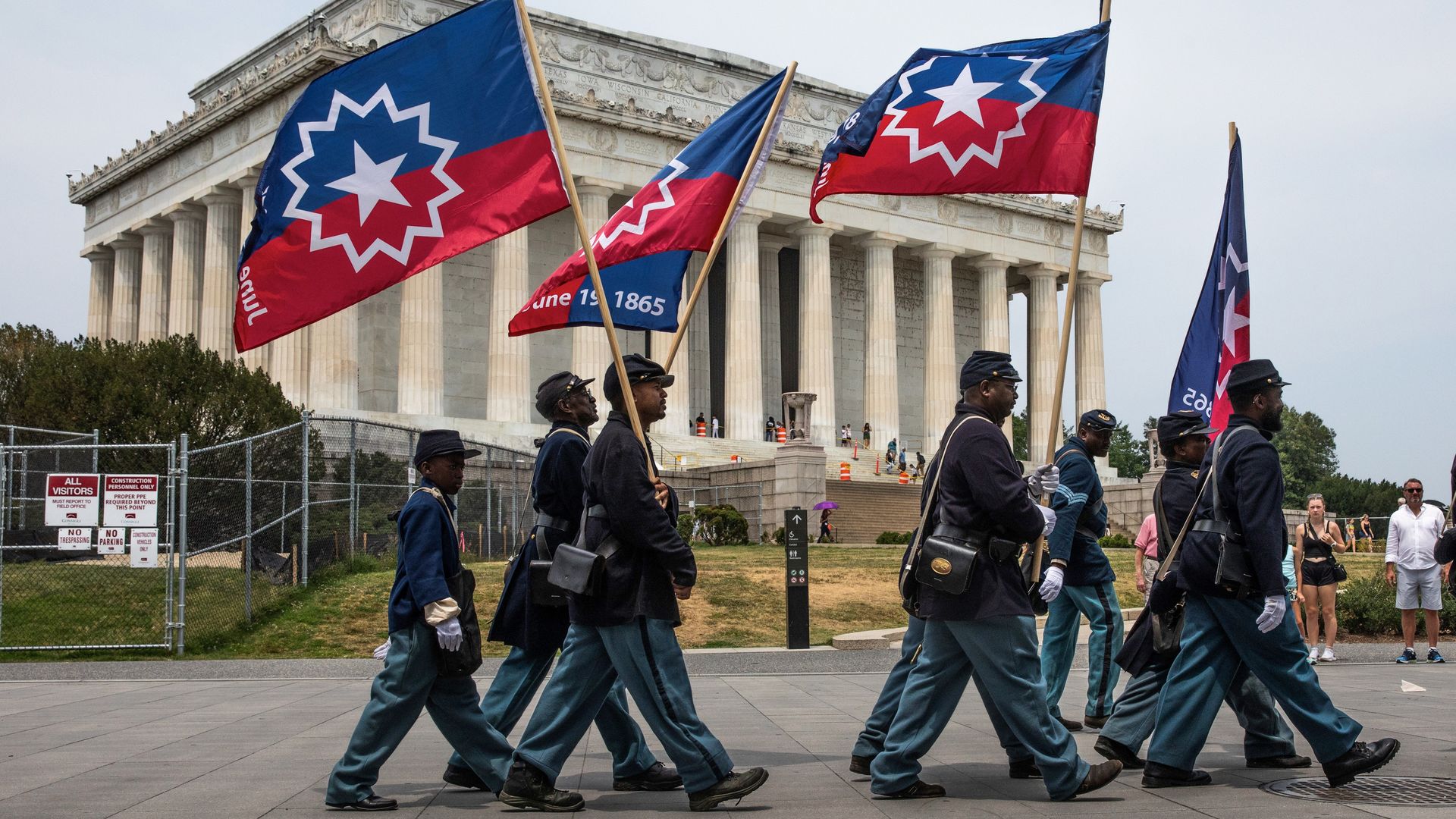
Members of a Civil War re-enactment troop are seen in front of the Lincoln Memorial during Juneteenth celebrations in Washington, D.C., in 2023. Photo: Aaron Schwartz/Xinhua via Getty Images
Juneteenth's popularity is encouraging more descendants of enslaved people to research their families' history and visit "sites of memory" linked to enslavement, experts tell Axios.
The big picture: Never before in U.S. history have descendants been able to easily access so many historic family documents online, thanks to improvements in technology, AI, DNA tests and genealogy websites.
- The National Park Service, nonprofit groups and some states have also better mapped or transformed historic sites connected to enslavement.
- "While we are looking at how African Americans honor Juneteenth by celebrating our future, we're also tipping our hat to a past that speaks to a liberation or freedom tradition," Samuel Livingston, professor of Africana Studies at Morehouse College, tells Axios.
Zoom in: Juneteenth celebrations became more prominent across the country following the murder of George Floyd, which helped build the momentum to make it a federal holiday.
- That racial reckoning sparked some Black Americans to research their own family history and explore their past with enslavement, Livingston said.
- They are uncovering ancestors who were enslaved, and finding documents on how they were bought and sold as families were broken up and spread across the country, he said.
- They're also discovering how their ancestors may have escaped enslavement or what their lives were like after emancipation.
How it works: Black Americans can research their families' past by searching the names of relatives on various genealogy websites.
- This month, Ancestry made available for free newspaper records from before 1870 connected to more than 183,000 enslaved people.
- AI combs through the once-hard-to-search records of newspapers for names of enslaved people, connecting names in Ancestry's other databases of probate documents to piece together the past.
- Users can also explore Michigan State University's Enslaved.org, a database containing millions of records cataloging the lives of enslaved Africans and their descendants.
Zoom out: Today, there are around 4,000 plantations and other places with histories of slavery that exist as museums, historic sites, and other publicly-accessible accommodations, according to the National Trust for Historic Preservation.
- Families can trace their connections to these places and visit to recapture their past, Kabria Baumgartner, Dean's Associate Professor of History and Africana Studies at Northeastern University, tells Axios.
- Such sites include Thomas Jefferson's Monticello in Virginia and the Freedom Monument Sculpture Park and National Monument to Freedom in Alabama.
Yes, but: Most sites with "histories of slavery, including privately owned and either state- or foundation-run sites, minimize, trivialize, or are completely silent on their histories of slavery," the National Trust said.
- "In 1860, there were 46,300 plantations in the United States and countless other sites of historical enslavement, including colleges and universities, municipal buildings, private homes, ships, military installations" and more, per the National Trust.
Background: Juneteenth has been celebrated for years in Houston and Galveston, Texas, to commemorate U.S. Major General Gordon Granger's issuing of General Order No. 3 during the Civil War.
- That order announced that, in accordance with the Emancipation Proclamation, "all slaves are free." Texas was one of the last places in the U.S. where enslaved people learned of the Emancipation.
- The day was marked for decades in the Houston area with cookouts, parades, concerts and lectures as a way to recapture the excitement of hope and emancipation.
Between the lines: Exploring records documenting human auctions and visiting sites where enslaved people were beaten can be painful for Black Americans today, Baumgartner said.
- "It prepares you to understand exactly what our ancestors went through," said Baumgartner, who warns users will also see racist language describing relatives.
- "The language is triggering," Livingston said, "but the reality is also triggering."
