LGBTQ+ animals: Many dolphins, penguins, bonobos are naturally queer

Add Axios as your preferred source to
see more of our stories on Google.
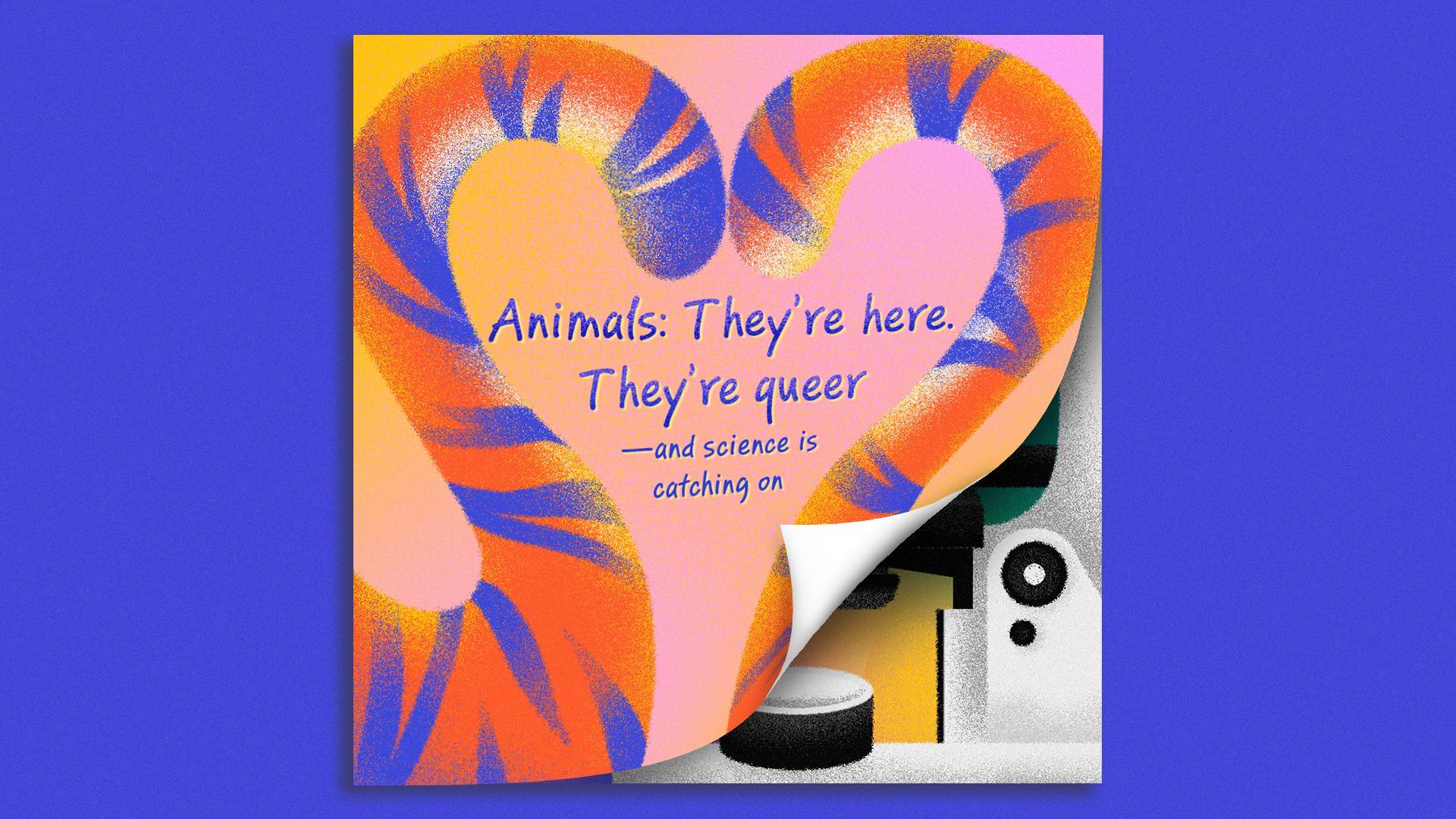
See full comic here; Illustration: Allie Carl/Axios
It's Pride month, a good time to share this reminder: It's natural to be queer in the animal world.
Why it matters: Looking at animals strictly through a heteronormative lens has long limited scientific understanding and contributed to the othering of members of the LGBTQ+ community, per science experts.
What they're saying: "The dismissal of homosexuality in animals, and the treatment of such animals as freaks or as pejorative, helps reify negative attitudes toward sexual minorities in humans," science journalist Rachel E. Gross writes in "Vagina Obscura," paraphrasing biologist Joan Roughgarden.
The big picture: Assuming all species only form female-male pairings that lead to reproduction — and are fixed when it comes to sexuality and gender — has had scientists overlooking the normal behaviors of several animals, from doodlebugs to dolphins.
Zoom in: In the 1830s, entomologists began observing the male-male sex of the common cockchafer (aka doodlebug or Maybug), and couldn't explain the behavior within the typical Darwinian framework of sexual selection.
- One scientist finally suggested in 1896 that the male-male pairing was simply a preference — he was scolded, says science journalist Eliot Schrefer, who wrote "Queer Ducks (and Other Animals): The Natural World of Animal Sexuality."
- "It explains why, after this decade where same-sex behavior was published and was sort of a lightning rod, it kind of disappeared. It's also the same century when you had a lot of capital punishment laws against sodomy among humans," Schrefer tells Axios.
Zoom out: Same-sex sexual behavior has been recorded in more than 1,500 animal species in well-regarded scientific journals, according to Nature.
Here are some LGBTQ+ animal examples Schrefer highlights in his book.
BONOBOS
- The intrigue: These primates share almost 99% of their DNA with humans.
- What we learned: Female with female sex is the most common form of sexual intimacy among bonobos. "It's actually a structuring element of their society to have what's basically sexually connected mothers," Schrefer says.
BOTTLENOSE DOLPHINS
- The intrigue: "Every whale species — in which someone has actually gone and done the numbers — has homosexual sex," Schrefer says.
- What we learned: The majority of dolphin sex is between males, which is related to the fact that the "only lasting pairing in dolphin society is between males," he says.
PENGUINS
- The intrigue: Zookeepers initially misgendered a pair of penguins at the Edinburgh Zoo, because they assumed all of the couples were male/female (sex is hard to determine in penguins). They weren't.
- What we learned: In our terms, many penguins could be considered bisexual and sexually non-monogamous. Same-sex penguin couples have also been documented caring for eggs and performing mating rituals at the Berlin Zoo and Central Park Zoo — penguins in the latter inspired a children's book that's been banned in certain places.
CLOWNFISH
- The intrigue: They — like a few hundred other animal species — can change sex.
- What we learned: A study found that clownfish have one female who's like a queen in their group, and if she dies, one of the big fish under her becomes female and the new queen. "All sorts of animals really blur the line between male and female, whether it's a kind of a designed constant part of their group like in the clownfish, or whether it's a capacity to help them all survive, like in reptiles and amphibians," Schrefer says.
The latest: Peacock's new documentary, "Queer Planet," covers nature's LGBTQ+ community with scenes that explore sexualities and genders in animals and plants, Axios' Maxwell Millington writes.
Behind the scenes: The 90-minute film includes commentary from scientists including an ornithologist, primatologist, entomologist, mycologist and several biologists.
Go deeper: Read the Axios comic about queer animals.
