How faculty and staff are supporting student protesters

Add Axios as your preferred source to
see more of our stories on Google.
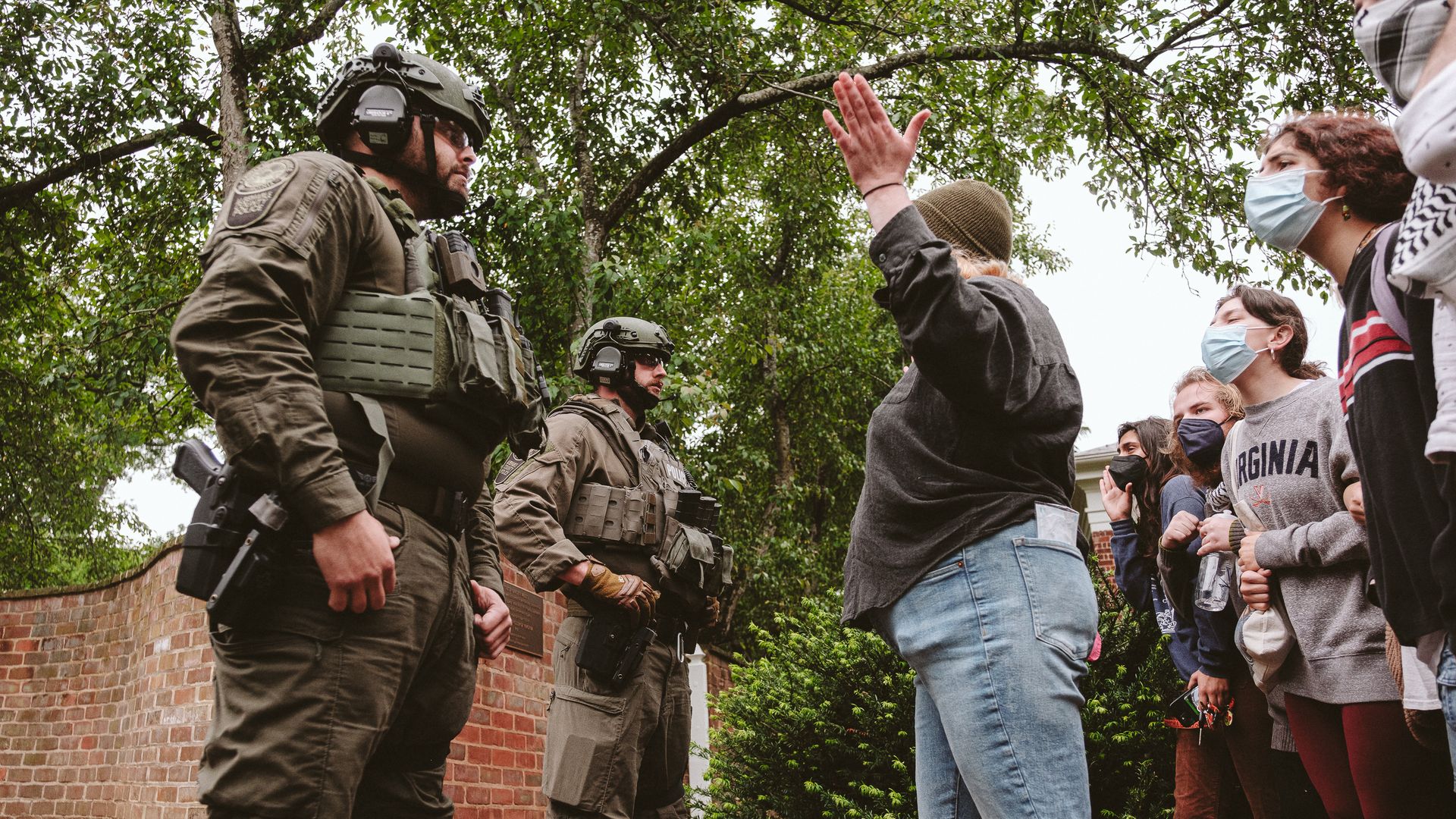
A protester at the University of Virginia confronts the police on May 4 in Charlottesville, Virginia. Photo: Eze Amos/Getty Images
Campus protests over the Israel-Hamas war have largely simmered as students left their universities for the summer, but faculty and staff have found different ways to keep the conversation going — and push back against their administratons.
The big picture: Some faculty and staff have held administrations accountable for their crackdowns on student protesters, through picket lines and walk-offs, or other means.
- Several faculty groups, including at Columbia University, have taken votes of no confidence against university leadership. Others, like faculty at USC and Dartmouth, have voted to censure their presidents.
Between the lines: Such symbolic votes have lost a lot of the weight they once held, Eddie R. Cole, a professor of education and history at UCLA, told Axios.
- "Historically, if a president received a vote of no confidence, it used to be the professional kiss of death," he said. "That isn't the case anymore."
- "Universities are run by administrators who have more power than they ever did before," Jonathan Zimmerman, a professor of education at the University of Pennsylvania, told Axios. "But I think that the more that faculty raise their voice, the more the administrators have to walk on eggshells."
Yes, but: Censure or a confidence vote is still an important gesture to show support for the students and reflect to university leadership where the majority of faculty stands, Cole said.
- Faculty can also support students by creating and facilitating spaces for them to have dialogue about what's going on, Cole, who led a teach-in on activism at UCLA last month, said.
- "On many campuses, the abrupt use of police to quickly end protests and encampments and other forms of resistance shows the shift toward the quick, ultimately stifling of dialog and conversation," he added.
- The free exchange of ideas, even around difficult topics, has been "a cornerstone of American higher education," Cole said. "Yet, we have not seen as many opportunities for students to have really robust dialog around their issues, and that is a role that faculty can play."
Walter Heinecke, associate professor at the University of Virginia, served as a faculty liaison during the recent pro-Palestinian student protests.
- "We were not telling the students what to do or not to do," Heinecke told Axios. "It was their protest, their decision, their lives."
- But, he said faculty "have a responsibility to care for our students and to create an environment in which they can learn. When they're being brutalized by militarized police on campus, it undermines the ability for us to do that."
Worth noting: While tenured professors have the job security to participate in such ways, it's trickier for other faculty and staff because they can be fired or placed on leave.
- "Tenure gives you very strong protections to say and write what you think," Zimmerman, who himself recently wrote op-eds about academia's selective defense of academic freedom, said.
- "Increasingly, the people we're hiring to teach in our universities don't have free speech protections because they don't have tenure," Zimmerman said.
- "Those people can't speak up safely in the same way that I can."
Go deeper:
