U.S. scrambling to prevent Israel-Hezbollah war amid Gaza ceasefire push

Add Axios as your preferred source to
see more of our stories on Google.
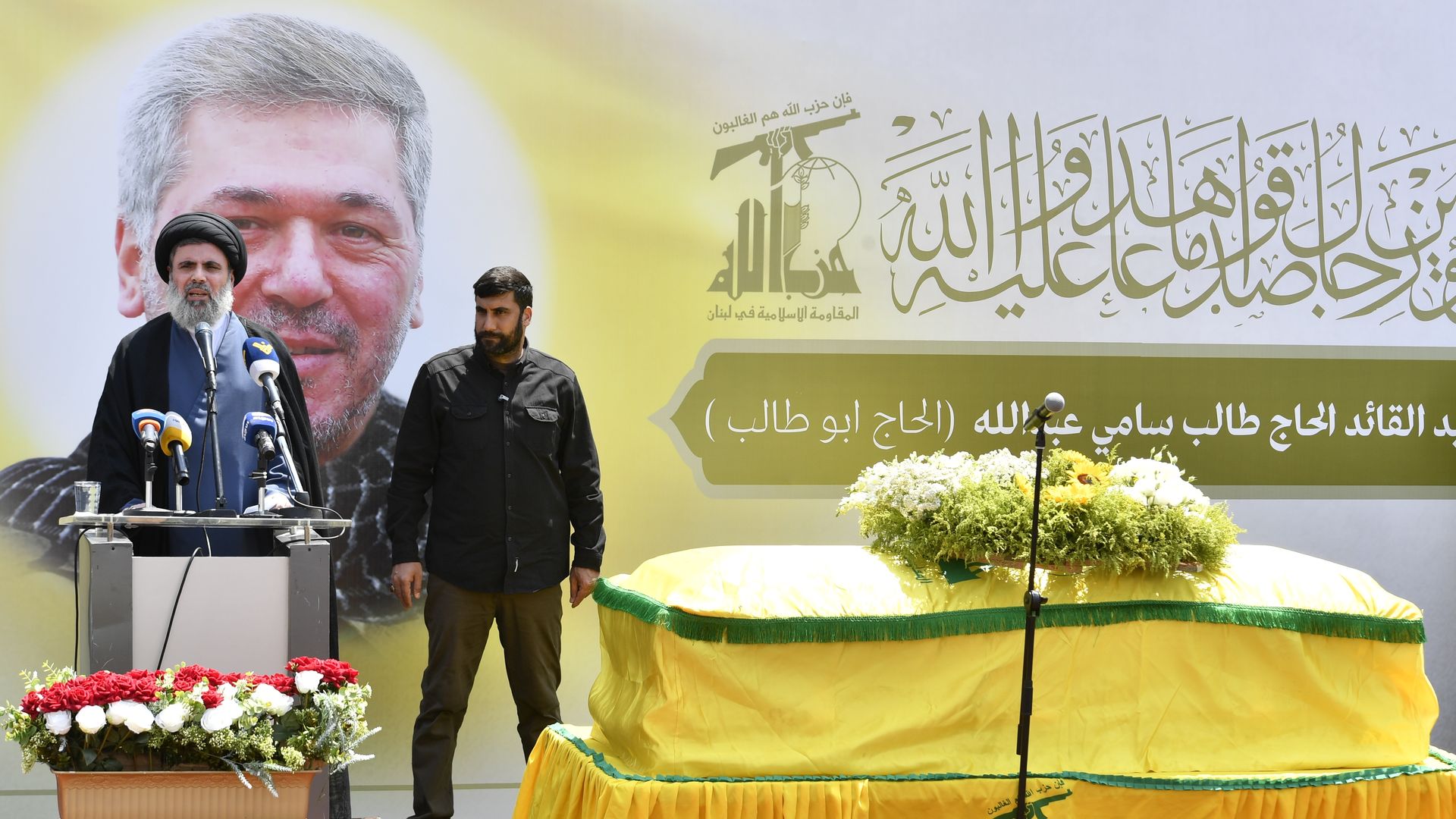
Chief of Lebanese Hezbollah's Executive Council Sayyid Hashim Safiuddin (L) gives a speech during a funeral ceremony held for Hezbollah commander Taleb Abdullah on Wednesday. Photo: Houssam Shbaro/Anadolu via Getty Images
The Biden administration has grown extremely concerned that escalating violence between Israel and Hezbollah in recent days will deteriorate into an all-out war — and is scrambling to prevent it, according to U.S. officials.
Why it matters: Amid the highly sensitive push to reach a ceasefire deal in Gaza, a full-blown war with the Lebanese militant group would dramatically exacerbate the regional crisis and draw the U.S. deeper into the conflict.
Behind the scenes: The Biden administration has cautioned Israel in recent weeks against the notion of "a limited war" in Lebanon — warning that Iran could intervene and flood Lebanon with pro-Iranian militants from Syria, Iraq and even Yemen who would want to join the fighting.
- The U.S. is concerned about Israel rushing into a war with Hezbollah — or getting dragged into one — without a clear strategy or consideration of the full implications of a wider conflict, officials say.
- U.S. officials say the Biden administration is trying to contain the fighting between Israel and Hezbollah as much as possible while working to secure a hostage-ceasefire deal in Gaza.
- The White House believes that a ceasefire in Gaza is the only thing that would significantly de-escalate the tensions on the Israeli-Lebanese border.
Driving the news: Israel conducted an airstrike on Tuesday that killed a senior Hezbollah commander in the town of Jwaya, around six miles north of the border.
- Taleb Sami Abdullah was the commander of the militia's "Naser" unit, which is in charge of Hezbollah operations in the eastern part of the border with Israel. Three of his aides were also killed in the strike.
- Abdullah — whose rank was the equivalent to a brigadier general, according to IDF officials — was the most senior Hezbollah commander killed since Oct. 7.
- Al-Akhbar newspaper, which is affiliated with Hezbollah, acknowledged that Abdullah was a prominent field commander and that his death had dealt a significant blow to the militia.
Between the lines: During Abdullah's funeral on Wednesday, the head of Hezbollah's executive committee, Hashem Safi al-Din, said the organization would ramp up its attacks against Israel in both quantity and quality.
- Hezbollah implemented its threats and on Wednesday launched 200 rockets at Israel — the most wide-ranging attack since Oct. 7.
- One of the Israeli targets that Hezbollah attacked was a factory for armored vehicles.
State of play: On Tuesday evening, Secretary of Defense Lloyd Austin called his Israeli counterpart Yoav Gallant and discussed the situation with Lebanon, Pentagon deputy spokeswoman Sabrina Singh told reporters.
- "We are concerned about an increase in activity in the north. We don't want this to escalate to a broad regional conflict and we urge de-escalation," she said.
- The commander of the Lebanese army, Gen. Joseph Aoun, is visiting Washington this week for meetings with White House and Pentagon officials and members of Congress about the current crisis.
What they're saying: Secretary of State Antony Blinken said during a press conference in Doha on Wednesday that "it's safe to say that actually no one is looking to start a war."
- He added that most of the parties involved believe that there can and should be a diplomatic resolution to the differences that could spark a broader conflict.
- "What I've heard from everyone concerned and others who are working on this is there's a strong preference for a diplomatic solution," Blinken stressed.
- While traveling with President Biden to the G7 summit in Italy on Wednesday, White House national security adviser Jake Sullivan told reporters aboard Air Force One that the U.S. "is particularly concerned" about the exchange of fire across the border with Lebanon. He stressed that the U.S. is in close consultation with Israel on this issue.
