America's critical shortage of school counselors

Add Axios as your preferred source to
see more of our stories on Google.
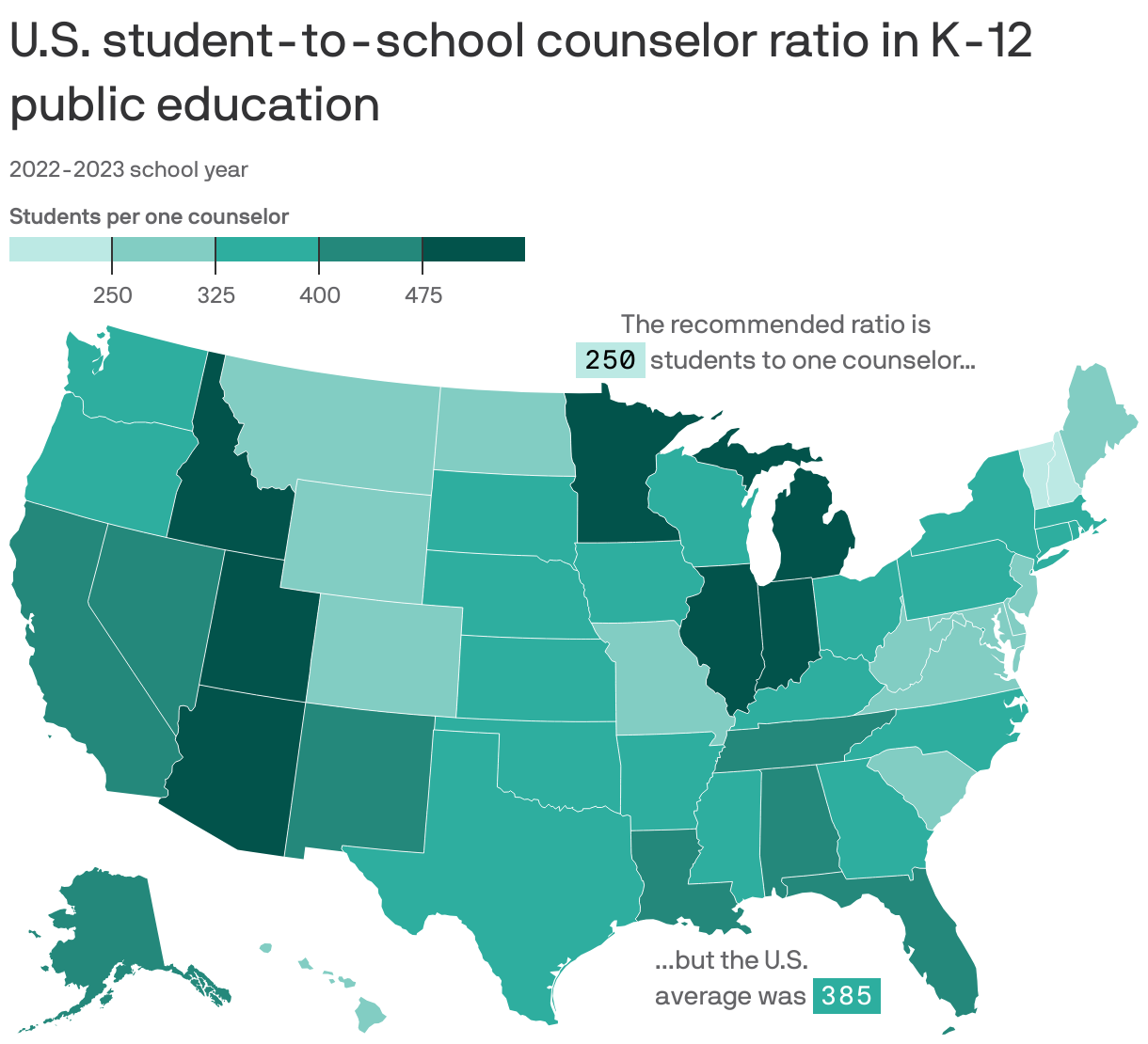
The American West and Midwest lead the U.S. with the highest student-to-school counselor ratios, an Axios review of federal data has found.
- Schools in these regions also have some of the highest rates of racial resegregation in states over the last 30 years.
Why it matters: Experts say the disparity of school counselor access disproportionately hurts students of color seeking mental health help or advice in applying to college in a post-affirmative action world.
The big picture: The growing shortage of school counselors is also hitting schools amid a rise in social media bullying and school shootings.
State of play: An Axios review the American School Counselor Association's (ASCA) analysis of federal data found that Arizona, a state with a large Latino and Native American population, had the worst student-to-school counselor ratio in the nation — 667-to-1 during the 2022-2023 school year.
- That's more than double the ASCA-suggested ratio of 250.
- Michigan had the second-highest ratio (598), followed by Minnesota (544), Indiana (519) and Illinois (501).
- The national average was 385.
The intrigue: Vermont (177) and New Hampshire (199) had the nation's lowest rates. The student population there is smaller than in other states and predominantly white.
- Colorado had a ratio of 261, which has dropped from nearly 300 in 2019 thanks to a grant program to hire more school counselors in low-income areas.
Stunning stat: Nationally, there are an estimated 8 million students without access to a school counselor, according to The Education Trust.
- Of those students, 1.7 million attend a school with police but no school counselor on campus, demonstrating a focus on policing over mental health or college preparedness.
Zoom in: School counselors are certified educators who help students navigate behavioral challenges, boost achievement, plan out class schedules, set goals, and explore career and college options.
- They serve as liaisons between students and mental health professionals, state child protective service agencies and university recruiters.
- School counselors are typically the first to know a child is facing abuse, struggling with hunger or contemplating suicide.
What they're saying: "Having fewer school counselors prohibits students from being identified or being seen," Eric Sparks, ASCA deputy executive director, tells Axios.
- A higher ratio of students to school counselors is especially evident in racially segregated schools and those with a higher percentage of incoming students, Sparks said.
- "Unfortunately, when it gets too high, it increases the likelihood that a student is going to fall through the cracks."
Zoom out: Based on states that report elementary and middle school counselors and secondary school counselors separately (37 states), the ASCA calculated average ratios of 737-to-1 for pre-K-8 school counselors and 232-to-1 for high schools.
- The U.S. Bureau of Indian Education, which oversees schools on Native American reservations that receive federal support, had a ratio of 179.
Between the lines: Not only is there a shortage of school counselors, but various studies show a lack of Latino and Black school counselors in many districts.
- For example, only 11% of school counselors nationally are Latino compared to 28% of students in K-12 public schools, according to The Education Trust.
What we're watching: The ASCA recommends that states pass legislation or introduce policies that offer alternative licensing options and pay incentives to attract more school counselors.
