Sizzling oceans tee up record-shattering summer for U.S.

Add Axios as your preferred source to
see more of our stories on Google.
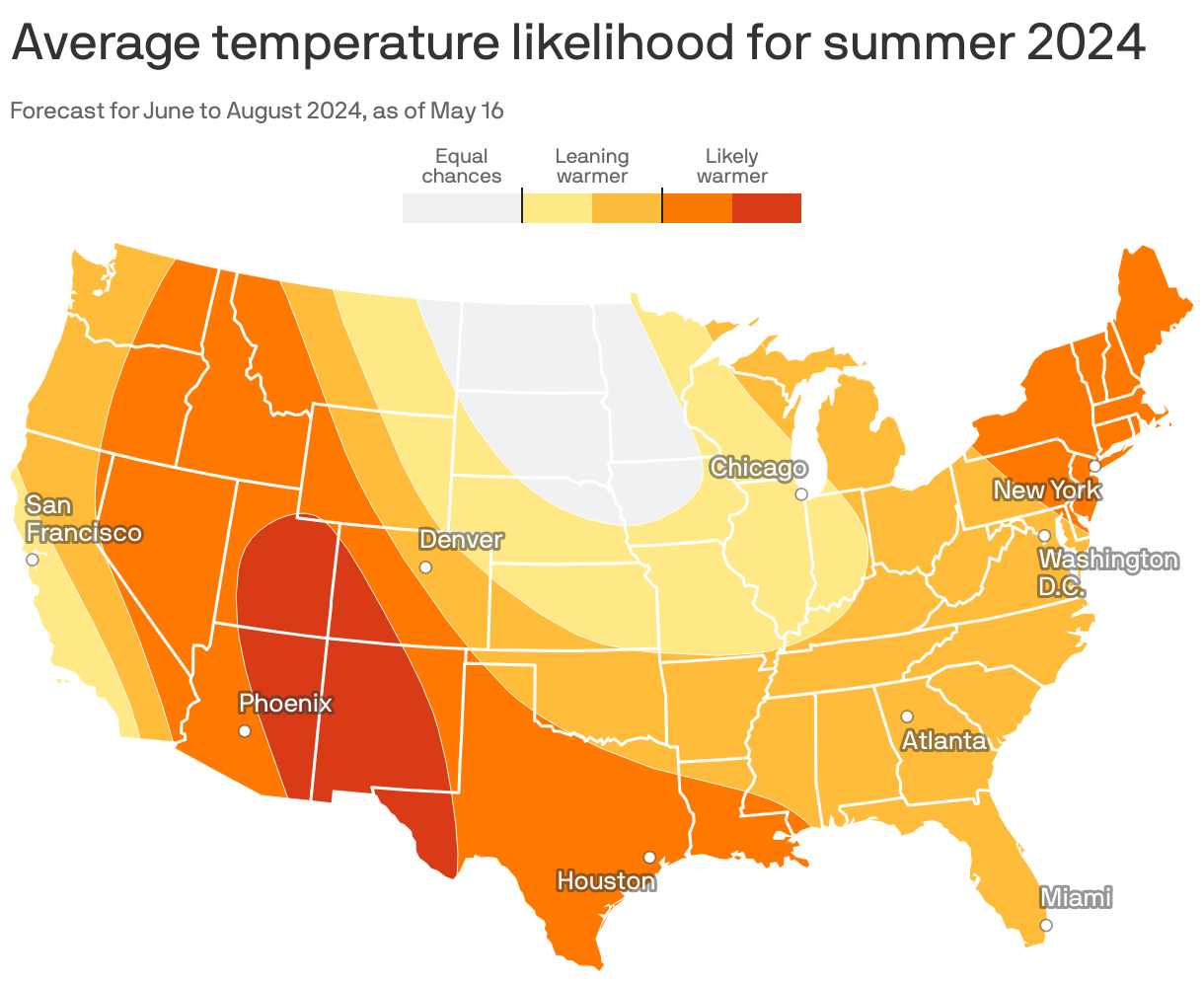
The continental U.S. could challenge its record for the hottest summer to date, according to the latest seasonal climate outlook released Thursday and other recent data. For millions along the Gulf Coast, the heat and humidity have already begun.
Why it matters: Heat is the top weather-related killer in the U.S. in a typical year. A combination of factors is coming together to make this summer particularly hazardous for the Lower 48 states.
- The Department of Health and Human Services recorded 2,302 heat deaths in the U.S. in 2023, up from years prior but potentially still an undercount based on how the data is collected.
Zoom in: First, there is the oceanic role. Unusually hot ocean waters can be found in the Gulf of Mexico as well as in the Caribbean, along the east coast of Florida and also northward along parts of the eastern seaboard.
- These unusually warm waters are already playing a role in elevating temperatures and increasing humidity levels, particularly in South Florida and southeastern Texas.
Stunning stat: Key West, Fla., recorded an all-time record warm heat index on Wednesday of 114.4°F, for example, and high temperatures this week have been in the upper 90s in much of South Florida.
- According to Climate Central's Climate Shift Index, human-caused climate change likely quintupled the odds of the stifling overnight minimum temperatures from Tampa southward to the Florida Keys on Wednesday night
The big picture: Events in the tropical Pacific Ocean also factor into NOAA's summer outlook.
- An El Niño event is transitioning into an likely La Niña, which would feature cooler than average ocean waters in the equatorial tropical Pacific Ocean.
- Summer weather patterns that are typically linked with La Niña include heat and drought in the Southwest, which NOAA is forecasting for this summer. However, forecasters stated on a press call that Southwestern heat and dryness is also a signal tied to long-term climate change.
Threat level: Given the sizzling ocean temperatures in the Atlantic as well as the Pacific, record global warmth that has persisted for the past 11 months straight, and the transition already underway from El Niño to La Niña, it is not out of the question that summer 2024 will be among the hottest on record across the Lower 48 states.
- In fact, given long-term, human-caused climate change, it is perhaps likely that this summer may rival the previous hottest seasons of 2021 and 1936.
Between the lines: On Thursday, Dan Collins of the Climate Prediction Center said, "Above normal seasonal mean temperatures are more likely across most of the U.S. as well as Alaska" during the meteorological summer months of June through August.
- The only part of the U.S. likely to have cooler than average temperatures is southwestern Alaska because of below normal ocean temperatures nearby.
- One potentially worrisome trend is the likelihood of below average precipitation and unusually warm temperatures across the Southwest and West overall, which could lead to an active second half of the wildfire season, despite abundant winter precipitation in most areas.
