Globe records its hottest April on record, with subtle signs of a shift

Add Axios as your preferred source to
see more of our stories on Google.
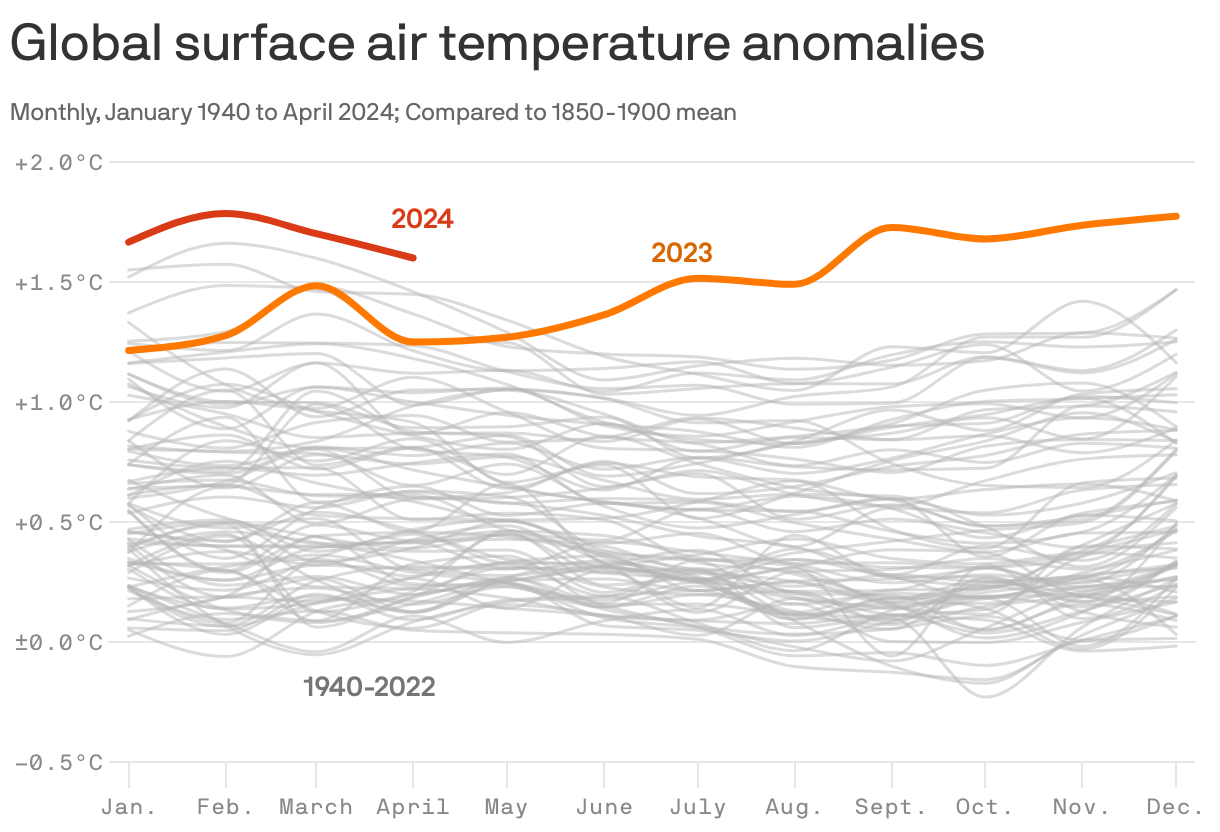
The globe recorded its hottest April on record, extending its record hot streak to 11 straight months, according to new data.
Why it matters: Temperatures on land and in the sea are having major impacts on people around the world, including ongoing, deadly heat in Southeast Asia.
- Due mainly to a combination of an El Niño event and human-caused climate change, plus an unknown X-factor, this global heat streak has raised fears of breaching the Paris targets earlier than expected.
- It has also sparked uncomfortable questions about the scientific understanding of warming rates.
Zoom in: Last month, global average surface temperatures were 1.6°C (2.88°F) above the preindustrial average, according to preliminary data from the Copernicus Climate Change Service in Europe.
- This exceeded the most ambitious target laid out in the Paris Agreement, but only for a short period. The agreement's 1.5°C (2.6°F) aspirational target applies to multiple decades.
- The world's oceans were hotter than in any previous April and extended that streak to 13 months, according to climate expert Brian Brettschneider.
- In addition, April extended the duration of the warmest 12-month global running mean temperature on record.
The intrigue: This year marked the first time that the 12-month running mean eclipsed the 1.5°C target.
- Climate scientists add weight to that metric rather than individual monthly milestones, since the latter can be caused by temporary fluctuations.
Yes, but: Month-to-month milestones do provide insights into what is influencing global average temperatures during the shorter term, and whether warming may be speeding up or slowing down.
- Scientists are paying close attention to global average temperatures this summer, since there was more warming during 2023 into 2024 than what was expected from a combination of El Niño and human-caused climate change.
Between the lines: During the past year, global average temperatures have received a boost from El Niño, which is a natural climate cycle in the tropical Pacific Ocean.
- However, that is now fading and is predicted to shift into a La Niña mode by early fall. This would feature below-average water temperatures in the tropical Pacific and may dampen global average temperatures.
- Along those lines, 2024 temperature anomalies so far, while still running above last year's record-shattering levels, have been diminishing somewhat.
What's next: It is very likely that this year will wind up as either the hottest or second-hottest year on record, but that second-place finish is looking increasingly plausible.
- NOAA will reveal its updated projection with its temperature data during the next two weeks, with data due out from NASA and Berkeley Earth as well.
