White House moves to stem wave of Chinese EVs

Add Axios as your preferred source to
see more of our stories on Google.
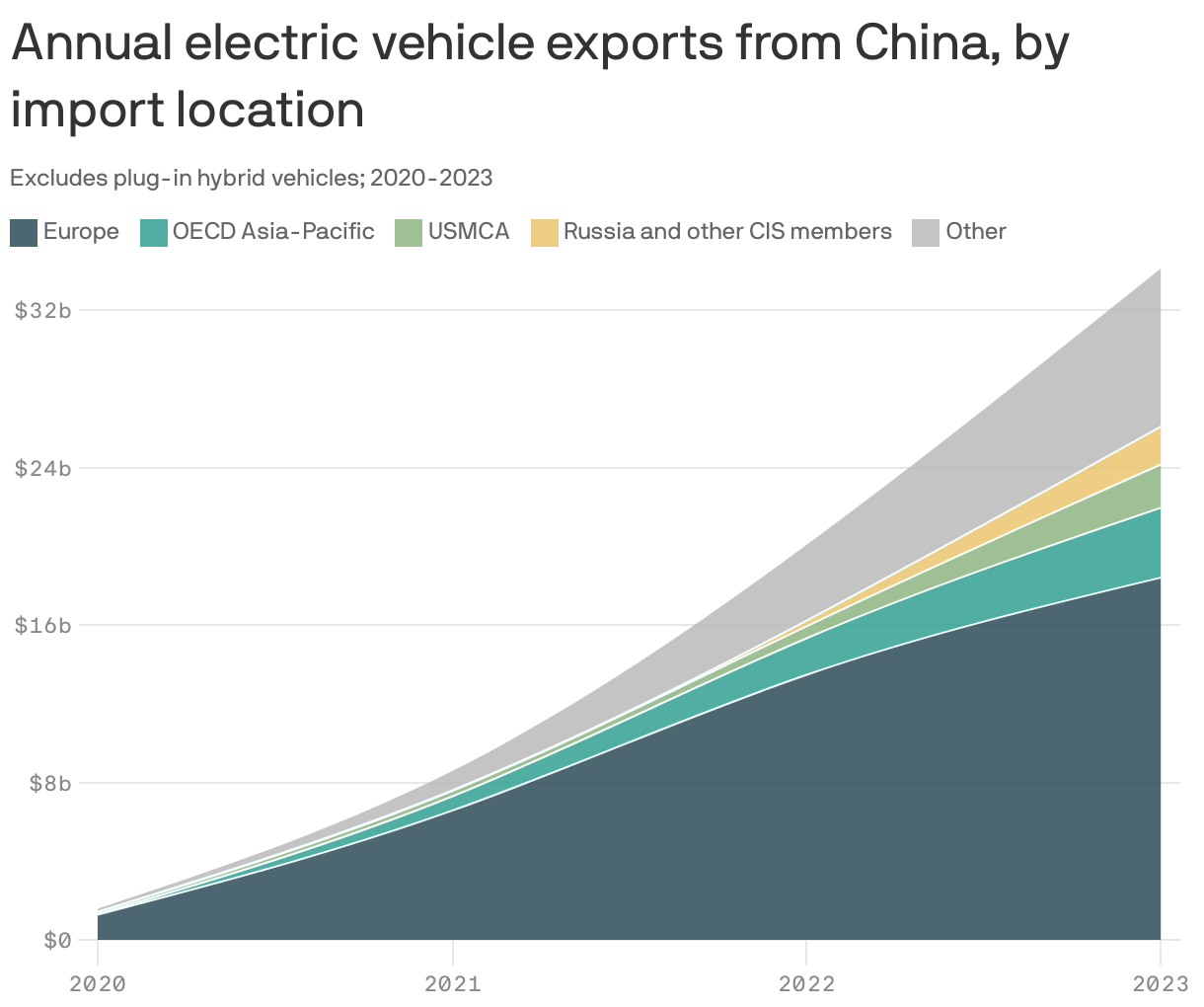
China's rapidly rising electric vehicle exports are forcing the White House to weigh climate goals against industrial policy — and the latter has the upper hand for now.
Why it matters: The world's second-largest economy is cranking out lots of affordable EVs, just as the White House increasingly views chargeable cars as a weapon in the fight against global warming.
- The White House wants EVs at 50% of U.S. sales by 2030, and looming EPA rules could effectively force much higher levels soon after.
Friction point: Biden officials also want clean tech made in the U.S., a big goal of the 2022 Inflation Reduction Act.
- Their economic pitch touts a green manufacturing surge that provides a bulwark against China. There are also fears of security threats from Chinese tech.
- Last week the White House, warning of a "flood" of Chinese cars, announced a Commerce Department probe of security risks from "connected" vehicles from there.
State of play: Chinese-branded EVs aren't for sale in the U.S. and very few have made it here, thanks in part to 27.5% tariffs. But they still could be low-cost enough to compete.
- And Chinese automakers potentially building factories in Mexico, which has a fluid trade relationship with the U.S., could open new avenues.
What's next: "The probe will inject uncertainty into Chinese plans to site EV manufacturing facilities south of the border, increasing investment risks and reducing the probability of [final investment decisions]," Joseph Webster of the Atlantic Council's Global Energy Center, tells me via email.
Quick take: EVs represent the deepest tensions between White House climate ambitions, economic goals and foreign policy.
- The 2022 law tethers big consumer EV subsidies to cars with battery materials sourced domestically from free-trade partners — but not China, a dominant player in those markets.
- There's also a political overlay. U.S. automakers see Chinese EVs as a major threat, and auto workers fear the EV transition will come at their expense.
What we're watching: The Atlantic Council's Webster, in a new post, says the U.S. and allies should develop a "joint, balanced" approach to managing competing goals.
- Among his recommendations: an "interim" policy, while the Commerce probe proceeds, that keeps Chinese EVs with sensors from "reaching locations sensitive to U.S. and allied security."
The bottom line: "There's almost an across-the-board apprehension about Chinese EVs, even though they would make an important contribution to [lower] CO2 emissions," Gary Clyde Hufbauer, a trade analyst at the Peterson Institute for International Economics, tells Vox.
