"Extraordinary torrential downpours" flood Southern California


Add Axios as your preferred source to
see more of our stories on Google.

City workers close a road after a creek overflows during heavy rains in Zuma Beach on December 21, 2023 in Malibu, California. Photo: Apu Gomes/Getty Images
A storm that's been flooding Southern California streets with historic rainfall, disrupting travel and prompting water rescues and evacuations is expanding into the Southwest on Friday.
The big picture: The slow-moving storm on Thursday morning dumped a month's worth of rain in one hour on Oxnard, a Ventura County city west of Los Angeles. As of Friday morning, more than 26 million people were under flood watches from Southern California to Central Arizona.
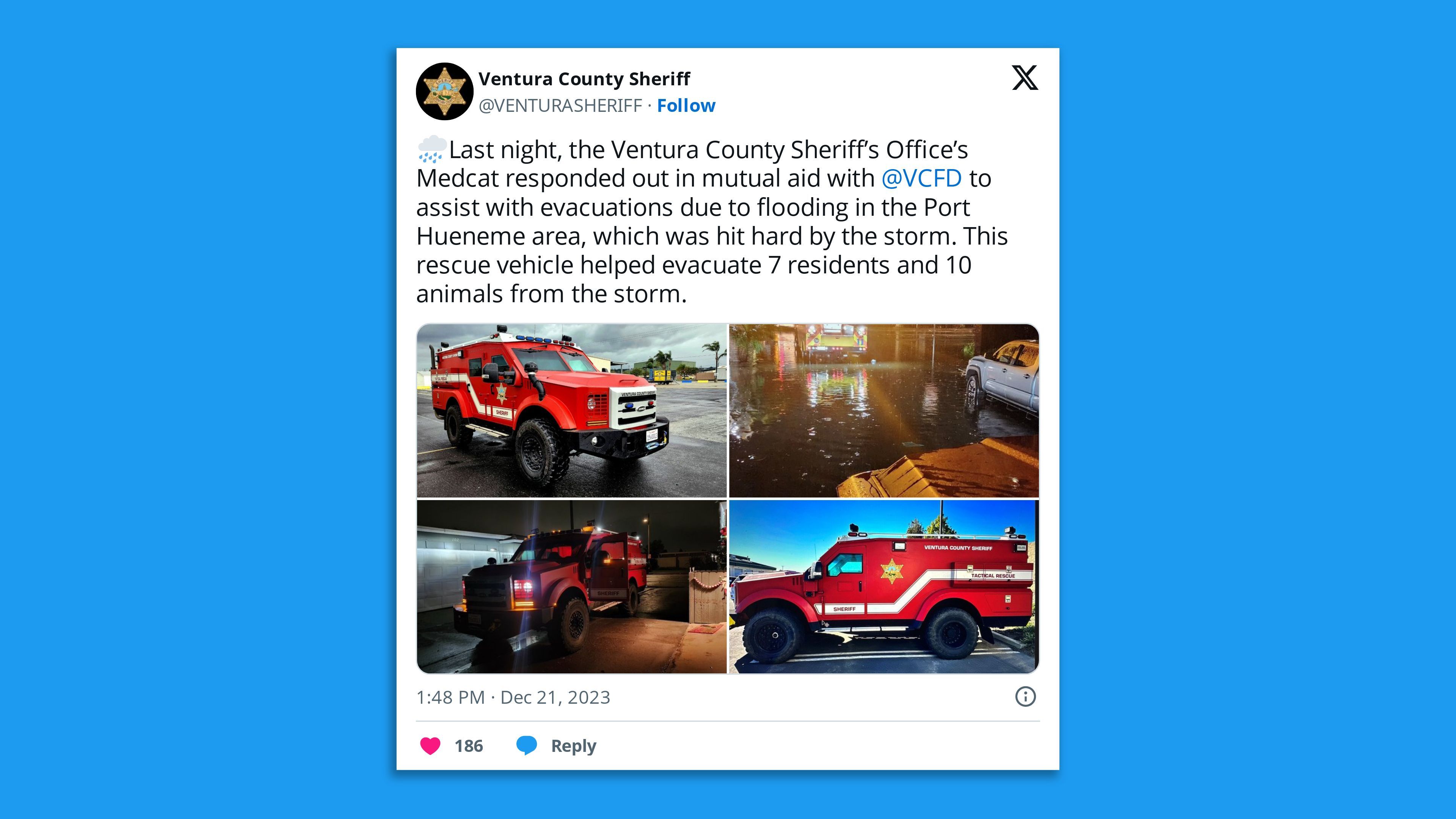
Why it matters: The "dramatic" storm has already unleashed historic rainfall rates. Daniel Swain, a climate scientist with UCLA, said during a Thursday briefing that the Ventura County downpour is likely "the heaviest rainfall that has been observed in this area in recorded history and is likely a multi-centennial kind of event,"
- "These are genuinely extraordinary torrential downpours and importantly, they're continuing."
The latest: The National Weather Service said that Southern California would continue to see heavy rainfall Friday morning.
- It predicted "upwards of 8 inches" of rain in the region with a "significant flash flood risk in place for the mountain ranges, recent burn scars and urban areas."
- In Arizona, the agency predicted "some isolated to scattered areas of flash flooding," but that noted that much of the precipitation would be "beneficial."
- The National Weather Service in Phoenix said the city was experiencing light to moderate rainfall Friday morning as the storm moved into the area.
By the numbers: Rocky Butte, San Luis Obispo County, Calif. recorded more than 16 inches of rainfall as of Friday morning, and Old Man Mountain, Ventura County, saw nearly 14 inches, preliminary NWS data shows.
- Six other Southern California places recorded over 10 inches of rain, including five in Santa Barbara County and one in Ventura County.
- Los Angeles County also received a soaking, with NWS data showing San Fernando Valley recorded up to 4.82 inches of rainfall and Santa Clarita up to 3.58 inches while the mountains saw up to 5.2 inches fall.
Context: Climate change is increasing the frequency and magnitude of precipitation extremes, studies show. The storm was able to tap into a narrow current of air rich in water vapor that flowed from southwest to northeast across the tropical Pacific.
- Such "atmospheric rivers" tend to be responsible for California's heaviest rainfall events, and the state may see more of them than usual this winter given an El Niño event is taking place in the tropical Pacific.
Go deeper: Extreme precipitation risks currently underestimated
Andrew Freedman contributed reporting.
