Scoop: Israel "likely" to open Gaza-Israel crossing to allow more aid into enclave

Add Axios as your preferred source to
see more of our stories on Google.
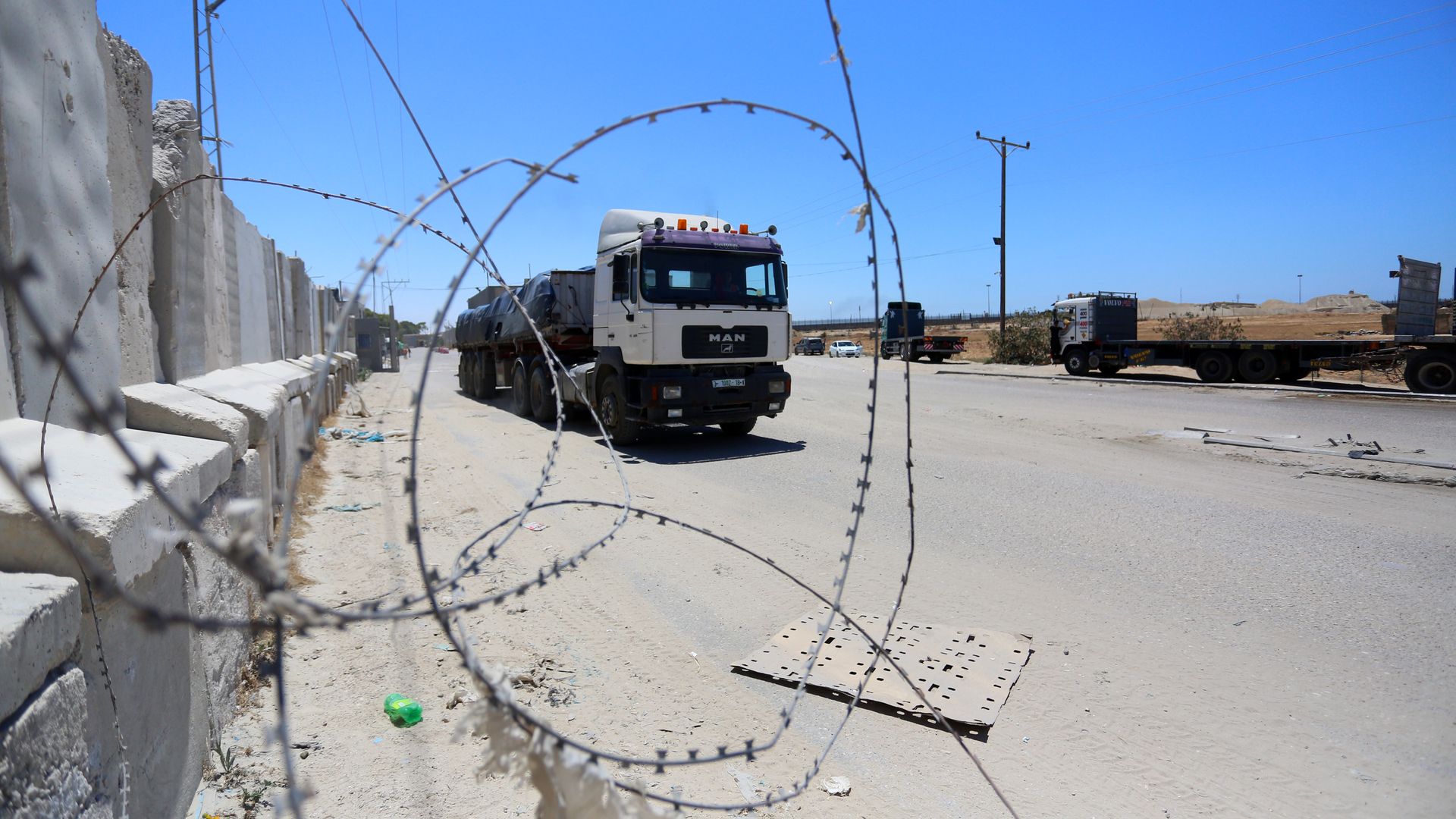
A truck carrying rice enters Gaza at the Kerem Shalom cargo crossing with Israel, in Rafah, southern Gaza Strip, on June 21, 2021. Photo: Majdi Fathi/NurPhoto via Getty Images
Under mounting U.S. pressure, the Israeli government will "likely" soon reopen the Kerem Shalom border between Israel and southern Gaza to allow aid trucks to enter the enclave, senior Israeli officials told Axios on Tuesday.
Why it matters: If Israel reopens the crossing, it will represent a significant shift in its policy, which has been to refuse to allow any aid to enter Gaza through its territory since the Oct. 7 attack.
- Instead, aid trucks have entered the enclave via the Rafah crossing on the Gaza-Egypt border.
Driving the news: The U.S. has been pressing Israel to reopen the Kerem Shalom crossing, also known as Kerem Abu Salem in Gaza, which would enable more than 300 aid trucks total everyday.
- "Rafah cannot absorb a sufficient amount of aid to meet the needs of the Palestinian people which are only growing as there have been more people displaced," White House national security adviser Jake Sullivan told CNN on Tuesday.
Sullivan added there is a need for the capacity that Kerem Shalom provides "on an emergency basis to get more food, water, medicine and essentials to be distributed to Palestinian civilians."
- Sullivan is expected to arrive in Israel on Thursday to Israeli Prime Minister Benjamin Netanyahu and other senior Israeli officials.
- The reopening of the crossing is one of the key U.S. demands ahead of Sullivan's visit, Israeli officials said.
What they're saying: A senior Israeli official said the war cabinet is discussing the U.S. request to reopen the crossing, but no decision has been made.
- A second senior official added that Israel recognizes that the Rafah crossing between Egypt and Gaza can't handle the dire humanitarian need in Gaza and that a Kerem Shalom decision "is likely to happen soon."
- "It's not effective, trucks are getting jammed. There is a real necessity here and we don't want people to die because of a humanitarian crisis," the official said, adding that Israel will disconnect itself from Gaza after the war, but for now, it has no other choice but to allow aid to enter the enclave through Israel.
- This is also because Israel wants to maintain U.S. support for the ongoing ground operation in Gaza, the Israeli officials stressed.
- The prime minister's office declined to comment.
Zoom in: About 100 trucks carrying humanitarian supplies have entered through the Rafah crossing daily since fighting resumed at the beginning of this month — "well below" the daily average of 500 truckloads of supplies that entered the enclave before Oct. 7, the UN humanitarian aid office has said.
- The already dire humanitarian conditions in the enclave have significantly worsened since the end of the seven-day ceasefire between Israel and Hamas on Dec. 1, according to the UN humanitarian office (OCHA).
In the southern border city of Rafah, aid distribution is limited, with large crowds waiting for hours to receive assistance, OCHA said on Tuesday. "In the rest of the Gaza Strip, aid distribution has largely stopped over the past few days, due to the intensity of hostilities and restrictions of movement along the main roads," the UN aid office added.
- Israel announced on Monday that it will allow scanning machines in Kerem Shalom to increase the number of trucks that can pass through security checks and expedite their arrival into Gaza through the Rafah crossing.
- More than 18,400 Palestinians have been killed since the war began, according to the Ministry of Health in Hamas-run Gaza.
