STEM gender gap shows no signs of closing with Gen Z

Add Axios as your preferred source to
see more of our stories on Google.
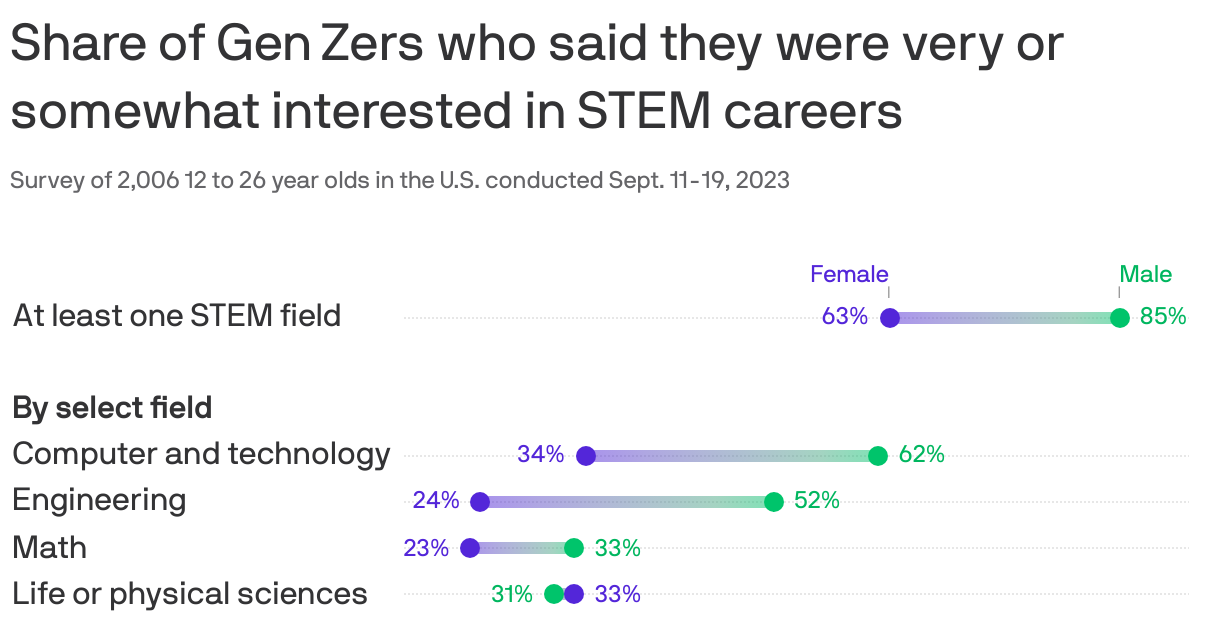
The gender disparity in pursuing STEM careers persists among young people ranging from tweens to recent grads, new data shows.
Why it matters: Like their older counterparts, girls aren't warming to STEM, as diversity in the field is critical for representative and responsible advancements — and despite efforts designed to boost their participation.
- More 12- to 26-year-old boys and men were interested in pursuing STEM careers than girls and women, who expressed a high lack of confidence in their abilities, per Gallup-Walton Family Foundation Survey data released Tuesday.
- "Despite much investment in STEM education — including in initiatives to reduce disparities in STEM participation by gender — significant gender gaps persist," the report said.
By the numbers: 57% of female respondents said they don't think they would be good at a STEM career, versus 38% of males.
- In a smaller gap, 61% of female Gen Z members said they don't enjoy the subjects, compared to 58% of males.
Zoom in: 85% of males said they were interested in at least one STEM field, compared to 63% of females.
- Computer and technology: 62% of males interested, 34% of females interested
- Engineering: 52% of males interested, 24% of females interested
- Math: 33% of males interested, 23% of females interested
- Life or physical science: 31% of males interested, 33% of females interested
All students were equally likely to say their schools supported STEM development, per Gallup.
- A stark pay gap also affects women who pursue STEM fields, according to a 2021 Pew Research Center report.
Zoom out: The lack of diversity in industries that represent so much of the workforce limits the potential of advancement in STEM fields, a report from the Massachusetts Institute of Technology said.
- "Closing the gender gap will not only bolster sustainable tech-enabled growth and innovation but is also deemed an economic necessity," the report said.
- Stereotypes, lack of role models, unconscious bias and work-life imbalance have been attributed for the lack of gender diversity.
Methodology: 2,006 respondents ages 12 and 26 responded to a web survey, conducted by Gallup and the Walton Family Foundation, between Sept. 11-19.
Go deeper: Austin STEM exercise aims to encourage girl gamers
