Biden's Iran danger

Add Axios as your preferred source to
see more of our stories on Google.
Photo illustration: Aïda Amer/Axios. Photo: Drew Angerer/Getty Images
A surge of attacks on U.S. forces in the Middle East — at least 66 since Oct. 17 — is forcing President Biden to navigate a dangerous tightrope on two life-and-death priorities:
- Protecting U.S. service members.
- Preventing the war in Gaza from escalating into a calamitous regional conflict.
Why it matters: Hamas' Oct. 7 terrorist attack and Israel's operation to eradicate the Palestinian militant group have turned the region into a tinder box at a key moment in which Biden is politically vulnerable at home.
Driving the news: Iranian-backed militants in Iraq used a close-range ballistic missile on U.S. forces at al-Asad air base Monday night, damaging infrastructure and causing non-serious injuries, according to the Pentagon.
- In response, the U.S. carried out an airstrike in Iraq for the first time since former President Trump ordered the killing of Iranian Gen. Qassem Soleimani in January 2020, killing some militants.
- On Tuesday night, the U.S. conducted "discrete, precision strikes against two facilities in Iraq," according to CENTCOM.
- The retaliatory attacks comes after Biden and his top officials had repeatedly warned Iran not to exploit the situation in Gaza, often by echoing one word: "Don't."
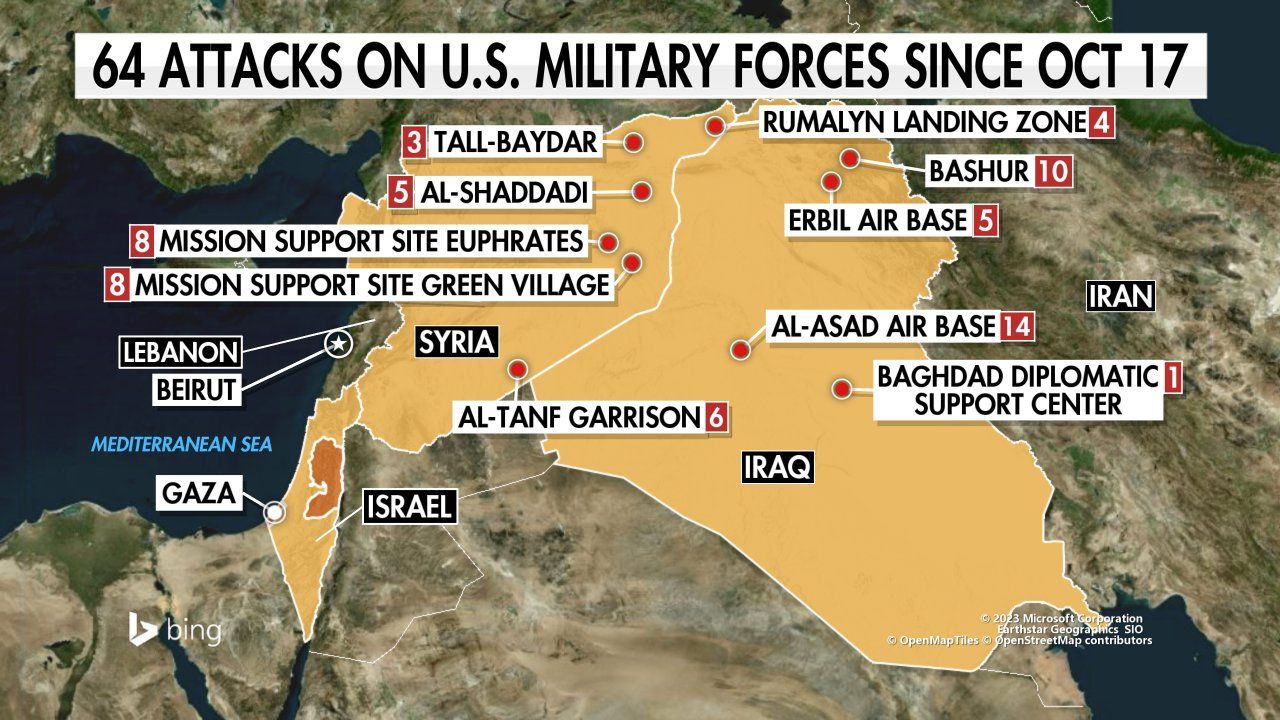
The big picture: While Iran's saber-rattling has not translated to direct military involvement over the last month, some critics have scoffed at the idea that Biden's words or policies have "deterred" the Islamic Republic.
- The Iran-backed Houthi rebels in Yemen yesterday hijacked a cargo ship in the Red Sea — believing it to be Israeli-linked — and since October have fired multiple missiles intercepted by the U.S. and Israel.
- White House National Security Council spokesman John Kirby said today the U.S. is considering re-designating the Houthis as a terrorist organization, a label Biden had rolled back within weeks of taking office.
- Senior Biden official Amos Hochstein arrived in Israel yesterday for talks on defusing tensions with Lebanon, amid concerns over escalating border skirmishes between the IDF and Iranian-backed Hezbollah.
Between the lines: Kirby also voiced concern today that Iran may provide Russia with ballistic missiles for its war with Ukraine, bolstering the nexus between two of the biggest global crises of Biden's presidency.
Zoom in: Foreign policy has played a remarkably outsized role in damaging Biden's approval rating over the last month, driven mainly by Democratic divisions over his backing for Israel's war in Gaza.
- With little daylight between GOP support for Israel and Biden's rhetoric since Oct. 7, Republicans have instead focused their attacks on what they see as the president's weakness toward Hamas patron Iran.
- Republicans hammered Biden for a September hostage deal that would have allowed Iran to access $6 billion in frozen funds — and are now ramping up criticism of a sanctions waiver established under Trump that allows Iraq to purchase electricity from Iran.
What to watch: A U.S. official noted to Axios that Biden has a "track record" of establishing deterrence during past cycles of attacks from Iranian proxies, including when he first took office and as recently as this past March.
What they're saying: "President Biden has shown he will never hesitate to take action to protect U.S. forces," NSC spokesperson Adrienne Watson said in a statement to Axios.
- "He has directed the U.S. military to conduct precision airstrikes in response to recent attacks against U.S. forces who are in Iraq and Syria to help defeat ISIS, and he is fully prepared to take further measures as needed at any given moment to protect our people."
