FTX's ex-general counsel says he never advised borrowing of customer funds

Add Axios as your preferred source to
see more of our stories on Google.
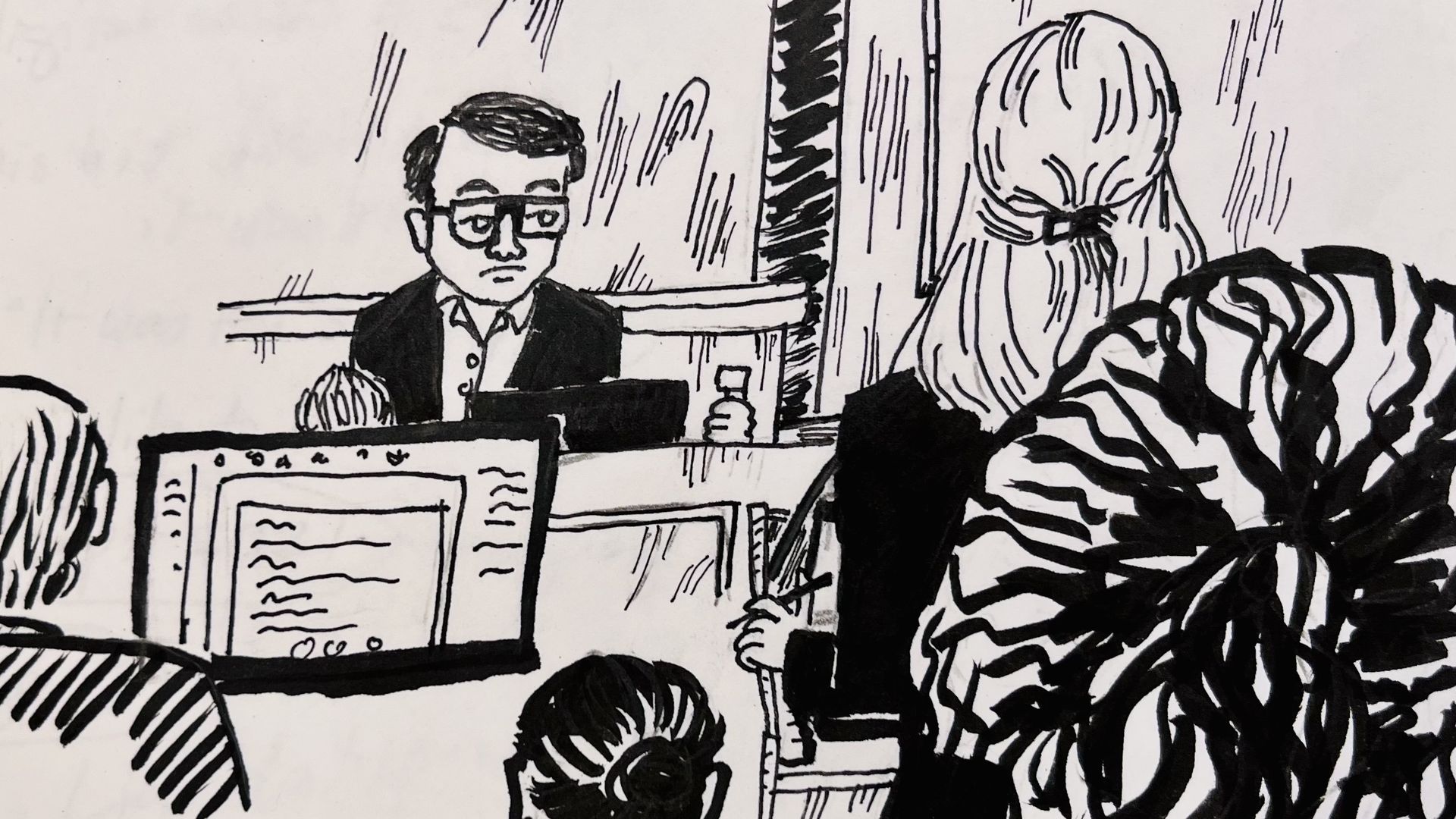
Can Sun under direct examination by prosecutor Danielle Sassoon. Drawing: Brady Dale/Axios
FTX's former general counsel testified in federal court on Thursday that he never signed off on borrowing customer funds, taking aim at Sam Bankman-Fried's anticipated defense that the ex-CEO relied on legal advice ahead of the company's collapse.
Why it matters: Filings indicate that SBF's legal team aims to use the advice claim to undermine prosecution's argument that he had fraudulent intent when conducting various activities specified in the government's charges that led to FTX's spiral. Can Sun's testimony appeared to contradict that claim.
Background: Sun was general counsel at FTX, supervised by SBF and also by Dan Friedberg, the first attorney the company hired.
- Sun joined FTX in August 2021. He left Nov. 8, 2022.
What they're saying: Sun said that when he started at FTX, and for as long as he worked there, he believed "that all customer assets of FTX were safeguarded, segregated and protected."
- He testified that he never advised that FTX or anyone else could borrow customer funds and take them off the exchange and that he never would have.
- He also testified to participating in public and private meetings where SBF and other executives affirmed those protections.
- "FTX has no rights to customer assets," Sun said.
- Revelations that FTX borrowed customer funds via its Alameda Research branch are what prompted the company's death spiral.
Of note: Sun testified under a non-prosecution agreement with the government, under which he agreed to tell the truth on the stand.
- Sun crafted a new set of terms of service for the site. The new terms went into effect in May 2022.
- While the old terms were not as specific about the use of customer funds, he believed the more explicit language in the new terms simply clarified what he believed had already been the policy: that customers never lose ownership of their assets (in money or in cryptocurrency).
- The new terms were key to the process of FTX Digital Markets getting licensed in the Bahamas and taking over operations for very nearly all customers using FTX.com (Japan and Australia had their own rules, so users there were managed by other entities).
He also testified that he had helped to draft a policy on the safeguarding of digital assets (which was entered into the record for the case).
- This policy was not public, but it was shared at times with large users when they asked. The government presented evidence to this effect.
Threat level: Based on his testimony, the first time Sun became uneasy about FTX's approach to customer funds came in August 2022, when he learned that Alameda Research had the privilege of going into negative balances on FTX.
- "Nishad [Singh] assured me that mechanism had never been triggered," he told the court.
- Sun testified he had insisted on disclosing the program and opening it to others. By the time FTX went into bankruptcy, the process to do this had begun but had not been finalized.
The intrigue: He testified that he first learned about the shortfall in customer balances in the final days of FTX, as crisis set in, on Nov. 7. He said he was shocked when spreadsheets revealed a $7 billion shortfall, a discovery he made in the presence of SBF and Singh.
- SBF asked him to come up with legal justifications for using customer funds. Sun said he was not able to do so.
Sun resigned the next day, Nov. 8.
What we're watching: Recent filings by the defense have suggested that it might attempt to argue that use of customer funds was not, in fact, improper (for example, this one).
- The defense is expected to begin on Oct. 26.
