Toyota's road to autonomy relies on human drivers

Add Axios as your preferred source to
see more of our stories on Google.
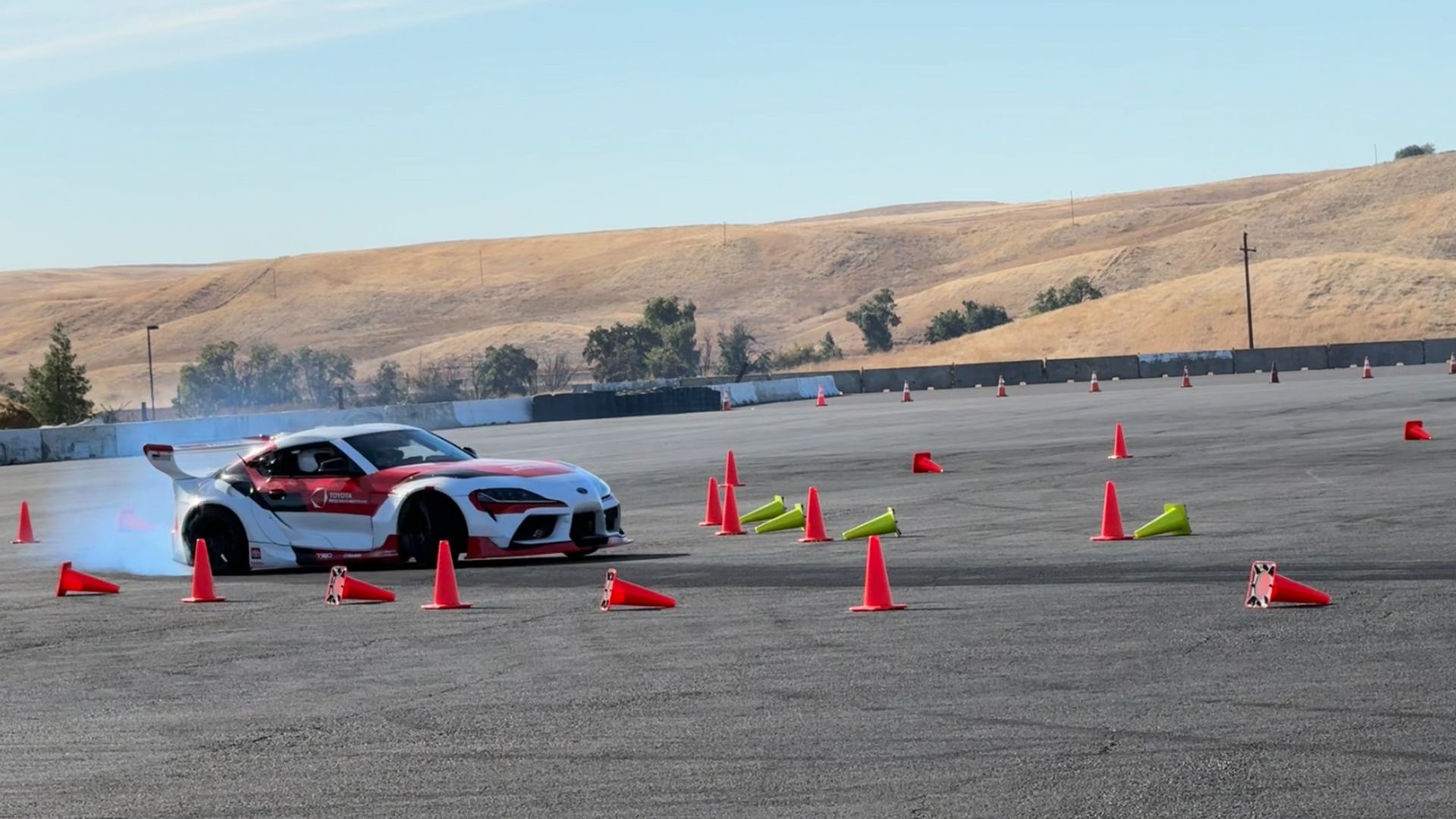
Photo: Ina Fried/Axios
As Cruise, Waymo and others test self-driving cars on the streets of San Francisco, Toyota is testing other approaches to autonomy at a racetrack 150 miles northeast.
Why it matters: Today's self-driving vehicles navigate big-city streets at slow speeds, but it could take decades before those cars can handle much higher speeds or we can add autonomous capabilities to privately owned cars.
What they're saying: "Scaling [full self-driving] technology to be available to everyone everywhere all the time is actually really, really hard," said Avinash Balachandran, senior director of the Human Interactive Driving division at Toyota's Los Altos, California-based Toyota Research Institute (TRI).
The big picture: Toyota's approach relies on human drivers to handle some — or even most — of the tasks, with the autonomous part kicking in only when it detects intervention is needed.
- By contrast, a self-driving car needs to be able to handle everything all the time. Toyota says its approach can save lives far sooner than waiting for self-driving cars to be ubiquitous.
- Doing so also preserves the fun of driving — and Toyota is even exploring whether the computers can teach people to be better drivers, says TRI head Gill Pratt.
- Toyota's approach relies on most of the same sensors and machine learning that fuels self-driving cars.
Between the lines: The key is shifting the goal from replacing drivers to saving lives, Pratt says.
- Pratt tells Axios it's more practical and expedient to augment the skills of the human driver "rather than saying we're just going to remove the driver, throw away all their skills and try to replace them."
- Another advantage for carmakers pursuing mixed human-computer modes is they don't have to take on liability the way they do with fully self-driving vehicles.
- In most cases, the driver and insurance remain liable even when cars have safety features like advanced cruise control or emergency automatic braking.
Yes, but: Mixing humans and computers isn't always easy.
- "There is an art to it," Pratt says. "You have to be very careful when you're giving a human being the part of the task, for instance."
Zoom in: Last Thursday, I had a chance to ride in several of Toyota's test vehicles at Thunderhil Raceway Park in Willows, California.
- In a heavily modified Toyota Supra, I experienced tight turns (known as drifting).
- In a nearly stock Lexus LC 500 outfitted with self-driving capabilities, I went up to 90 miles per hour and witnessed the vehicle's ability to spot and avoid a stalled car.
- Finally, I got behind the wheel in another test vehicle where I learned to drift and experienced what it's like when you're at the wheel while sharing control with a computer.
My thought bubble: The experience highlighted that while autonomous vehicles face challenges, computers are much better suited to many driving tasks. And they can do things a human can't, such as applying only the front or rear brake or applying the brake differently to the right and left sides of the pedal.
What's next: Different companies will pursue both approaches. Most traditional carmakers will focus more heavily on mixing in autonomous capabilities, while upstarts will prioritize the mix of financial and safety benefits that could come with removing human drivers entirely.
- One shift to watch for is that driver actions, such as pressing a pedal or turning the steering wheel, may serve less as a way to directly manipulate the car and more as an indication of a driver's intent to the computer.
Go deeper: Dividing work between humans and AI
Editor's note: This story has been corrected to make clear that Toyota's program to develop automated driving systems that rely on human drivers is not a "full self-driving approach."
