Biden official dismisses idea of US-China "divorce"

Add Axios as your preferred source to
see more of our stories on Google.
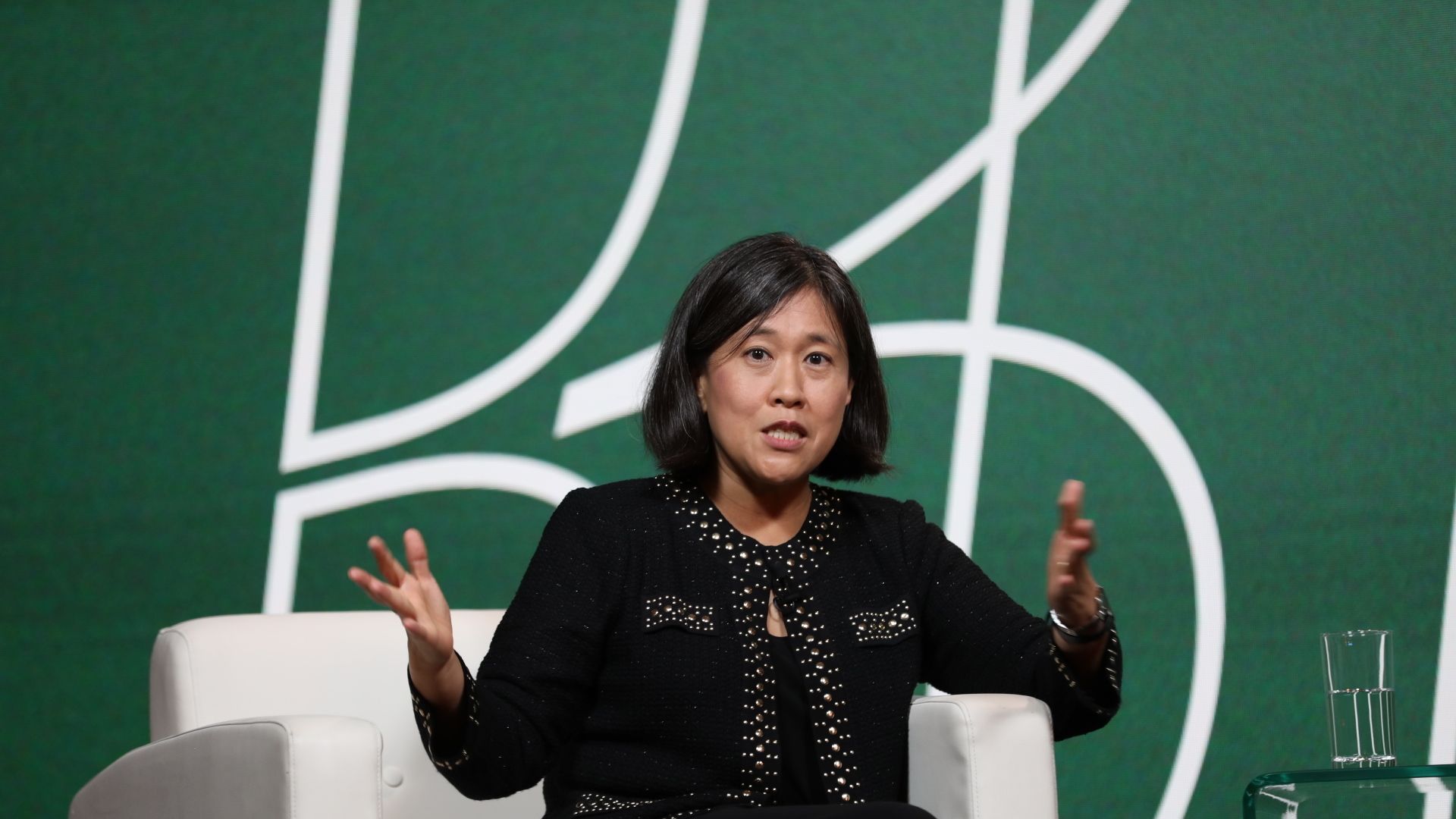
Photo: Steven Duarte for Axios
The U.S. is still into China, but wants to enjoy the benefits of an open relationship.
Why it matters: The increasingly fraught U.S.-China dynamic has seen the world's two largest economies challenging each other on multiple diplomatic, military and economic fronts, leading some to question whether a "decoupling" is in the cards.
Driving the news: At Axios BFD on Thursday, U.S. Trade Ambassador Katherine Tai said that she constantly fields questions about a Sino-American rupture, jokingly that the language resembles a married couple on the verge of separation.
- "Are you going to get a divorce? Are you gonna economically divorce yourself from or you de-risk. Are you going to see other people?" she told Axios' Hope King. "I guess if those are my choices, Yeah, I think as an economy, we should see lots of other people."
- Tai, however, did call U.S.-China bilateral ties "a profoundly consequential relationship, certainly on the economic side… How we relate to each other also has implications for the entire world," she added.
Context: The Biden administration, along with a growing bipartisan consensus in Congress, have taken a tougher stance on China, even as business leaders and economists worry about the reverberations of a rupture.
Meanwhile, large technology and consumer goods companies corporations are still heavily reliant on the billion-strong market that China represents. Which is why a parade of U.S. chief executives have recently made pilgrimages to Beijing to emphasize the importance of the country.
- Nonpartisan trade organization Future Union, found in a recent survey that technology companies "remain entrenched, unyielding and determined to maintain existing practices in China. This is likely attributable to the enduring legacy of cheap manufacturing available in China."
- "Consumer goods, having had a longstanding presence in the country, continue to be heavily intertwined with China and the average consumer," Future Union added.
What's happening: Last month, Congressional leaders met with Wall Street executives to "war game" the systemic and global market risks of a potential Chinese invasion of Taiwan.
- In a follow-up interview with Axios, Reps. Mike Gallagher (R-WI) and Raja Krishnamoorthi (D-IL) said that there was a "non-trivial chance of an open conflict" between China and Taiwan, and the U.S. needed to be prepared.
- "U.S. companies need to minimize their exposure to China [because] risks are accumulating," Gallagher told Axios. Some AI companies in the U.S. with "military-adjacent" functions might have to countenance a "harder break" with the country, he added.
- Tai, however, said at BFD that the Biden administration sees "an increasing premium being placed on engagement…We place a premium on how we partner with the rest of the world."
The bottom line: Congress and the White House will factor in economic and commercial realities as they navigate the relationship.
