Lessons from the AI whirlwind

Add Axios as your preferred source to
see more of our stories on Google.
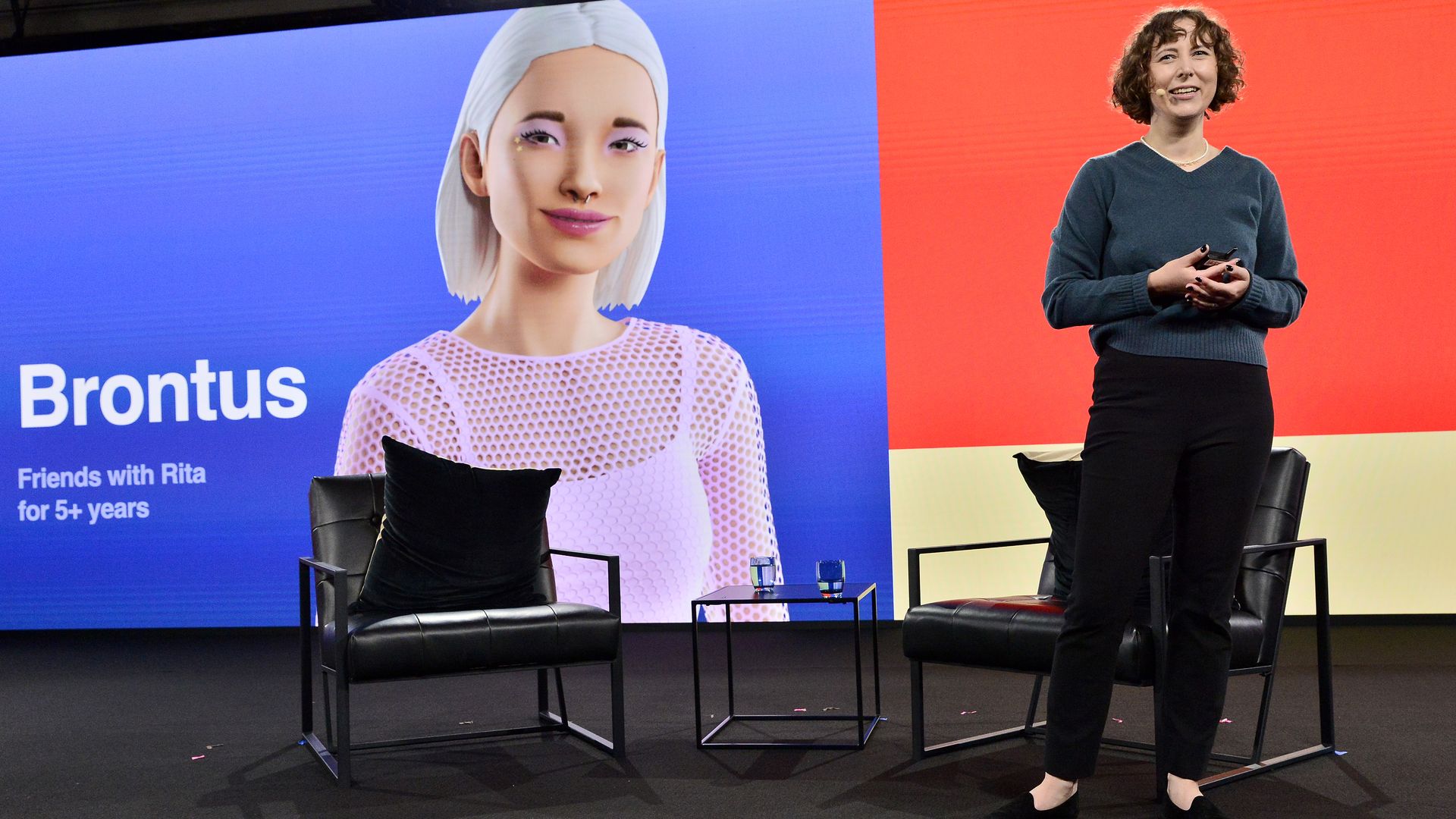
Replica & Blush product chief Rita Popova speaks on stage during Vox Media's 2023 Code Conference. Photo: Jerod Harris/Getty Images for Vox Media
A year ago, the last time the Code Conference gathered a crowd of Silicon Valley luminaries in Southern California, AI was just one item on a long agenda of tech issues, and TikTok dominated the discussions.
Yes, but: The year since brought ChatGPT, an AI boom, and a slew of controversies that the industry is only beginning to address.
What's happening: The pace of AI change over the past year has been incredibly rapid.
- Pixelated photos with seven-fingered hands have given way to photorealistic images you can control with precision.
- Chatbots that once knew nothing beyond mid-2021 are augmenting their web-based training with input from voice, images and current events.
- Any company that can plaster an "AI" label on their products is doing so, along with some who probably shouldn't.
The conversations at Code offered three takeaways from this accelerating whirlwind.
1. No one really knows how the legal issues will shake out.
- Almost everyone at the conference agreed there are thorny issues around intellectual property and AI. Most believed that courts will have to settle the key issues surrounding AI models trained on large pools of data that contained considerable copyrighted material.
- In general, owners of the words and photos used to train generative AI systems argue they need to give consent and be paid for the use of their content. Many AI companies are betting that such training is protected fair use under copyright law.
- While the courts are seen as the most likely place for these questions to be answered with certainty, there are also ways for the players to sort out issues themselves.
- The music industry, for example, has often found ways to share revenue among multiple contributors and could lead once again if it finds a path forward in AI.
- Getty, which is suing the maker of Stable Diffusion, said it has had productive discussions with "the Microsofts and the Googles" — but CEO Craig Peters added there was no guarantee those talks would lead to an agreement.
2. Human connection remains important, maybe even more important in an AI world.
- HBO CEO Casey Bloys said that, though AI may assist writers, he doesn't foresee a world in which the entire creative process is performed by computers — nor does he want to live in such a world.
- Roblox CEO Dave Baszucki talked up his company's potential to bring dating to the metaverse, while Bumble CEO Whitney Wolfe Herd expressed hope that even if some encounters begin in a virtual world, they will quickly move to real-world relationships.
- Even Replika, known for creating bots that people want to have a relationship with, hopes its romantic AI product, Blush, serves as a training ground for real-life dating, not its replacement.
- It's also really important to distinguish humans from machines in an AI world where either one could be at the other end of a conversation, says Georgetown University's Helen Toner, who spoke on an AI ethics panel at Code. Smart user interfaces can make these distinctions clearer, as can decisions over how much to humanize AI chatbots.
3. "Don't collect data you don't need" is one way to avoid violating users' privacy.
- Bird Buddy, a bird feeder with a built-in AI camera, for example, throws out any images with a license plate or a person.
- In building its generative AI tool, Getty focused on its creative collection rather than its editorial images, making sure that the model does not acquire information about public figures and brand names.
- The result, said Peters, the Getty CEO, is that Getty's engine couldn't put the pope in a puffy Balenciaga jacket because it doesn't know who the pope is or what Balenciaga means.
Yes, but: AI's future remains unknown, because there's no way to know in advance what a new large language model or other large-scale AI system will do.
- "I just want to say how crazy that is," Georgetown's Toner said.
