Report: Hate crimes surged in most big cities in 2022

Add Axios as your preferred source to
see more of our stories on Google.
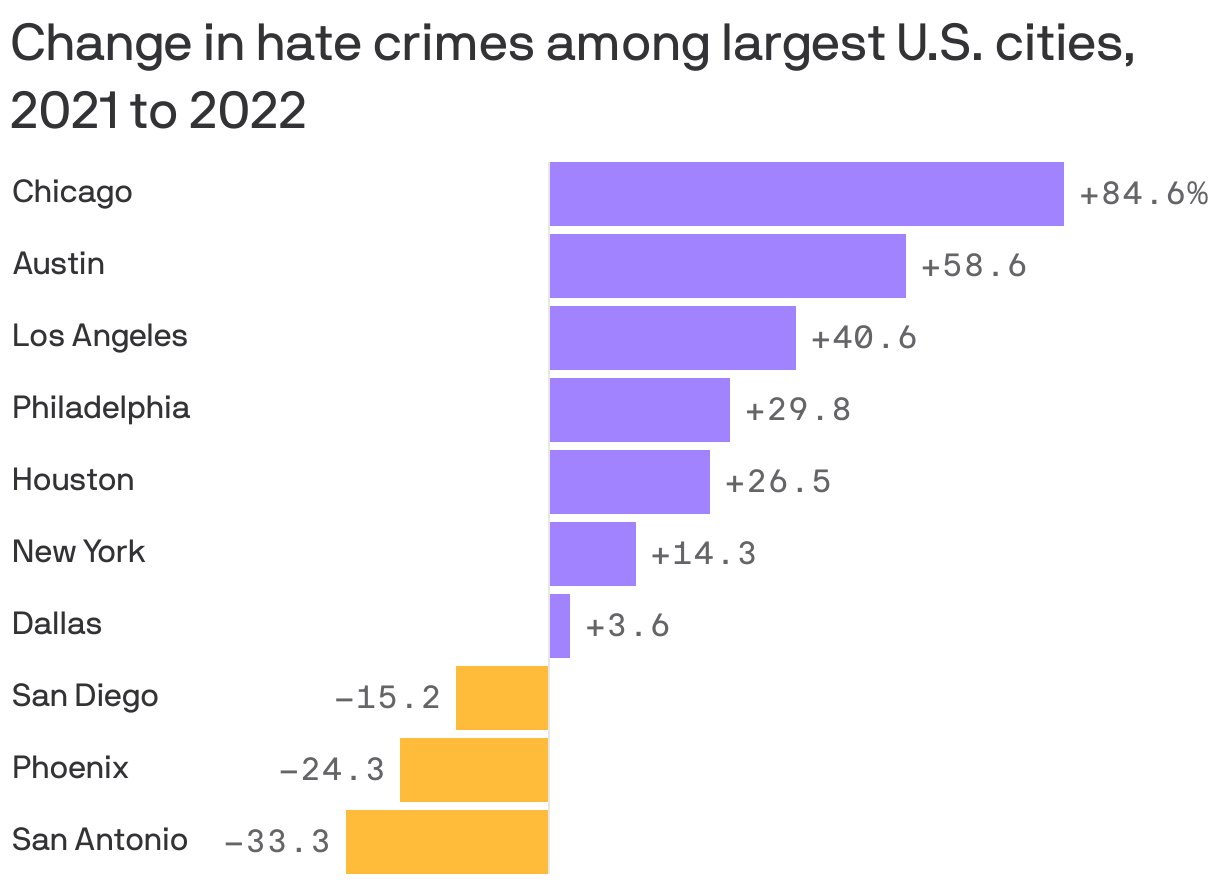
Most of the nation's 10 largest cities had significant jumps in hate crimes last year, increases that averaged 22% to a record 1,889 cases, according to a new report.
Why it matters: It was the second straight year of increases in the big cities' overall average number of hate crimes — typically defined as violence stemming from victims' race, color, sexuality, religion or national origin.
- The unpublished report by the Center for the Study of Hate and Extremism at California State University, San Bernardino, reflects a 22-year trend of increasing hate crimes nationwide, amid a rise in white nationalism and soaring numbers of attacks on Asian Americans during the pandemic.
- Los Angeles, the nation's second-largest city, had the most reported hate crimes — a record 609, with 195 of those classified as anti-Black, 98 as anti-gay (male), 91 as anti-Jewish and 88 anti-Latino.
- Chicago, the third-largest city, had the biggest increase — 84.6%, followed by Austin, Texas, at 58.6%.
There are positive signs for some big cities in the report: Phoenix, San Diego and San Antonio had significant declines in hate crimes last year.
Zoom in: Among smaller cities — those with populations of 500,000 to 1 million — Sacramento, Calif., saw the most significant percentage rise in hate crimes (47.4%), followed by Kansas City, M0. (32.3%).
Zoom out: Black Americans were the most frequently targeted group in many cities, but the study said there were some cities where the LGBTQ+ community, Asian Americans, whites and Jews were the most attacked.
- Attacks on Asian Americans have increased since the beginning of the pandemic, as some people blamed them for the coronavirus pandemic.
State of play: The new report comes days after Attorney General Merrick Garland said the Justice Department will investigate the killing of three Black people in Jacksonville, Fla., as a "hate crime and an act of racially motivated violent extremism."
- President Biden, in a statement, noted that the attack happened near a historically Black university as "our nation marked the 60th anniversary of the March on Washington."
What they're saying: "A lot of people are talking about civil war and all that. That's leading to a climate where hate crimes increase," the center's Brian Levin tells Axios.
- Levin said hate crimes have jumped in recent decades partly because of better record keeping but also because of hate spreading quickly on social media.
Yes, but: Early data suggest that hate crimes declined in major cities in the first part of 2023.
But, but, but: Such crimes tend to pick up at the end of the year around religious holidays — and in the months before presidential elections, Levin warned.
The center collects hate crime stats from police data, state reports and open records requests.
- In recent years, it's collected more data than the FBI, which struggles to get law enforcement agencies from across the country to submit data on hate crimes.
Background: A supplemental report from the FBI released in March said increased in 2021; the agency initially had reported a decline.
- The FBI is expected to release 2022 data on violent and property crimes next month.
