Why rescuing the Titanic sub isn't as simple as locating it

Add Axios as your preferred source to
see more of our stories on Google.
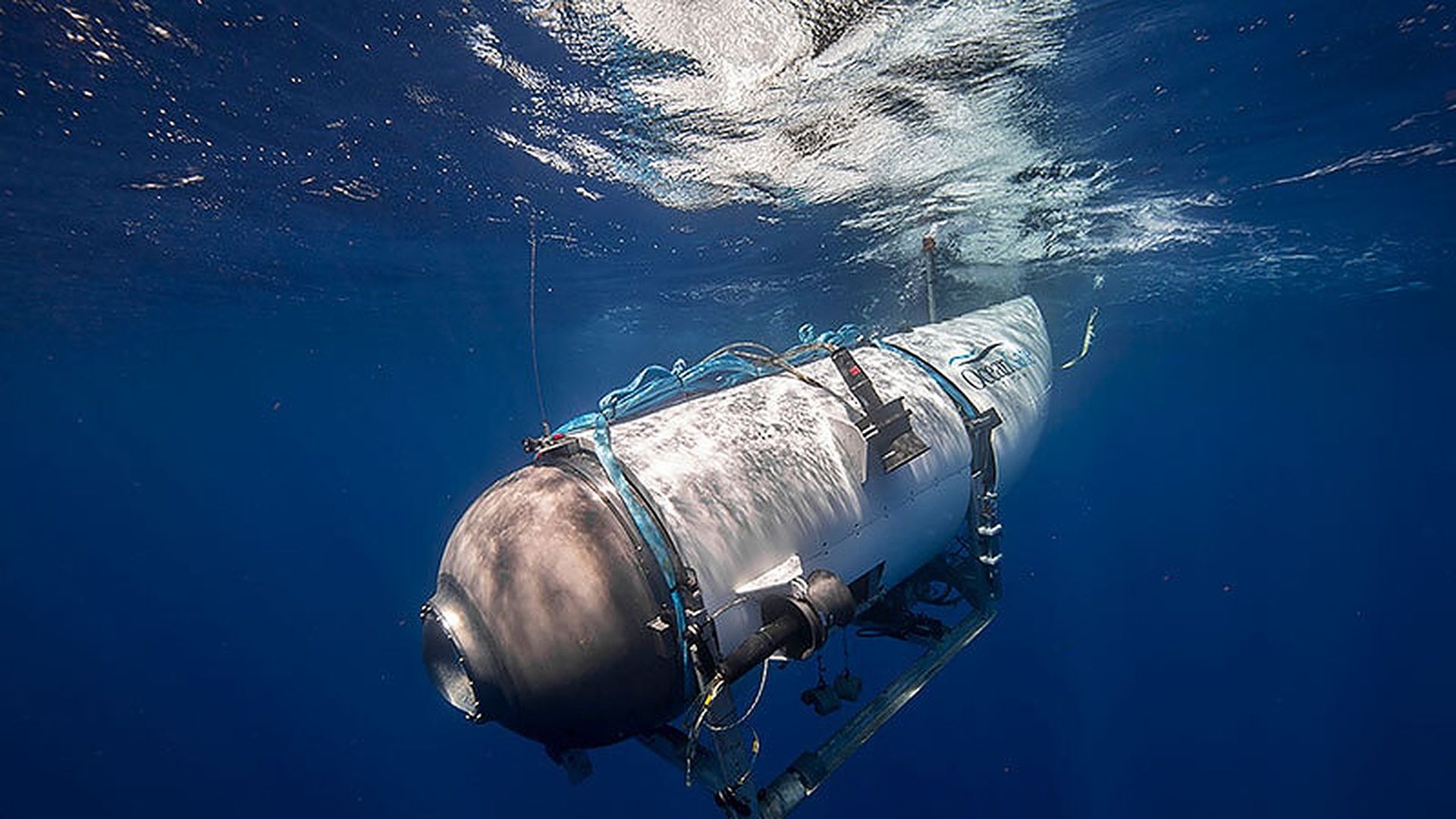
An undated photo shows OceanGate's tourist submersible at sea. Photo: Ocean Gate / Handout/Anadolu Agency via Getty Images
The massive effort to rescue those inside a missing tourist submersible that vanished Sunday during a journey to the wrecked RMS Titanic came to a halt Thursday, with the pilot and four passengers believed to be dead.
Driving the news: While officials from the U.S. and Canadian Coast Guards worked for days to locate the vessel, debris discovered in the search area ultimately led them to believe the vessel's pressure chamber suffered a "catastrophic loss."
- They also found that the vessel's tail cone and other debris about 1,600 feet from the bow of the Titanic.
But prior to the discovery and while the passengers were still presumed to be alive, finding the vessel was deemed just the first step in a complicated and difficult mission to bring the submersible back to the surface — all before the oxygen supply ran out.
How the rescue effort proceeded
The U.S. Coast Guard said Wednesday that underwater noises were detected by a Canadian aircraft, though it was not immediately clear what the sounds were.
- The breakthrough came after authorities said during a news conference Tuesday that the vessel had an estimated 40 hours of air left.
- The submersible lost contact with the vessel one hour and 45 minutes into the dive on Sunday afternoon. It was reported overdue about 900 miles off Massachusetts' Cape Cod.
- Capt. Jamie Frederick, the Coast Guard’s response coordinator, said the search is complex for a number of reasons, including the size of the search area and the fact that it's both a surface and subsurface search effort.
The challenge if the vessel were located
The submersible, dubbed Titan, is designed to take five people to depths of 13,123 feet, according to OceanGate Expeditions, which runs the tours.
- The Titanic wreckage is laid on the ocean floor in 12,500 feet of water, some 370 miles off the coast of Newfoundland, Canada.
- OceanGate claims that Titan "is the only sub in the world that can take five crewmembers to these depths."
- "While the submersible might still be intact, if it is deeper than more than 200m (656ft) there are very few vessels that can get that deep, and certainly not divers," Alistair Greig, a marine science professor at University College London, told The BBC.
- "The vehicles designed for navy submarine rescue certainly can't get down to anywhere near the depth of the Titanic," he added.
- The Navy's submarine rescue specialists can go down to a maximum depth of 2,000 feet of seawater, according to the Underwater Rescue Command.
- This limits the options for rescue if the sub is on the ocean floor, and points to the potential use of an ROV, which was what ultimately discovered debris in the search area and led authorities to believe the vessel's pressure chamber suffered a major loss.
What is an ROV?
- "ROV" stands for remotely operated vehicle, which is an unoccupied underwater machine that can be maneuvered from above the water's surface.
- After underwater noises were detected in the search area, ROVs were deployed to look for the missing sub, the U.S. Coast Guard said Wednesday.
- As two ROVs were actively searching Wednesday, several more were expected to arrive by Thursday morning, Frederick said during a news conference Wednesday.
- An ROV would be of use if the vessel is trapped on the ocean floor, though few ROVs can even go that deep.
- The U.S. Navy's Curv-21 ROV can go down to a maximum depth of 20,000 feet of seawater and is designed for deep ocean salvaging. But it would require specialized ships (of which the Navy has a limited amount) to lower it into the water and then recover it, the Washington Post notes.
- If used, an ROV could potentially attach a cable to the vessel, and a surface ship would use a winch to lift it to the surface. In 2022, the U.S. Navy previous lifted a fighter plane from 12,400 feet depth after it crashed into the South China Sea via such a method.
Other complications for the vessel
The crew inside the submersible can't get out, as it requires someone to undo the bolts from the outside, Greig explained to Reuters.
- The sub is about the size of a large transit van and it's white, making it difficult to spot from the air, he said.
- "You're not going to be able to transfer [the people inside] onto another vessel at depth," Greig said.
Tourists knew risks of trip
Mike Reiss, a New York-based writer and producer, took the same trip last year, and told BBC Breakfast Tuesday that he had to sign a lengthy waiver before getting on board the submersible.
- "You sign a massive waiver that lists one way after another that you could die on the trip," Reiss said. "They mention death three times on page one."
Editor's note: This story has been updated with the discovery of the debris field and news that the five passengers are believed to be dead.
