Signal error likely caused deadly train crash in India, officials say

Add Axios as your preferred source to
see more of our stories on Google.
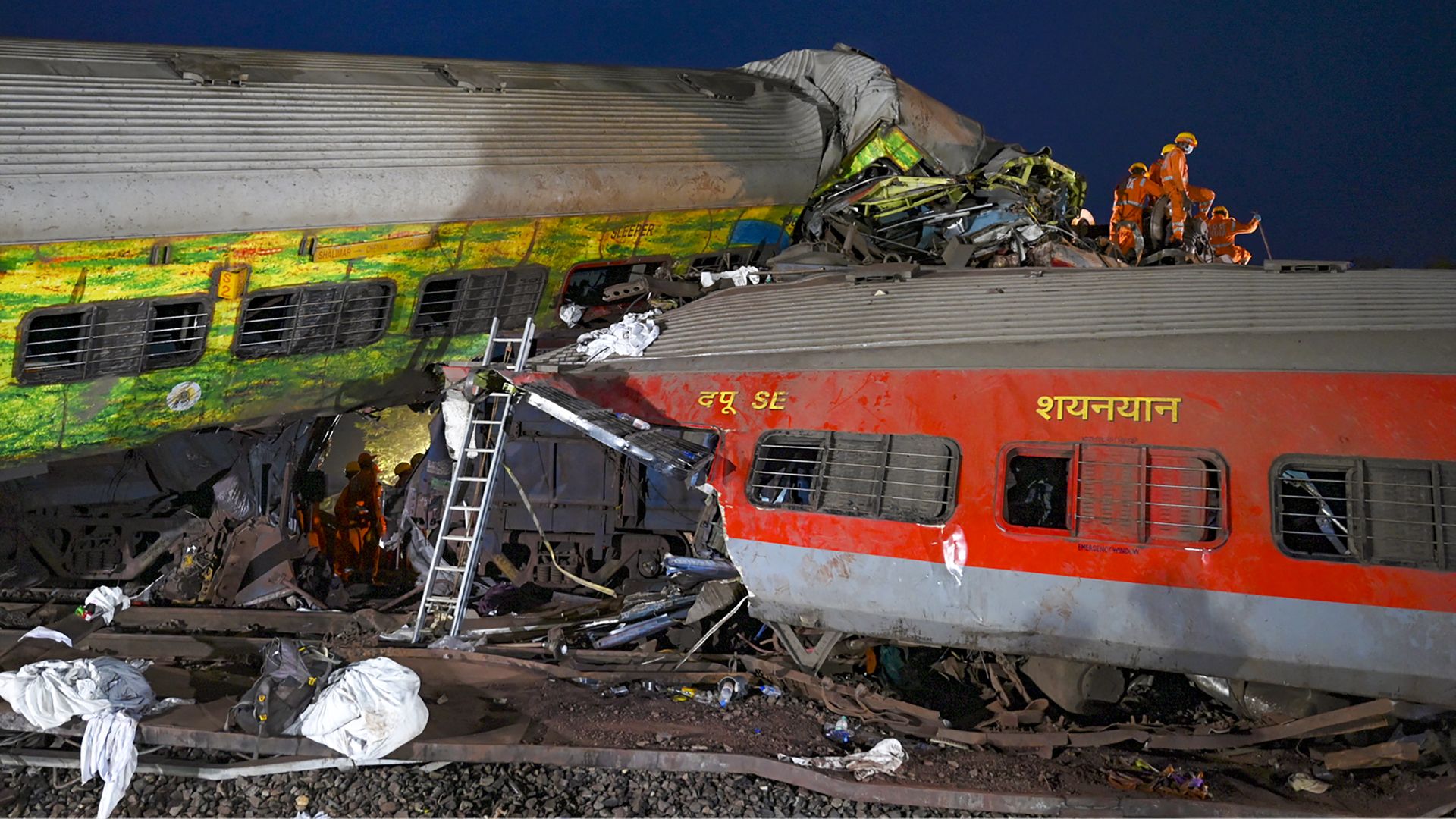
Rescue workers recover victims' bodies from the carriage of train collision near Balasore, in India's eastern state of Odisha. Photo: Punit Paranjpe/AFP via Getty Images
Officials in India said on Sunday that an electronic signaling system failure likely caused Friday's deadly train crash in the eastern part of the country, AP reported.
The big picture: At least 275 people were killed in one of the country's deadliest railway accidents in more than two decades. The death toll was revised down from more than 280 after officials said Sunday that some bodies had been counted twice. Hundreds of others were injured.
- Authorities said the accident in the Balasore district of Odisha State involved two passenger trains and a freight train. A total of 2,200 people were on board the trains involved in the accident.
- The disaster occurred at about 7 pm when a likely signal error led to one of the passenger trains striking the freight train, causing several train coaches to flip onto another track where the second passenger train was approaching, per AP. Several coaches of the second passenger train also derailed.
- “The system is 99.9% error-free. But 0.1% chances are always there for an error," said Jaya Verma Sinha, a senior railway official, per AP. She added that "nothing" had been "ruled out" when asked if the crash could have been caused by sabotage.
- Officials said families of the victims will receive compensation, per Reuters.
What they're saying: "Took stock of the situation at the site of the tragedy in Odisha," Indian Prime Minister Narendra Modi tweeted after visiting the crash site.
- "Words can’t capture my deep sorrow. We stand committed to providing all possible assistance to those affected. I laud all those working round the clock, on the ground and helping out in relief work," he added.
- "The courage and compassion shown by the people of our nation in the face of adversity is truly inspiring. As soon as the train mishap took place in Odisha, people immersed themselves in assisting rescue ops. Several people lined up to donate blood."
President Biden in a statement on Saturday said the U.S. and India “share deep bonds rooted in the ties of family and culture that unite our two nations—and people all across America mourn alongside the people of India. As the recovery effort continues, we will hold the people of India in our thoughts.”
State of play: Modi was scheduled to inaugurate a high-speed train that connects Goa to Mumbai on Saturday, but the event was canceled after Friday's tragedy, AP reported. That high-speed train is equipped with a system designed to help avoid collisions, AP noted, adding that the trains in Friday's incident did not have the system.
- Some have criticized Modi's government, saying it hasn't prioritized safety enough in its efforts to modernize the country's railway system after a history of deadly train disasters, according to Reuters.
- India's deadliest railway tragedy occurred in 1981 when a train derailed and plunged into a river, killing an estimated 800 people in the eastern Indian state of Bihar.
Editor’s note: This story has been updated with additional details throughout.
Go deeper: Listen to the Axios Today podcast, where Margaret Talev, filling in for host Niala Boodhoo, shares more on one of the country's deadliest rail disasters.
